


Classic Children's Books in the Public Domain
Classic children's books in the public domain, from Peter Rabbit to Winnie-the-Pooh, sorted by age, with free audiobook links and listening times.
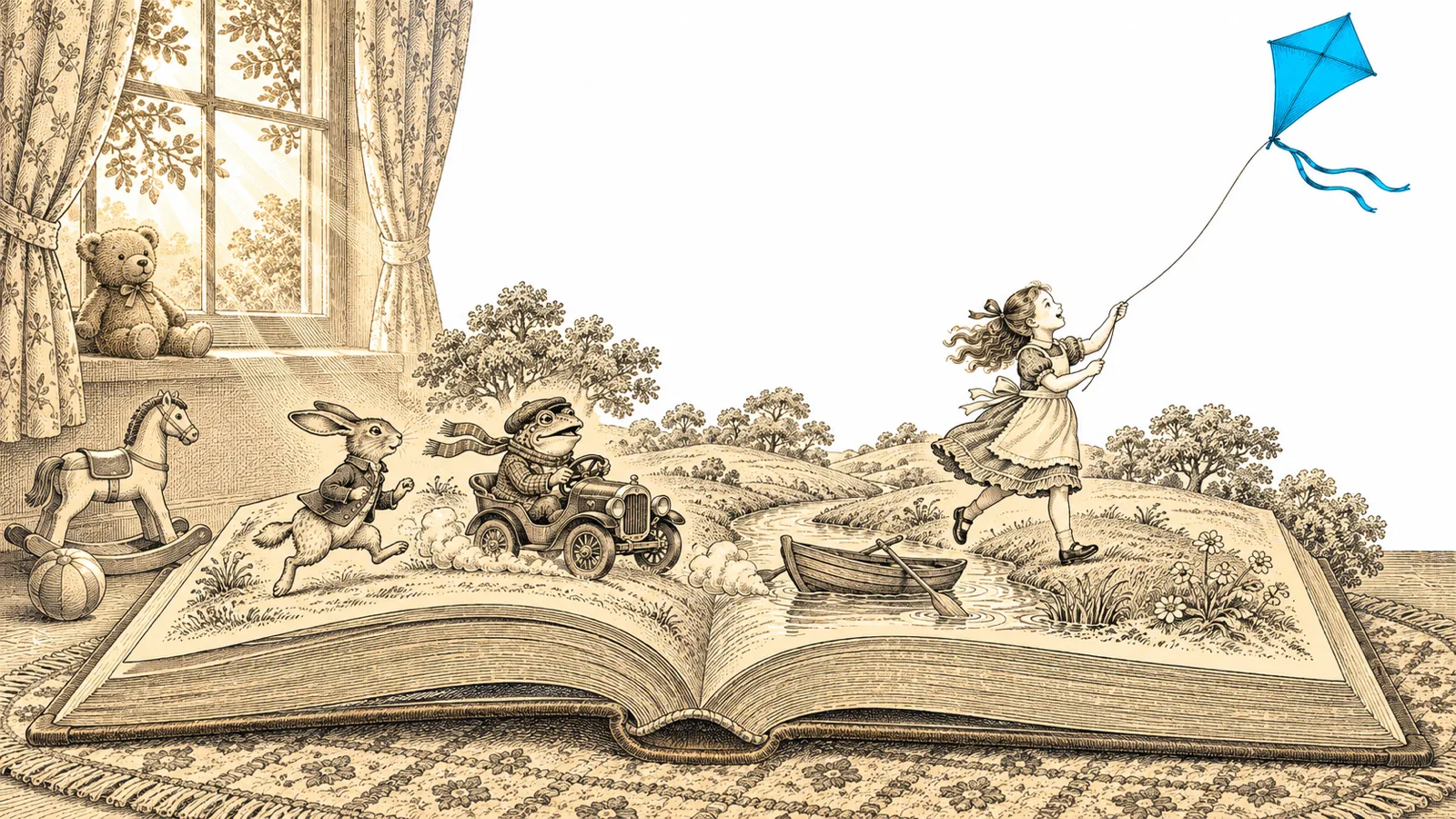
Classic children's books in the public domain include The Tale of Peter Rabbit, Alice's Adventures in Wonderland, The Wonderful Wizard of Oz, The Wind in the Willows, The Secret Garden and Winnie-the-Pooh. In the US, books published in 1930 or earlier are public domain as of 2026, and most have free audiobooks on LibriVox.
Classic children's books in the public domain include The Tale of Peter Rabbit, Alice's Adventures in Wonderland, The Wonderful Wizard of Oz, The Secret Garden and, since 2022 in the US, Winnie-the-Pooh. That means that in the US they're free to read, share, read aloud online and record, and almost all of them have free audiobooks on LibriVox.
We've picked 25 of the best, grouped by age, with the running time of each free recording, so you can choose a 30-minute bedtime story or a novel to share over a month of car rides. Want the book read in one calm voice with the words highlighted so your child can follow along? Speechly does that; details near the end.
Classic children's books in the public domain, by age
| # | Book | Author | Year | Ages | Free audiobook |
|---|---|---|---|---|---|
| 1 | The Tale of Peter Rabbit and others | Beatrix Potter | 1902 | 3+ | 2 h 58 min |
| 2 | The Velveteen Rabbit | Margery Williams | 1922 | 3+ | 29 min |
| 3 | A Child's Garden of Verses | Robert Louis Stevenson | 1885 | 3+ | 1 h 16 min |
| 4 | Winnie-the-Pooh | A. A. Milne | 1926 | 4+ | 2 h 54 min |
| 5 | The House at Pooh Corner | A. A. Milne | 1928 | 4+ | 2 h 47 min |
| 6 | Just So Stories | Rudyard Kipling | 1902 | 4+ | 3 h 33 min |
| 7 | Grimms' Fairy Tales | Brothers Grimm | 1812 | 5+ | 10 h 33 min |
| 8 | Andersen's Fairy Tales | Hans Christian Andersen | 1835 on | 5+ | 5 h 51 min |
| 9 | Alice's Adventures in Wonderland | Lewis Carroll | 1865 | 6+ | 2 h 59 min |
| 10 | The Wonderful Wizard of Oz | L. Frank Baum | 1900 | 6+ | 3 h 45 min |
| 11 | The Story of Doctor Dolittle | Hugh Lofting | 1920 | 6+ | 3 h 9 min |
| 12 | Peter and Wendy (Peter Pan) | J. M. Barrie | 1911 | 6+ | 4 h 59 min |
| 13 | The Adventures of Pinocchio | Carlo Collodi | 1883 | 6+ | 4 h 36 min |
| 14 | The Wind in the Willows | Kenneth Grahame | 1908 | 7+ | 6 h 30 min |
| 15 | The Jungle Book | Rudyard Kipling | 1894 | 7+ | 5 h 2 min |
| 16 | Five Children and It | E. Nesbit | 1902 | 7+ | 5 h 39 min |
| 17 | The Railway Children | E. Nesbit | 1906 | 7+ | 5 h 1 min |
| 18 | Black Beauty | Anna Sewell | 1877 | 8+ | 6 h 15 min |
| 19 | Heidi | Johanna Spyri | 1881 | 8+ | 9 h 45 min |
| 20 | The Secret Garden | Frances Hodgson Burnett | 1911 | 8+ | 9 h 8 min |
| 21 | Anne of Green Gables | L. M. Montgomery | 1908 | 9+ | 10 h 30 min |
| 22 | The Adventures of Tom Sawyer | Mark Twain | 1876 | 9+ | 6 h 46 min |
| 23 | Treasure Island | Robert Louis Stevenson | 1883 | 9+ | 7 h 30 min |
| 24 | Little Women | Louisa May Alcott | 1868–69 | 10+ | 19 h |
| 25 | The Tower Treasure (Hardy Boys) | Franklin W. Dixon | 1927 | 9+ | 4 h 26 min |
Ages are a rough guide for listening together; children can usually follow a story read aloud well before they can read it themselves. Running times are for the linked LibriVox recordings, checked on November 18, 2026, and many books have other versions.
Picture books and first read-alouds (ages 3 to 5)
1. The Tale of Peter Rabbit (1902) and the other Potter tales
Why it's here: Peter squeezes under Mr. McGregor's gate and loses his jacket and shoes. Potter's tales are tiny, funny and a little dangerous, the perfect size for bedtime. The linked recording collects several, each a few minutes long.
Good to know: every Potter tale published in her lifetime is now free in the US, the last being The Tale of Little Pig Robinson (1930). Use an original edition so your child sees her watercolors.
2. The Velveteen Rabbit (1922), Margery Williams
Why it's here: a toy rabbit learns from the old Skin Horse what it means to become Real. Under half an hour aloud, and it may make the grown-up reading it cry.
3. A Child's Garden of Verses (1885), Robert Louis Stevenson
Why it's here: 64 short poems about bedtime, shadows, swings and rainy days, written from a child's point of view. Read one or two a night. For more verse, see our list of free poetry collections to listen to.
4–5. Winnie-the-Pooh (1926) and The House at Pooh Corner (1928), A. A. Milne
Why they're here: a bear of very little brain, Piglet, Eeyore and the Hundred Acre Wood. Each chapter is a complete story of about 15 to 20 minutes. Tigger first bounces in in the second book.
Good to know: the original books and E. H. Shepard's drawings are free in the US; Disney's own versions of the characters are a separate matter. Milne's two poetry books, When We Were Very Young (1924) and Now We Are Six (1927), are free too, each about an hour.
6. Just So Stories (1902), Rudyard Kipling
Why it's here: "How the Leopard Got His Spots," "The Elephant's Child" and more, told in a teasing, sing-song voice made for reading aloud. Kipling illustrated them himself.
7–8. Grimms' and Andersen's fairy tales
Why they're here: the original "Hansel and Gretel," "Rapunzel," "The Little Mermaid" and "The Ugly Duckling." Some are much darker than the films, so preview a story before bedtime. Andrew Lang's Blue Fairy Book (1889) is a gentler anthology.
Chapter books to share (ages 6 to 8)
9. Alice's Adventures in Wonderland (1865), Lewis Carroll
Why it's here: Alice follows a White Rabbit down a hole into a world of nonsense, wordplay and very rude adults. Under 3 hours; follow with Through the Looking-Glass (1871).
10. The Wonderful Wizard of Oz (1900), L. Frank Baum
Why it's here: Dorothy, the Scarecrow, the Tin Woodman and the Cowardly Lion follow the yellow brick road. In the book, Dorothy's magic shoes are silver, not ruby. Baum wrote 13 more Oz books, all public domain.
11. The Story of Doctor Dolittle (1920), Hugh Lofting
Why it's here: a country doctor learns to talk to animals and sails to Africa to cure sick monkeys. Its sequel won the Newbery Medal.
Good to know: the original text includes racist caricatures of African characters, which later editions revised. Preview it, or use it to talk with older kids about how books change.
12. Peter and Wendy (1911), J. M. Barrie
Why it's here: the novel of Peter Pan: Wendy and her brothers fly to Neverland with the boy who won't grow up. It's wittier and sadder than most adaptations.
Good to know: in the US, the 1904 play's script became public domain in 2024 because it wasn't published until 1928, per Duke's Center for the Study of the Public Domain. In the UK, Great Ormond Street Hospital keeps a special right to Peter Pan royalties.
13. The Adventures of Pinocchio (1883), Carlo Collodi
Why it's here: a wooden puppet who can't stay out of trouble. Funnier and stranger than the Disney film, with a talking cricket who meets a sudden end.
14. The Wind in the Willows (1908), Kenneth Grahame
Why it's here: Mole, Rat, Badger and the motorcar-mad Mr. Toad on the riverbank. Grahame began the stories for his young son. The Toad chapters are pure comedy; the quieter ones are some of the most beautiful prose in children's books.
15. The Jungle Book (1894), Rudyard Kipling
Why it's here: Mowgli raised by wolves, plus "Rikki-Tikki-Tavi" and "The White Seal." Each story stands alone, so it's easy to listen in short bursts.
16–17. Five Children and It (1902) and The Railway Children (1906), E. Nesbit
Why they're here: Nesbit invented the modern family adventure. In the first, siblings find a grumpy sand-fairy who grants a wish a day; in the second, three children whose father has vanished make friends along a country railway line.
Novels for older kids (ages 8 and up)
18. Black Beauty (1877), Anna Sewell
Why it's here: a horse tells his own life story, from a happy colthood to hard labor pulling London cabs. Sewell wrote it to make readers kinder to horses and died just months after it was published.
19. Heidi (1881), Johanna Spyri
Why it's here: an orphan girl sent to live with her gruff grandfather in the Swiss Alps. Translated from German; the linked recording is a solo reading.
20. The Secret Garden (1911), Frances Hodgson Burnett
Why it's here: sour, lonely Mary Lennox discovers a locked garden on a Yorkshire estate and brings it, and her sickly cousin Colin, back to life. Burnett's A Little Princess (1905) is a great follow-up.
21. Anne of Green Gables (1908), L. M. Montgomery
Why it's here: talkative, red-haired orphan Anne Shirley arrives on Prince Edward Island by mistake: the Cuthberts wanted a boy. Montgomery wrote many sequels, and the early ones are public domain in the US too.
22. The Adventures of Tom Sawyer (1876), Mark Twain
Why it's here: fence-painting, a graveyard murder, and getting lost in a cave on the Mississippi. A great first Twain before Huckleberry Finn.
23. Treasure Island (1883), Robert Louis Stevenson
Why it's here: young Jim Hawkins, a treasure map and Long John Silver. This book gave us much of what we imagine about pirates. It's a superb family listen.
24. Little Women (1868–69), Louisa May Alcott
Why it's here: the four March sisters growing up during the Civil War. At 19 hours, it's the longest listen here, best shared a chapter a night over a couple of months.
25. The Tower Treasure (1927), Franklin W. Dixon
Why it's here: the first Hardy Boys mystery, in its original 1927 text, free in the US since 2023. The first four Nancy Drew books (1930) joined in 2026, starting with The Secret of the Old Clock. For older mystery fans, see the best public domain mystery novels.
Which children's classics aren't public domain yet?
In the US, books published in 1930 or earlier are public domain as of 2026, and each January 1 another year joins, according to Duke's Center for the Study of the Public Domain. Some favorites still to come:
| Book | Published | Free in the US from |
|---|---|---|
| Little House in the Big Woods | 1932 | January 1, 2028 |
| Mary Poppins | 1934 | January 1, 2030 |
| The Hobbit | 1937 | January 1, 2033 |
| Charlotte's Web | 1952 | 2048 at the earliest |
Our guide to books entering the public domain tracks each new year.
Outside the US, many countries protect books for 70 years after the author's death instead. Most authors above died long enough ago that their books are free there too, but not all: Milne died in 1956, so Winnie-the-Pooh becomes free in those countries on January 1, 2027, and the Hardy Boys and Nancy Drew books are still protected because their ghostwriters died much later. LibriVox follows US law and asks listeners elsewhere to check local rules.
Watch out for modern editions. A new illustrated edition, abridgment or retelling can carry its own copyright even when the original story is free.
Where to find free children's audiobooks
- LibriVox: every book above, free to stream or download, with several versions of most. Some are dramatic readings with a different volunteer for each character.
- Your public library: apps like Libby lend professionally narrated children's audiobooks free with a library card.
- Free eBooks: Project Gutenberg and Standard Ebooks have free editions of most of these books, many with the original illustrations.
More options are in our guide to where to find free audiobooks legally.
How to listen together with Speechly
Volunteer recordings vary in sound and pace, and some switch readers between chapters. Speechly reads any of these books in one natural voice and highlights each word, which helps a child follow along with the text:
- Download Speechly for iPhone and iPad or Android. You can start without an account.
- Open a book from the built-in catalog of 75,000+ free public-domain books, import an EPUB, or take a photo of a page from your own copy.
- Pick from 25+ voices and slow the speed down for younger listeners; the range is 0.5× to 2×.
- Speechly saves your place, so tomorrow night's chapter starts where you stopped, and it estimates how long each book will take.
The free plan includes two text-to-speech files with premium voices; Premium is $14.99/month or $139/year for unlimited listening on every device.
Start with a short one tonight
Begin with The Velveteen Rabbit or a Peter Rabbit tale tonight, then try a chapter of Winnie-the-Pooh tomorrow. Download Speechly to hear any of these classics in a calm, natural voice with the words on screen.
Frequently asked questions
Is Winnie-the-Pooh in the public domain?
In the US, yes: Winnie-the-Pooh (1926) became public domain on January 1, 2022, and The House at Pooh Corner (1928), which introduced Tigger, on January 1, 2024. In the UK and other life-plus-70 countries, A. A. Milne's text becomes free on January 1, 2027, while E. H. Shepard's drawings stay protected there until 2047.
Is Peter Pan in the public domain?
In the US, yes. The novel Peter and Wendy (1911) has long been free, and the play's script, first published in 1928, joined the public domain on January 1, 2024. In the UK, Great Ormond Street Hospital still has a special right to royalties from performances and publications of Peter Pan.
Are Beatrix Potter's books in the public domain?
Yes. Every Peter Rabbit book she published in her lifetime is public domain in the US, the last being The Tale of Little Pig Robinson (1930), which joined in 2026. Potter died in 1943, so her books are also free in countries that use the life-plus-70 rule.
Are Nancy Drew and the Hardy Boys in the public domain?
The earliest ones are, in the US, in their original text. The first Hardy Boys book, The Tower Treasure (1927), became free in 2023, and the first four Nancy Drew books (1930) in 2026. The revised versions published from 1959 on are still under copyright.
When will Mary Poppins and The Hobbit be public domain?
In the US, Mary Poppins (1934) joins the public domain on January 1, 2030, and The Hobbit (1937) on January 1, 2033, under the 95-year rule for books of that era.
Can I read public domain children's books aloud online or record them?
Yes, in the US you can read, record and share any book that is public domain there, which is how LibriVox volunteers make their recordings. Use the original text and pictures, not a modern edition, since new illustrations, abridgments and introductions can carry their own copyright.
Listen with Speechly
Natural AI voices on iPhone, iPad, Android, Mac and Windows, with word highlighting and your place saved on every device. Free to download.
Prices and features of other products were checked on November 18, 2026 and can change. Speechly is not affiliated with the other companies named here.
Where to Find Free Audiobooks Legally
Where to find free audiobooks legally: Libby and Hoopla bestsellers with a library card, 21,000+ LibriVox classics, and how to spot pirated copies.
Books Entering the Public Domain (2027)
The Good Earth, The Waves, Sanctuary, The Glass Key: the books entering the public domain in 2027, the 2026 list, and where to read them all free.
Free Poetry Collections to Listen To
Free poetry collections to listen to, from Dickinson and Whitman to The Waste Land and Harlem Shadows, each with a free audiobook link and running time.