


How Fast Do People Read and Listen? Words per Minute Explained
How fast do people read and listen? Words per minute explained: silent reading, reading aloud, speech, audiobooks and 2× audio, with a reading-time chart.
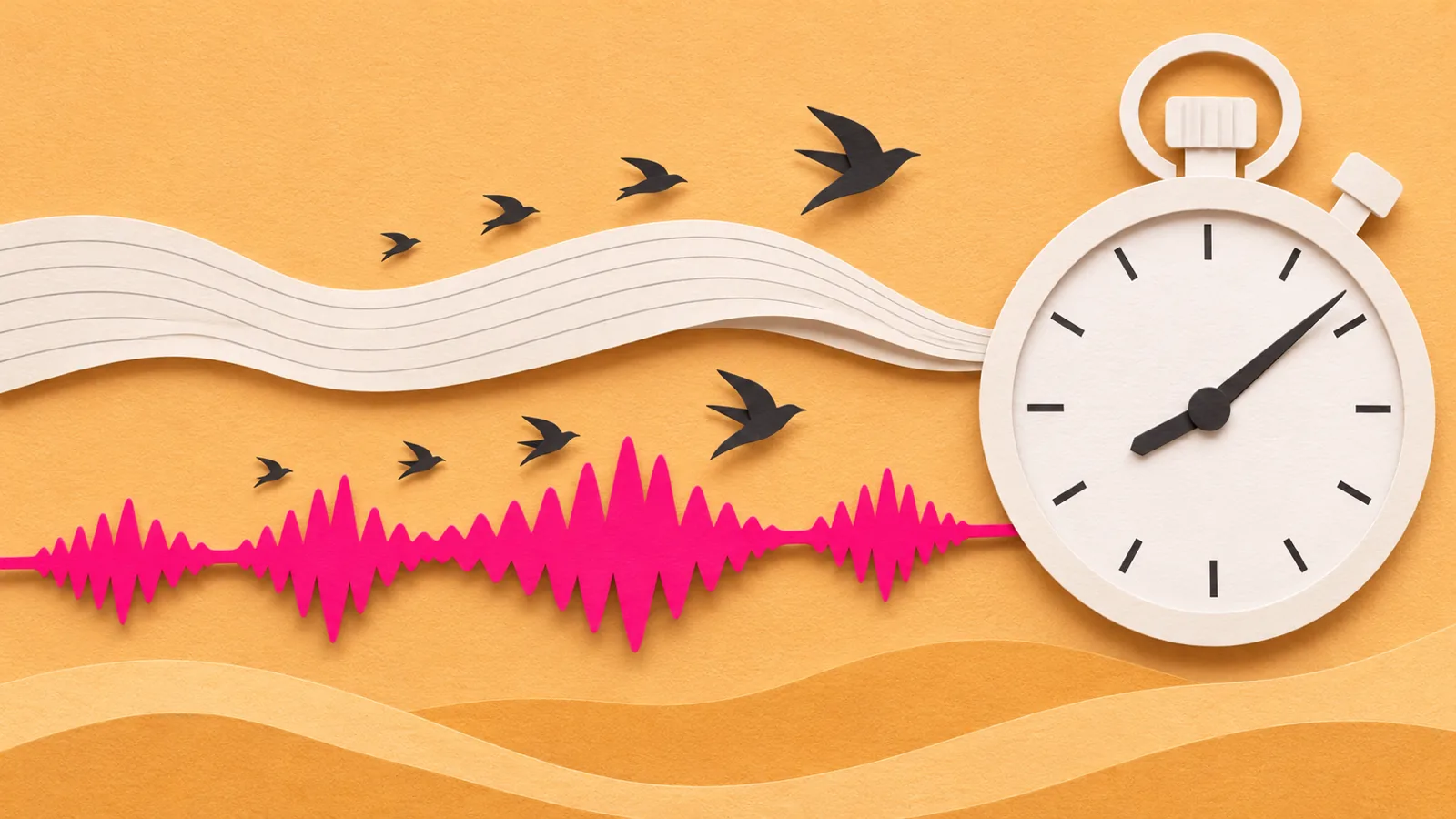
How fast do people read and listen? Words per minute explained simply: adults read silently at about 238 words per minute for nonfiction and 260 for fiction, and read aloud at about 183. People speak at about 150 words per minute, and listeners can follow speech up to roughly 270 words per minute before comprehension drops.
Silent reading averages about 238 words per minute for nonfiction and 260 for fiction. Most adults fall between 175 and 300.
The popular figure of 300 words per minute is too high; a review of 190 studies found real averages are lower.
Speech runs at about 150 words per minute and audiobooks at 140 to 180, so listening at 1× is slower than reading.
At 1.5× to 1.75×, listening matches typical reading speed. Comprehension holds up to about 270 words per minute, then drops.
To estimate reading time, divide the word count by your speed: 5,000 words at 238 wpm is about 21 minutes.
How fast do people read and listen? Words per minute explained in one line: adults read silently at about 238 to 260 words per minute, read aloud at about 183, and speak at about 150. Listeners can follow speech up to roughly 270 words per minute, so sped-up audio can match the pace of reading.
Below: the numbers for each way of taking in words, where they come from, why the often-quoted 300 is wrong, and how to work out how long any document will take you.
How fast do people read and listen? The numbers at a glance
| Activity | Typical words per minute | Source |
|---|---|---|
| Silent reading, English nonfiction | 238 (most adults 175–300) | Brysbaert, 2019 |
| Silent reading, English fiction | 260 (most adults 200–320) | Brysbaert, 2019 |
| Reading aloud | 183 | Brysbaert, 2019 |
| Everyday speech | About 150 | UCLA researchers |
| Audiobook narration | 140–180 | Brysbaert, 2019 |
| Text to speech at 1× (NaturalReader) | 180 | NaturalReader |
| Fastest efficient listening rate | About 270, falling steeply by 315 | Kuperman et al., 2021 |
| Reading to memorize for a test | Roughly 90–140 | Studies reviewed in Brysbaert, 2019 |
The reading figures come from Marc Brysbaert's meta-analysis of 190 studies with 18,573 participants. They hold for adults aged roughly 18 to 60, reading in their first language without reading difficulties. Children, older adults and second-language readers read more slowly.
How fast do people read silently?
The average adult reads English nonfiction at about 238 words per minute and fiction at about 260. Fiction is faster mainly because its words are shorter.
The spread is wide. Most adults fall between 175 and 300 words per minute for nonfiction. Speed also changes with purpose: when people in the reviewed studies read knowing they'd be tested from memory, rates fell to roughly 90 to 140 words per minute. Careful study reading is slower than reading for pleasure, and that's normal.
Speed also depends on age. Children read more slowly and speed up through school, and reading tends to slow again in later life. See average reading speed by age for the numbers by grade and decade.
Why "300 words per minute" is the wrong average
You'll often see 300 words per minute quoted as normal. Brysbaert traced that figure to a handful of influential older studies and reading tests. Many measured short passages, where rates vary widely, and some tested selected groups such as college students. Across 190 studies, the real average is lower. He concluded that a 300 wpm target is unrealistic for most people.
The practical point: if you read at 220, you're not slow. You're normal.
How fast do people speak and listen?
People generally speak at about 150 words per minute, and audiobook narrators at 140 to 180. That's why listening at normal speed takes longer than reading: an 80,000-word novel is 5 to 5.5 hours of silent reading but about 9 hours at 150 words per minute.
The brain can take in speech faster than people talk. In a 2021 study, Victor Kuperman and colleagues sped up recorded texts and tested comprehension. Listeners understood speech at 270 words per minute without loss, but comprehension dropped steeply at 315. The most efficient listening rate, about 269 words per minute, matched the same people's silent reading speed for matched texts. The authors concluded that listening and reading follow the same time constraints.
Is reading faster than listening?
Only at normal speed. Speed up the audio and listening catches up. Using 150 words per minute as normal speech:
| Playback speed | Approx. words per minute | Compared with average silent reading (238–260) |
|---|---|---|
| 1× | 150 | Much slower |
| 1.25× | 188 | Slower |
| 1.5× | 225 | Close to nonfiction reading |
| 1.75× | 263 | About the same as fiction reading |
| 2× | 300 | Faster than average, near the comprehension limit |
Real voices vary, so treat these as estimates. Research on learning suggests a sweet spot below 2×. A meta-analysis of 24 lecture-video studies found a very small cost up to 1.5×, and a moderate to large drop at 2× and above. One of the studies found older adults were more affected by fast playback than younger ones. For how to choose, see the best listening speed for learning.
Can speed reading make you much faster?
Not without understanding less. A 2016 review in Psychological Science in the Public Interest found a trade-off between speed and accuracy. Speed-reading methods mostly work by skimming. Brysbaert's review also notes that average reading rates line up with the fastest rate at which people can follow speech, which suggests the limit is understanding language, not moving your eyes.
What does work is reading more, which builds vocabulary and makes words faster to recognize. There's more in how to read faster with techniques that work.
How long will it take to read or listen to a document?
Divide the word count by your speed. Here's the math at average rates:
| Length | Example | Silent reading (238 wpm) | Listening at 1× (150 wpm) | Listening at 1.5× (225 wpm) |
|---|---|---|---|---|
| 1,000 words | News article | 4 min | 7 min | 4.5 min |
| 5,000 words | Long report or feature | 21 min | 33 min | 22 min |
| 20,000 words | Short nonfiction book | 1 h 24 min | 2 h 13 min | 1 h 29 min |
| 80,000 words | Typical novel | 5 h 36 min | 8 h 53 min | 5 h 56 min |
Word processors show the word count: in Microsoft Word it's in the status bar at the bottom, and in Google Docs under Tools > Word count.
How to measure your own reading speed
A one-off test is enough to plan with:
- Pick a book or article you'd read anyway, not something easier or harder.
- Set a timer for 5 minutes and read normally, for understanding.
- Count the words in three full lines, divide by three to get words per line, then multiply by the number of lines you read.
- Divide by 5 to get words per minute.
- Without looking back, summarize what you read in two sentences. If you can't, you were going too fast.
Do it twice, with fiction and nonfiction, since your speeds will differ.
What these numbers mean for you
- Plan by time, not pages. At about 240 words per minute, a 30-page work report of 9,000 words is roughly 40 minutes of focused reading.
- Read what you need to study or quote. Silent reading is the fastest at 1×, and the page lets you skim and look back.
- Listen to what you'd otherwise never get to. Speech at 1.25× to 1.5× approaches reading pace and works on a commute, a walk or in the kitchen, when you couldn't read at all.
- Slow down for dense or unfamiliar material, and if you're reading or listening in a second language.
Listen at your own pace with Speechly
Speechly reads PDFs, Word documents, web pages, eBooks and photos of printed pages aloud with 25+ natural AI voices on iPhone, iPad, Android, Mac and Windows. You can set the speed anywhere from 0.5× to 2×, follow word-by-word highlighting, and see an estimate of how long each document will take to listen to before you start.
On a Mac, select text in any app and press ⌘E to hear it in a floating mini player; on Windows, press Alt+R. The free plan includes two text-to-speech files with premium voices, and Premium is $14.99/month or $139/year for unlimited listening on every device.
The bottom line
Adults read silently at about 238 to 260 words per minute, speak at about 150, and can understand speech up to about 270. Listening at 1.5× to 1.75× brings audio close to reading speed. To hear your own documents at the pace that suits you, download Speechly free.
Frequently asked questions
What is a good reading speed in words per minute?
For an adult reading in their first language, anything from about 200 to 300 words per minute is normal. The average is about 238 for nonfiction and 260 for fiction. Understanding what you read matters more than raw speed.
How many words per minute do people speak?
About 150 words per minute in ordinary speech. Audiobook narrators usually speak at 140 to 180 words per minute, and speed varies a lot from person to person.
How fast is 2× speed in words per minute?
Roughly 300 words per minute if the speaker's normal pace is 150. That's near the top of the normal reading range and just past the point where research finds comprehension starts to fall.
How long does it take to read 1,000 words?
About 4 minutes at an average silent reading speed of 238 words per minute, about 5.5 minutes reading aloud, and nearly 7 minutes listening at normal speech speed.
Can people read 1,000 words per minute?
Not with full understanding. A 2016 review of speed-reading research found a trade-off between speed and accuracy: reading much faster than normal means skimming, and you understand less.
Do people read faster in some languages?
Words per minute differ by language because languages use different numbers of words to say the same thing. Brysbaert's review found Spanish readers averaged more words per minute than English readers, while second-language readers are slower than native readers.
Listen with Speechly
Natural AI voices on iPhone, iPad, Android, Mac and Windows, with word highlighting and your place saved on every device. Free to download.
Prices and features of other products were checked on November 18, 2026 and can change. Speechly is not affiliated with the other companies named here.

Average Reading Speed by Age
Average reading speed by age, from first grade to 80+: words per minute by grade, adult and older-adult norms, why speed varies, and when to get help.
The Best Listening Speed for Learning
The best listening speed for learning is 1.25× to 1.5× for most people. See what studies found at 2×, a speed chart, and a 5-minute self-test.

How to Read Faster: Techniques That Actually Work
How to read faster without losing understanding: 7 techniques backed by research, which speed-reading tricks don't work, and how to skim and listen faster.