


Bookshare vs Learning Ally
Bookshare vs Learning Ally, checked November 2026: who qualifies, what each costs, human vs computer voices, braille, apps and which to choose.
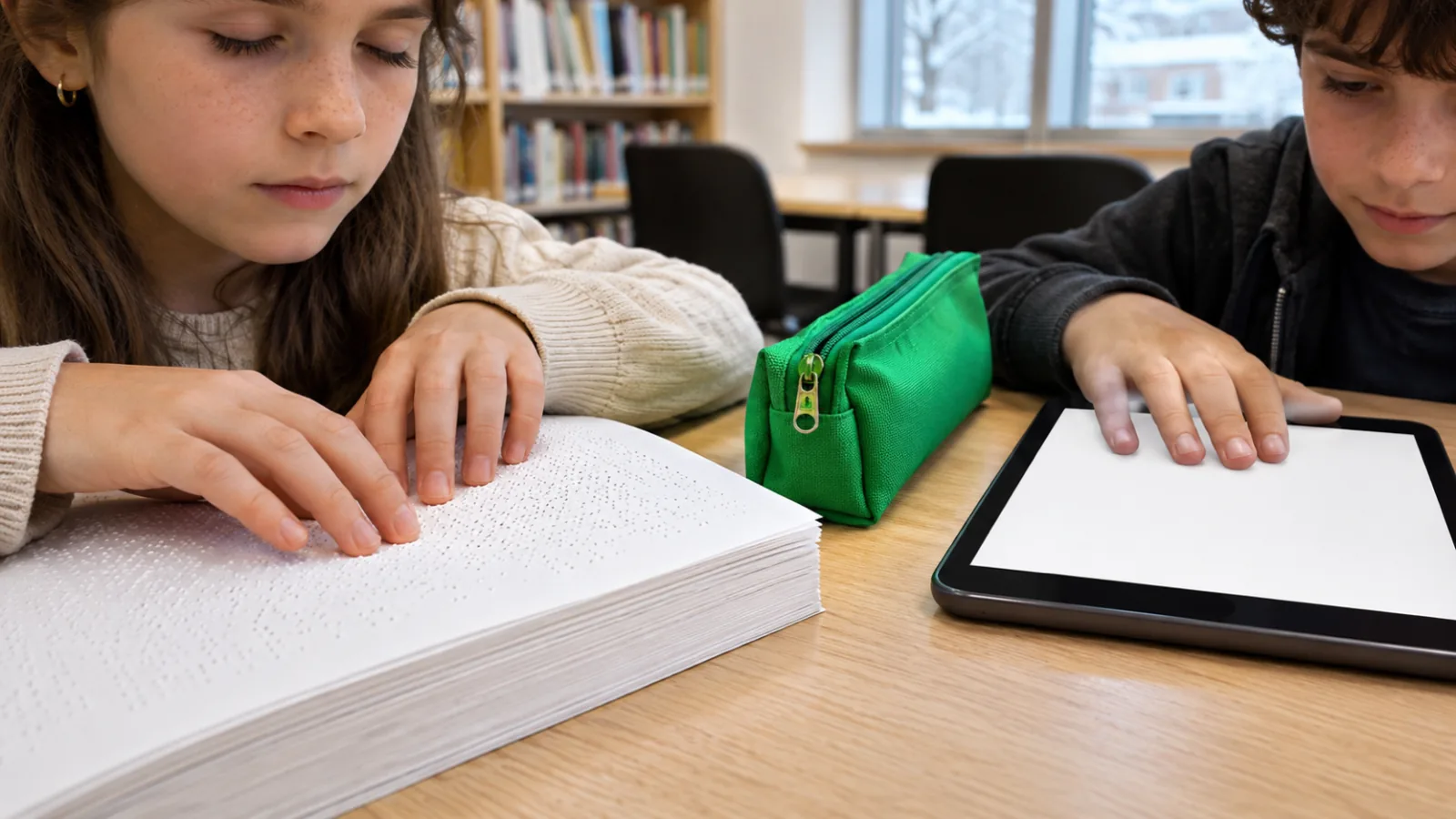
Bookshare vs Learning Ally comes down to cost, voice and format. Bookshare is free for qualifying US students, has over a million ebooks read by computer voices, and offers braille. Learning Ally costs $135 a year and has 80,000+ audiobooks read by human narrators. Many students use both.
Bookshare is free for qualifying US students from kindergarten through graduate school; US adults pay $79.99 a year.
Learning Ally individual and family memberships cost $135 a year, with financial assistance for families in hardship.
Bookshare's books are mostly read by text-to-speech voices; Learning Ally's 80,000+ titles are read by people.
Only Bookshare offers braille (BRF), DAISY and Word downloads; Learning Ally is listen-first, with highlighted text on many titles.
Both require a professional to confirm a print disability, and Bookshare accepts Learning Ally membership as proof.
Bookshare vs Learning Ally is the choice most families and students with print disabilities face first. The short version: Bookshare is free for qualifying US students and has the bigger library, read by computer voices. Learning Ally costs $135 a year and is read by human narrators.
They aren't really rivals. Both are US nonprofits serving people who can't read standard print because of dyslexia, a visual impairment or a physical disability, and plenty of students use both. We checked every price, rule and feature below on Bookshare's and Learning Ally's own pages on November 18, 2026. Many older comparisons still quote fees that have since changed.
Bookshare vs Learning Ally at a glance
| Bookshare | Learning Ally | |
|---|---|---|
| Run by | Benetech, a nonprofit | Learning Ally, a nonprofit founded in 1948 |
| Library | Over 1 million titles | 80,000+ audiobooks |
| How books are read | Mostly text-to-speech voices; some human-narrated titles | Human narrators |
| Highlighted text | Yes, in Bookshare Reader | On many titles (VOICEtext); many textbooks are audio-only |
| Braille | Yes (BRF downloads) | No |
| Download formats | EPUB 3, DAISY, BRF, Word, MP3, DAISY Audio | Learning Ally app only |
| US students | Free if qualified (K-12, college, graduate) | $135/year, or free through a subscribing school |
| US adults | $79.99/year | $135/year |
| Financial help | One-time $59.99 discounted fee | Financial assistance form |
| Outside the US | Yes, fees vary by country | Not offered to non-US citizens outside the US |
| Apps | Bookshare Reader (web, iOS, Android, Alexa beta) plus many partner tools | Learning Ally app (iOS, Android, Chromebook, Mac, Windows, web) |
| Best for | Free access, braille readers, wide reading | Students who listen best to a human voice |
What's the difference between Bookshare and Learning Ally?
Bookshare is an ebook library you can listen to; Learning Ally is an audiobook library you can read along with. Almost every other difference flows from that.
Bookshare is run by Benetech. It turns books into accessible digital text, which you can hear through text-to-speech, read in large print, follow with highlighting, or send to a braille display. Because the text is digital, one book works in many formats and many apps.
Learning Ally started in 1948 as Recording for the Blind, making recorded textbooks for blinded World War II veterans. Today it records books with human narrators and delivers them through its own app. Many titles come in a format it calls VOICEtext, with the text on screen highlighted in sync with the narrator. Learning Ally's own Q&A notes that textbooks are usually "Classic Audio": narrated, but without on-screen text.
Both rely on the US copyright exemption for people with print disabilities (Section 121, often called the Chafee Amendment). That's why both ask for proof of eligibility before giving full access.
Which is cheaper, Bookshare or Learning Ally?
Bookshare is cheaper for nearly everyone, and free for qualifying US students. Learning Ally is a flat $135 a year unless a school or state covers it.
Bookshare pricing
According to Bookshare's cost page, as of November 18, 2026:
- US students: free, through an award from the US Department of Education's Office of Special Education Programs. This covers college and graduate students as well as K-12, and homeschooled students can qualify too.
- US adults (non-students): $79.99 a year.
- Financial need: a one-time discounted fee of $59.99.
- Outside the US: fees vary by country, and some partner organizations give their members free access.
Learning Ally pricing
Learning Ally's family page lists membership at $135 a year, annual only, with no monthly plan. Its adult membership FAQ lists the same $135 for an annual membership with unlimited downloads. Its own pages show occasional promo codes, so check the checkout price.
Two ways to pay less:
- Through school. Learning Ally sells its Audiobook Solution to schools and districts, and its FAQ says some states partner with it so schools get it at no charge. If your child's school subscribes, they can use it without a family membership.
- Financial assistance. Families in financial hardship can send Learning Ally an individual application and a financial assistance form.
The family page also mentions a 30-day refund policy under its terms of service.
Who qualifies for Bookshare and Learning Ally?
The rules are nearly the same: you need a print disability confirmed by a qualified professional. Neither requires an IEP or 504 plan.
Bookshare is for people who find it hard to read or process printed words because of a learning disability such as dyslexia, a visual impairment such as blindness or low vision, or a physical disability that makes holding or using a book difficult. A professional with appropriate expertise must confirm it. Bookshare says conditions like ADHD, autism or dyscalculia don't qualify on their own, though someone with one of them may qualify through an accompanying print disability. Membership in Learning Ally, the National Library Service or a similar organization can serve as verification.
Learning Ally serves people with reading-based differences such as dyslexia, as well as visual and physical disabilities. A qualified professional determines eligibility through assessments, observations or a review of student work, and Learning Ally says the qualification doesn't expire. Your proof must arrive within 30 days of registering, or the account goes on hold. Until it's confirmed, you can use three audiobooks of your choice.
If you're not sure whether a reading difficulty qualifies, a teacher, school psychologist, reading specialist or doctor can help. Our guide to assistive technology for dyslexia explains what an evaluation looks for.
Human narrators vs computer voices: which is better?
Learning Ally's human narration is the main reason people pay for it. A person reads with natural phrasing and expression, and Learning Ally's narrators handle the textbooks students are assigned as well as novels.
Bookshare uses text-to-speech for most books. The voice depends on where you read:
- The Bookshare Reader mobile app now offers AI natural voices, which Bookshare says sound closer to a human narrator. AI voices on the web version are listed as "coming soon."
- Elsewhere, Bookshare uses the voices built into your device. Bookshare's voice guide explains how to install Apple's Enhanced and Premium voices on iOS, or use Microsoft's Natural voices in Edge on a PC.
Bookshare does have some human-narrated audiobooks from publishers, delivered as DAISY or MP3, but they are a small part of the collection.
Which sounds better is personal. Some readers find a human narrator easier to follow for a whole chapter. Others prefer text to speech because it reads any book the moment it's in the library and lets them pick their own voice and speed.
Library size and what's in it
Bookshare is far bigger; Learning Ally is narrower but focused on school reading.
Bookshare's adult page lists over 1 million titles, including over 10,000 public domain books, and Benetech's September 2026 announcement put the library at nearly 1.5 million. That breadth means you're more likely to find a specific novel, a niche nonfiction title or a recent release.
Learning Ally lists 80,000+ human-narrated titles, including textbooks and popular fiction. Its pitch to families is that students get "the textbooks they are assigned and the fiction they actually want to read." The catalog is smaller because every book is recorded by a person.
For a required textbook, search both. If it's missing from each, ask your school's disability services or special education team about requesting an accessible copy.
Formats, braille and apps
Bookshare works with far more devices and formats; Learning Ally keeps everything in its own app.
Bookshare
Bookshare's format page lists:
- EPUB 3, for Bookshare Reader and many mainstream reading apps
- DAISY, for DAISY players, braille notetakers and scan-and-read software
- Braille Ready Format (BRF), for refreshable braille displays, notetakers and embossers
- Microsoft Word, which you can edit and restyle
- MP3 and DAISY Audio, made with text to speech
The free Bookshare Reader runs in Chrome, Edge, Safari and Firefox on computers and Chromebooks, and as an app on iPhone, iPad and Android. It offers karaoke-style highlighting and speed control, and phones can read offline. Bookshare also lists an Alexa skill in beta and partner tools such as Kurzweil, WYNN and OpenBook.
For blind and low-vision readers who use braille, this settles it: only Bookshare offers braille downloads.
Learning Ally
The Learning Ally app runs on iPhone, iPad, Android, Chromebook, Mac and Windows, and in a browser at read.learningally.org. It includes highlighted text, adjustable speed, bookmarks and notes you can share with a teacher, vocabulary lists, a dictionary, and text size and color settings. You can download books to listen offline after adding them to your bookshelf online, and your progress syncs across devices.
Learning Ally says its audiobooks don't work on Kindle e-readers or Fire tablets.
A free option to check first: NLS
If you live in the US, also look at the National Library Service for the Blind and Print Disabled (NLS) at the Library of Congress. It is a free braille and audio book library for US residents and Americans living abroad who can't read regular print because of a visual, physical, perceptual or reading disability. Its BARD Mobile app downloads audio and braille books to iPhone and Android.
NLS membership can also count as proof of eligibility for Bookshare.
Which should you choose?
Choose Bookshare if:
- You're a US student with a qualifying disability and want a free service.
- You read braille, or use a DAISY player, notetaker or screen reader.
- You want the biggest possible library, including recent and niche titles.
- You like choosing your own voice, speed and reading app.
- You live outside the US.
Choose Learning Ally if:
- You or your child follows a book far better with a human narrator.
- You want assigned school texts read by a person, with highlighted text where available.
- Your school or district already subscribes, so it costs your family nothing.
- You want notes, bookmarks and vocabulary lists a teacher can see.
Use both if you can. Bookshare's free student membership plus Learning Ally through school covers more books than either alone. For more tools that support reading, see our best text-to-speech apps for dyslexia.
A third option: Speechly
Speechly fills the gap neither library covers: the reading that isn't a published book. Worksheets, class handouts, PDFs from a teacher, web articles, emails and letters aren't in Bookshare or Learning Ally.
Speechly is a text-to-speech reader for iPhone, iPad, Android, Mac and Windows. Take a photo of a printed page or handout to hear it, or open a PDF, Word document, EPUB, text file or web link. It reads with 25+ natural voices in eight languages, highlights each word as it reads, and runs from 0.5× to 2× speed. It keeps reading with the phone locked and saves your place across devices. A built-in catalog also has 75,000+ free public-domain books.
On a Mac, select text in any app and press ⌘E; on Windows, select text and press Alt+R.
To be clear about the limits: Speechly isn't an accessible-book library and doesn't connect to Bookshare or Learning Ally. It has no braille or DAISY support and no offline listening. It's a reading tool, not a treatment or a replacement for school accommodations. The free plan includes two text-to-speech files with premium voices, and Premium costs $14.99 a month or $139 a year. See how it works for dyslexia, or how it compares with the best-known reader app in Speechify vs Speechly.
Every pick at a glance
Free access to the largest accessible ebook library, with braille and many formats
Free for qualifying US students; US adults $79.99/year; fees vary outside the US
Web (Chrome, Edge, Safari, Firefox), iPhone, iPad, Android, Alexa (beta), braille and DAISY devices
Human-narrated audiobooks and textbooks for students with dyslexia
$135/year for individual or family membership (US); school access through the Audiobook Solution
iPhone, iPad, Android, Chromebook, Mac, Windows, Web
Frequently asked questions
Can you have Bookshare and Learning Ally at the same time?
Yes. They are separate nonprofits with separate memberships, and many students use both: Bookshare for its size and Learning Ally for human narration. Bookshare says membership in an organization like Learning Ally can serve as verification of eligibility, which makes joining the second one easier.
Is Learning Ally free for students?
Not automatically. Individual and family memberships cost $135 a year. Students whose school or district subscribes to Learning Ally's Audiobook Solution get access through school, and some states fund that access, so ask your school first.
Does Bookshare have human-narrated audiobooks?
Some, but most Bookshare books are ebooks read aloud by text-to-speech voices. Bookshare says human-narrated titles come from publishers in DAISY or MP3, and you can't choose the audio format for those.
Do you need an IEP or 504 plan for Bookshare or Learning Ally?
No. Both say a qualified professional must confirm the print disability, but neither requires an IEP or 504 plan. A teacher, school specialist, doctor or other professional with the right expertise can usually certify it.
Does ADHD qualify for Bookshare?
Not on its own. Bookshare says conditions such as ADHD or autism don't qualify automatically, but a person who also has a print disability, like dyslexia, can qualify through that.
Can Learning Ally books play on a Kindle?
No. Learning Ally says its audiobooks aren't compatible with Kindle e-readers or Fire tablets. Use the Learning Ally app on a phone, tablet, Chromebook or computer, or the web app.
Listen with Speechly
Natural AI voices on iPhone, iPad, Android, Mac and Windows, with word highlighting and your place saved on every device. Free to download.
Prices and features of other products were checked on November 18, 2026 and can change. Speechly is not affiliated with the other companies named here.

Best Text-to-Speech Apps for Dyslexia (2026)
The best text-to-speech apps for dyslexia in 2026, compared on word highlighting, photo reading, fonts and price. Three top picks are free and built in.
Assistive Technology for Dyslexia: A Complete Guide
Assistive technology for dyslexia by task: text to speech, dictation, reading pens and audiobooks, the free tools on your devices, and who pays for more.

Text to Speech for Low Vision: A Practical Guide
Text to speech for low vision: the free read-aloud tools on iPhone, Android, Windows and Mac, how to hear printed pages, and when to add magnification.