


Listening vs Reading: Which Is Better for Comprehension?
Listening vs reading: 46 studies found no reliable comprehension gap. See when reading wins, when audio matches it, and how to remember more by ear.
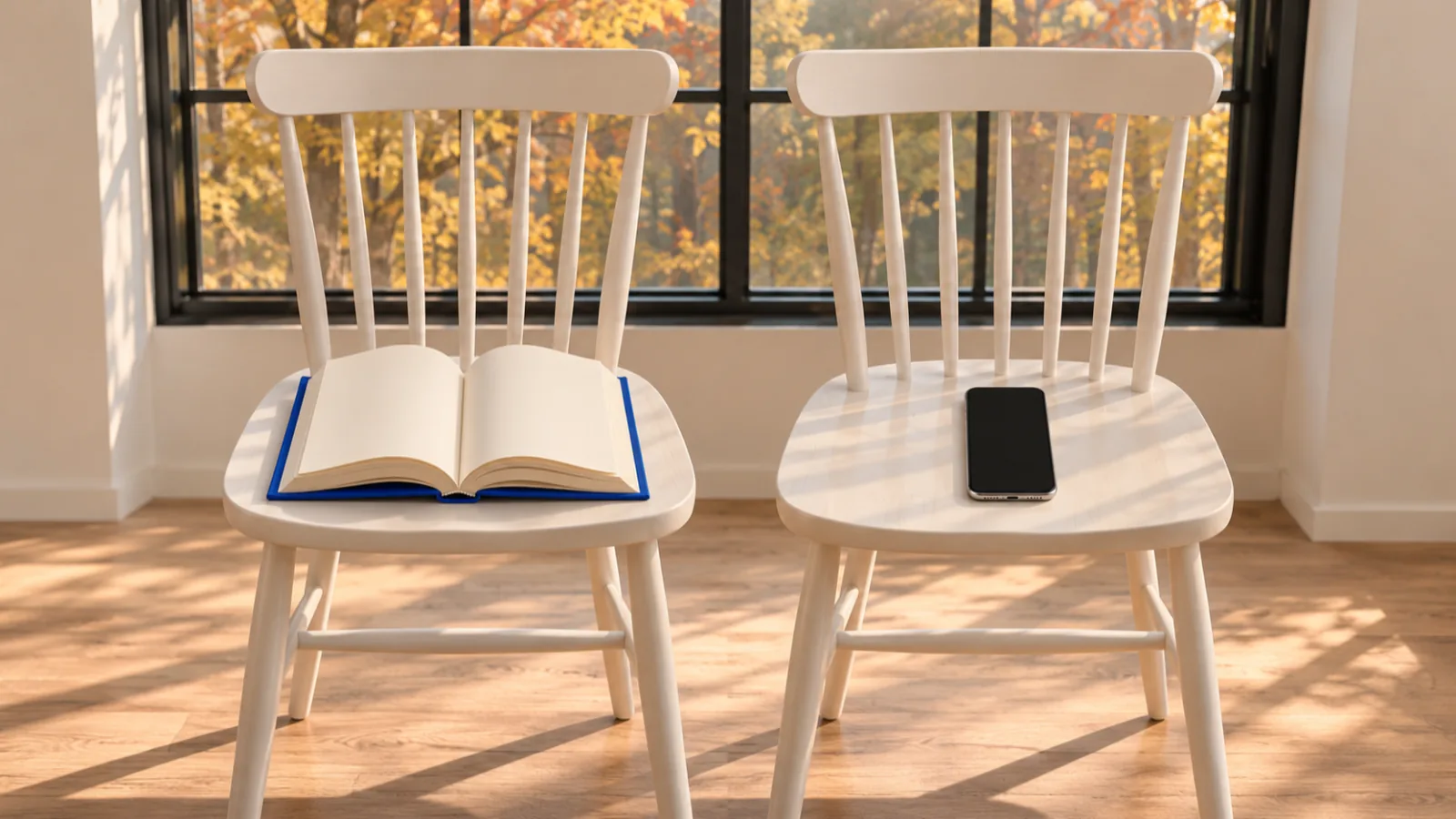
Neither wins overall: in listening vs reading tests, a meta-analysis of 46 studies found no reliable difference in comprehension. Reading has a small edge on hard material and inference questions, mostly because you can slow down and reread. For stories and straightforward text, listening works just as well, and it helps most when reading print is hard.
Across 46 studies and 4,687 people, comprehension after listening and after reading was not reliably different.
Reading pulls ahead on difficult texts and inference questions, mainly because readers control the pace and can look back.
Listeners zone out more often and lose more when they multitask, so attention matters more for listening than for reading.
Listening helps most when decoding print is the bottleneck, such as for young children and people with dyslexia.
Reading along while you listen adds little for fluent readers who set their own pace, but it can support struggling readers.
Listening vs reading is closer than most people think: across dozens of experiments, people understand a text about as well when they hear it as when they read it. The gaps show up in specific situations: dense material, questions that need inference, and listening while doing something else.
Below is what the research found, why it comes out that way, and how to pick the right mode for what you need to learn. If you already study by ear, the last two sections show how to get reading-level comprehension from audio, including with a text-to-speech app like Speechly for students.
Listening vs reading: what does the research say?
There is no overall winner, but reading has a small, real advantage for hard texts and deeper questions.
The best summary of the evidence is a 2021 meta-analysis by Virginia Clinton-Lisell in the Review of Educational Research, Listening Ears or Reading Eyes. It pooled 46 studies with 4,687 participants, from elementary school children to adults, that compared reading and listening comprehension directly. The overall difference was not statistically reliable. Two details matter more than the headline:
- Pacing. Reading came out ahead only when readers set their own pace. When the researchers controlled how fast people read, the reading advantage disappeared.
- Type of question. Reading did better on inference questions (connecting ideas, reading between the lines) and had a smaller edge on general comprehension. On literal questions about what the text said, there was no difference at all.
Here is how the main studies line up.
| Study | What it compared | What it found |
|---|---|---|
| Clinton-Lisell, 2021 | 46 studies, 4,687 people | No reliable overall difference; reading ahead on inference questions and when self-paced |
| Rogowsky, Calhoun & Tallal, 2016 | Audiobook vs e-text vs both, nonfiction chapter, 91 adults | No significant difference right after or two weeks later |
| Deniz et al., 2019 | Brain scans while people heard and read the same stories | Word meanings were represented almost identically in both |
| Varao Sousa et al., 2013 | Silent reading vs reading aloud vs listening, university students | Listening had the most mind wandering and the weakest memory |
| Daniel & Woody, 2010 | Podcast vs text of the same source, college course | The podcast group scored lower on the quiz |
So the honest answer to "which is better" is: it depends on the text, on who controls the pace, and above all on whether you are actually paying attention.
Is listening the same as reading for your brain?
Almost. Once words are recognized, the same language system makes sense of them, whether they came in through your eyes or your ears.
Reading researchers call this the simple view of reading: reading comprehension is the product of decoding (turning print into words) and language comprehension (understanding those words). Listening skips decoding. For a fluent adult, decoding is fast and automatic, so both routes end up in the same place.
Brain imaging backs this up. In the 2019 Journal of Neuroscience study by Fatma Deniz and colleagues, nine people listened to and, on separate days, read the same stories from The Moth Radio Hour inside an fMRI scanner. The maps of where their brains represented word meanings were almost identical for listening and reading, and a model trained on one could predict brain activity during the other.
This is also why the psychologist Daniel Willingham of the University of Virginia argues that listening to an audiobook is not cheating. As he explained in a Wisconsin Public Radio interview, the comprehension process is shared, but difficult texts call for extra strategies, and "print makes those strategies easier to use." Our article on whether audiobooks count as reading takes up that debate.
When is reading better than listening?
Reading wins when the material is hard, when you need to think between the lines, and when your attention is split.
You control the pace and can look back
On a page, you slow down at a tricky sentence, glance back at a definition and skim what you know. Audio moves forward at the narrator's pace, and rewinding to find one sentence is clumsy. That is likely why Clinton-Lisell found a reading advantage only when readers set their own pace.
There is a catch: as Tech & Learning reported, none of the experiments in her review let listeners control their own pace. Players with speed control and skip-back may narrow the gap, but the review had no way to test that.
Dense nonfiction and inference questions
Stephanie Del Tufo, a language scientist at the University of Delaware, sums up the research in The Conversation: comprehension is similar for simple stories, but listening gets harder when nonfiction is complex or unfamiliar. Textbook chapters, research papers, contracts and anything full of new terms fall into that category.
Your mind wanders more when you listen
In a University of Waterloo study by Varao Sousa, Carriere and Smilek, each student read one excerpt of Bill Bryson's A Short History of Nearly Everything silently, read one aloud and listened to one. When prompted at random moments, students reported mind wandering about half the time while listening, compared with about a third of the time during silent reading. Their memory for the listened-to passage was also the weakest. Reading aloud kept minds on task best of all.
Multitasking costs listeners more
In Daniel and Woody's classroom study, students who read a primary source on their own time scored higher on a quiz than students who listened to it as a podcast. Del Tufo notes that many of the listeners reported multitasking, such as using their computers while it played. Attention appears to matter more for listening than for reading, so "listening while" is fine for a novel and risky for exam material. If your attention drifts easily, see how people use text to speech with ADHD.
When is listening better than reading?
Listening wins when decoding print is the hard part, when the narration adds meaning, and when the alternative is not reading at all.
- When decoding is the bottleneck. For people with dyslexia, turning letters into words takes effort that other readers rarely notice. Listening removes that step, so comprehension can come closer to their actual language ability. A meta-analysis in the Journal of Learning Disabilities found that text-to-speech and read-aloud tools improved reading comprehension for students with reading disabilities, with an average effect size of 0.35. Our page on text to speech for dyslexia covers how people use it.
- For young children. While decoding still takes effort, kids understand more by ear than they can read on their own. The review behind the simple view of reading describes a long-term study in which listening and reading comprehension had become essentially one skill by eighth grade. Until then, listening builds vocabulary and background knowledge that later pays off in reading.
- Tone and emphasis. A good narrator signals sarcasm, emotion and stress, which can make dialogue and poetry clearer than flat print.
- Time you couldn't read in. Commutes, walks and chores become study time for familiar or lighter material, and audio rests your eyes after a day of screens.
Does reading while listening help comprehension?
Less than you might expect for fluent readers, but it can help people who struggle with print.
A 2023 meta-analysis by Clinton-Lisell looked at 30 studies with 1,945 participants comparing reading while listening with reading only. The overall benefit was trivial, and it appeared only when the researcher paced the reading. When people read at their own pace, adding audio made no reliable difference. The review did find signs that audio-assisted reading helps struggling readers' comprehension and second-language learners' vocabulary, though there are too few studies to generalize.
In practice, following highlighted text is a useful anchor for dense material and a real support if reading takes effort for you. Our guide to reading while listening goes deeper.
Are you an "auditory learner" or a "visual learner"?
Probably not in a way that matters for comprehension. The idea that you learn best when material matches your preferred style has very little evidence behind it, as a major review of learning styles research by Pashler and colleagues concluded in 2008.
Rogowsky, Calhoun and Tallal tested this directly in a 2015 study: adults who called themselves auditory learners did not understand an audiobook better, and self-described visual learners did not understand e-text better. Choose the mode by the material and the situation, not by a label.
Listening or reading: which should you choose?
Read when the material is hard and you need to think about it. Listen when it is familiar or narrative, or when you otherwise wouldn't get to it.
| Situation | Better choice | Why |
|---|---|---|
| Dense textbook chapter or research paper | Read, or read along with audio | You can slow down, reread and annotate |
| Novel, memoir or narrative nonfiction | Either | Comprehension is similar for stories |
| Commute, walk, gym or chores | Listen | Your eyes are busy; keep the material lighter |
| Reviewing material you've already read | Listen | A fast extra pass, without sitting down |
| Reading print takes a lot of effort | Listen, or listen and follow along | Removes the decoding bottleneck |
| Learning vocabulary in a new language | Read while listening | Connects spelling and pronunciation |
How to understand and remember more when you listen
The research points to three fixes: give it your full attention, take back control of the pace and do something with what you heard.
- Single-task for anything you'll be tested on. Save multitasking for familiar or lighter material.
- Use the controls. Pause at the end of each section and skip back when you lose a sentence. That recovers the "look back" advantage reading has.
- Match the speed to the material. Most narrators read about 9,300 words an hour, according to ACX, or about 155 words a minute. A meta-analysis of reading rate puts average adult silent reading at 238 words a minute for nonfiction, so 1.5× listening is roughly reading speed. In a lecture-video study, comprehension held up at 1.5× and 2× but dropped beyond 2×. See the best listening speed for learning for more.
- Recap out loud. After each chapter, say the main points in a sentence or two. In the Waterloo study, reading aloud, the most active mode, had the least mind wandering, which suggests that doing something with the words keeps you on task.
- Follow the text for the hard parts. Switch to reading along for formulas, tables, definitions and anything you'd underline.
- Re-listen close to the test. In the same lecture-video study, watching a second time at 2× right before the test beat a single normal-speed viewing a week earlier.
More techniques are in how to remember what you listen to.
Get the best of listening and reading with Speechly
Speechly is a text-to-speech app that reads your own material aloud, so you can switch between listening and reading the same text instead of choosing one.
- Read along when it gets dense. Each word is highlighted as it's read, and you can jump to any sentence to hear it again.
- Set the pace. Choose any speed from 0.5× to 2×, slower for a hard chapter and faster for review.
- Bring your real course material. Listen to PDFs, Word documents, EPUB eBooks, web pages and photos of printed pages or handouts.
- Pick up anywhere. Your place saves automatically, and you can continue on iPhone, iPad, Android, Mac or Windows with the same account. On a Mac, select text in any app and press ⌘E; on Windows, press Alt+R.
The free plan includes two files with premium voices, so you can test listening against reading on your next assignment and see which works for you.
Frequently asked questions
Do you remember more when you read or when you listen?
About the same, as long as you pay attention. In one study, people remembered a nonfiction chapter equally well two weeks later whether they read it or heard it, but in studies where listeners zoned out or multitasked, listening fell behind.
Is listening to an audiobook as good as reading the book?
For most books, yes. Your brain builds the same meaning from both, and comprehension tests usually show little difference. Dense nonfiction is the exception: reading, or reading along with the audio, makes it easier to slow down and reread.
Is reading faster than listening?
Yes, at normal speed. The average adult silently reads nonfiction at about 238 words a minute, while audiobook narrators average about 155. Listening at about 1.5× closes most of the gap.
Why do I zone out when I listen to audiobooks?
Audio moves at the narrator's pace and asks nothing of your eyes or hands, so your mind drifts more easily than when you read. Listening without distractions, pausing every section to recap and switching to the text for hard parts all help.
Does listening at 2× speed hurt comprehension?
Not much for many people. A study of lecture videos found minimal comprehension costs at 1.5× and 2×, with a clear drop beyond 2×. Slow down for difficult or unfamiliar material.
Is it better to read and listen at the same time?
For fluent adults reading at their own pace, it adds little. It can help struggling readers and second-language learners picking up vocabulary, and it gives you a visual anchor when the audio gets dense.
Should kids listen to books or read them?
Both. Young children usually understand more by ear than they can read on their own, so listening builds vocabulary and background knowledge while they learn to read. Keep practicing reading alongside it.
Listen with Speechly
Natural AI voices on iPhone, iPad, Android, Mac and Windows, with word highlighting and your place saved on every device. Free to download.
Prices and features of other products were checked on November 17, 2026 and can change. Speechly is not affiliated with the other companies named here.
Does Listening Help You Study? What the Research Says
Does listening help you study? What the research says about audiobooks, lectures, music, white noise and sleep audio, plus a study routine that works.
Reading While Listening: Why Doing Both Helps You Remember
Does reading while listening help you remember? What 30 studies found, the one condition that decides it, who gains most and how to use it well.

Does Listening to Audiobooks Count as Reading?
Does listening to audiobooks count as reading? Usually yes. What 46 studies and brain scans show, the 4 exceptions, and how it counts for goals and school.