


Does Listening to Audiobooks Count as Reading?
Does listening to audiobooks count as reading? Usually yes. What 46 studies and brain scans show, the 4 exceptions, and how it counts for goals and school.

Yes, for most purposes listening to audiobooks counts as reading: when the goal is to understand and enjoy a book, studies find comprehension is about the same either way. It doesn't count as reading practice, because listening skips decoding print, so children learning to read still need to read the words themselves.
If the goal is the book itself (the story, the ideas, the conversation afterward), an audiobook counts. Comprehension tests show no reliable gap between listening and reading.
If the goal is the skill of reading, it doesn't. Listening skips decoding, the step that turns letters into words, which is what beginning readers need to practice.
Print has a real edge for dense nonfiction, because you can slow down, look back and annotate. In lab studies, listeners also mind-wander more than silent readers.
In a 2025 NPR/Ipsos poll, 41% of U.S. adults agreed that audiobooks are not a form of reading, so expect some disagreement, but the research is on the listener's side.
Abridged editions, summaries and half-heard chapters don't count as reading the book. A full, unabridged book you paid attention to does.
Does listening to audiobooks count as reading? For most purposes, yes. If you want to understand, enjoy and talk about a book, an audiobook gets you there about as well as print. The exceptions are specific: learning the skill of reading, studying dense material, and listening with half your attention.
The real question is what "reading" means in your situation. Below are the three meanings, what the research says about each, and what to do about school assignments, reading goals and kids. If you study with audio, there's also a section on getting reading-level understanding from your ears, including with a text-to-speech app like Speechly for students.
Does listening to audiobooks count as reading? It depends what you mean by reading
People use "reading" for three different things, and the answer changes with each one.
| What you mean by reading | Does an audiobook count? | Why |
|---|---|---|
| Taking in a book: its story, ideas and language | Yes | Comprehension is about the same by ear and by eye |
| The skill of reading: turning print into words fluently | No | Listening skips decoding, which is the part being practiced |
| A record of what you've read: goals, book clubs, conversation | Your call, or the organizer's | It's a convention, not a science question |
Most arguments about audiobooks happen because one person means the first and the other means the second.
What happens in your brain when you listen instead of read
Reading has one extra step at the start; after that, your brain treats a book the same way whether you see it or hear it.
Reading researchers describe this with the simple view of reading: reading comprehension is decoding (turning letters into words) multiplied by language comprehension (understanding those words). An audiobook hands you the words already decoded. For a fluent adult, decoding is fast and automatic, so both routes end in the same place.
Brain imaging agrees. In a 2019 Journal of Neuroscience study, Fatma Deniz and colleagues scanned nine people while they listened to stories from The Moth Radio Hour, then while they read the same stories. The maps of where word meanings are processed came out virtually identical.
That is the core of the case made by Daniel Willingham, a psychology professor at the University of Virginia who studies reading. Once words are identified, he argues, the same mental process understands them, so listening isn't cheating. His advice to listeners, as reported by Wisconsin Public Radio: "Fly your audiobook flag proudly." He adds two caveats: difficult texts are easier to work through in print, and a book you half-hear while multitasking doesn't get your full attention.
Is listening to an audiobook as good as reading the book?
For understanding most books, yes. For hard material, print has a small but real edge.
- Comprehension is about the same overall. A 2021 meta-analysis by Virginia Clinton-Lisell pooled 46 studies with 4,687 participants and found no reliable overall difference between reading and listening comprehension.
- Memory holds up too. In a 2016 study by Beth Rogowsky and colleagues, 91 adults listened to a nonfiction chapter, read it, or did both at once. All three groups scored about the same, both right away and two weeks later.
- Reading has a small edge on inference and self-pacing. In the same meta-analysis, reading came out slightly ahead when readers set their own pace, and on questions that required reading between the lines rather than recalling facts.
- Dense nonfiction favors print. Stephanie Del Tufo, a language scientist at the University of Delaware, writes in The Conversation that listening can be harder than reading when material is complex or unfamiliar. On a page, you can reread, skim and underline.
- Attention slips more when you listen. In a University of Waterloo study of more than 200 students, participants said their mind was wandering at about half of the random check-ins while listening, versus about a third during silent reading.
The pattern: an audiobook of a novel you're paying attention to counts fully. A textbook chapter playing while you answer messages probably doesn't. Our comparison of listening vs reading for comprehension walks through each study in more detail.
When an audiobook doesn't count as reading
There are four cases where "I listened to it" is not the same as "I read it."
When the goal is learning to read
Children who are still learning to decode need practice turning print into words, and audio does that work for them. Rogowsky, whose research found no comprehension gap in adults, told NPR in 2025 that children learning to read need the experience of reading, because listening alone doesn't reinforce those skills. Audiobooks are still great for vocabulary, stories and a love of books, as long as they sit alongside reading practice rather than replace it. See how parents can use text to speech to help kids read.
When the assignment is about the text on the page
Close reading of a poem's line breaks, a lab manual's diagrams or a contract's exact wording depends on what's printed. Listen for a first pass, then read the parts you'll quote or analyze.
When it isn't the whole book
An abridged audiobook cuts parts of the text, a summary app gives you someone else's condensed version, and a dramatized adaptation may change dialogue. None of these is the book. Check that the edition says "unabridged."
When you weren't really listening
If you can't say what happened in the last chapter, you didn't read it in either format. Background listening while you do something demanding is the weakest form of audiobook use.
Why do some people say audiobooks aren't reading?
Mostly habit. For many people, reading means eyes on a page, and listening can look too easy to count.
In a 2025 NPR/Ipsos poll of 2,033 U.S. adults, conducted February 21–27, 41% agreed that audiobooks are not a form of reading. NPR reported that adults over 65, men and people without a four-year degree were more likely to agree. The same poll found that 16% of Americans had listened to an audiobook in the past month.
The skepticism ignores some history. Stories were told aloud long before they were written down, and by 1934 the Library of Congress was ordering its first talking books for blind readers. Nobody says a braille reader isn't reading because they use their fingers. Reading through a different sense is still reading. For many people with dyslexia or low vision, listening is how they read at the level of their actual understanding; our page on text to speech for dyslexia covers how people use it.
Do audiobooks count for reading goals, book clubs and school?
Usually, but the person who sets the rules decides.
- Personal reading goals. It's your goal, so count what serves you. If you'd rather keep score separately, track audiobooks on their own list or shelf in whatever reading tracker you use.
- Public reading challenges and book clubs. Most care that you finished the book, but check the rules of the specific challenge before you log a listen.
- School assignments. Ask the teacher what the assignment is for. If it's about discussing a novel, an unabridged audiobook usually works. If it's reading fluency practice, it won't.
- Accommodations. Students with an IEP or 504 plan may have audiobooks or text to speech written in as a reading accommodation. Our guide to IEP and 504 plan reading accommodations explains how to request them.
How to get reading-level understanding from an audiobook
Treat listening like reading: give it your attention and take back the control print gives you.
- Single-task for books that matter. Save chores and commutes for novels and lighter nonfiction you won't be tested on.
- Match the speed to the book. Speed up for stories and familiar material, and slow down for dense chapters or new terms. Our guide to listening at 2× and still understanding explains how to build up to it.
- Pause and recap. At the end of each chapter, say the main points in a sentence or two.
- Rewind on purpose. When you notice you've drifted, go back to the last thing you remember instead of pushing on.
- Read along for the hard parts. Following the text while you listen gives you the look-back advantage of print without losing the audio. If holding focus is the hard part for you, our page on text to speech for ADHD covers listening while each word is highlighted.
Read and listen at the same time with Speechly
Speechly is a text-to-speech app that reads your own material aloud, so you don't have to choose between reading and listening.
- Every word highlighted as it's read. Follow along for dense passages, and jump to any sentence to hear it again.
- Your course material, not just audiobooks. Listen to PDFs, Word documents, EPUB eBooks, web pages and photos of printed pages, plus a built-in catalog of 75,000+ free public-domain books.
- Speed from 0.5× to 2×, with 25+ natural AI voices across eight languages.
- Pick up on any device. Your place saves automatically on iPhone, iPad, Android, Mac and Windows. On a Mac, select text in any app and press ⌘E; on Windows, press Alt+R.
The free plan includes two text-to-speech files with premium voices, no card required, so you can try listening and reading along on your next assigned chapter.
Frequently asked questions
Can you say you read a book if you listened to the audiobook?
Yes. If you listened to the full, unabridged book and followed it, you know it as well as someone who read it in print. Say "I listened to it" only if the format matters to the conversation, such as a book club discussing page numbers.
Is listening to audiobooks cheating?
No. Cognitive psychologist Daniel Willingham argues it's only cheating if the point of the exercise is decoding print. If the point is the story, the ideas or the language, listening gets you there.
Do audiobooks improve your reading skills?
Not directly. Listening builds vocabulary and background knowledge, but it doesn't train decoding or spelling. If you want both, follow the printed or highlighted text while you listen so your eyes stay on the words.
Is it better to read a book or listen to it?
For novels, memoirs and narrative nonfiction, either works about equally well. For textbooks, research papers and anything you'll be tested on, reading or reading along with the audio is safer, because you can slow down and reread.
Does listening to an audiobook at 2× speed still count?
Yes, as long as you're still following it. A simple test: if you can sum up each chapter in a sentence or two afterward, the speed is working. If you can't, slow down and rewind to the last part you remember.
Do audiobooks count as reading for kids?
As exposure to stories and language, yes. As reading practice, no. Children who are still learning to decode need time reading the words themselves, so use audiobooks alongside reading, not in place of it.
Listen with Speechly
Natural AI voices on iPhone, iPad, Android, Mac and Windows, with word highlighting and your place saved on every device. Free to download.
Prices and features of other products were checked on November 18, 2026 and can change. Speechly is not affiliated with the other companies named here.
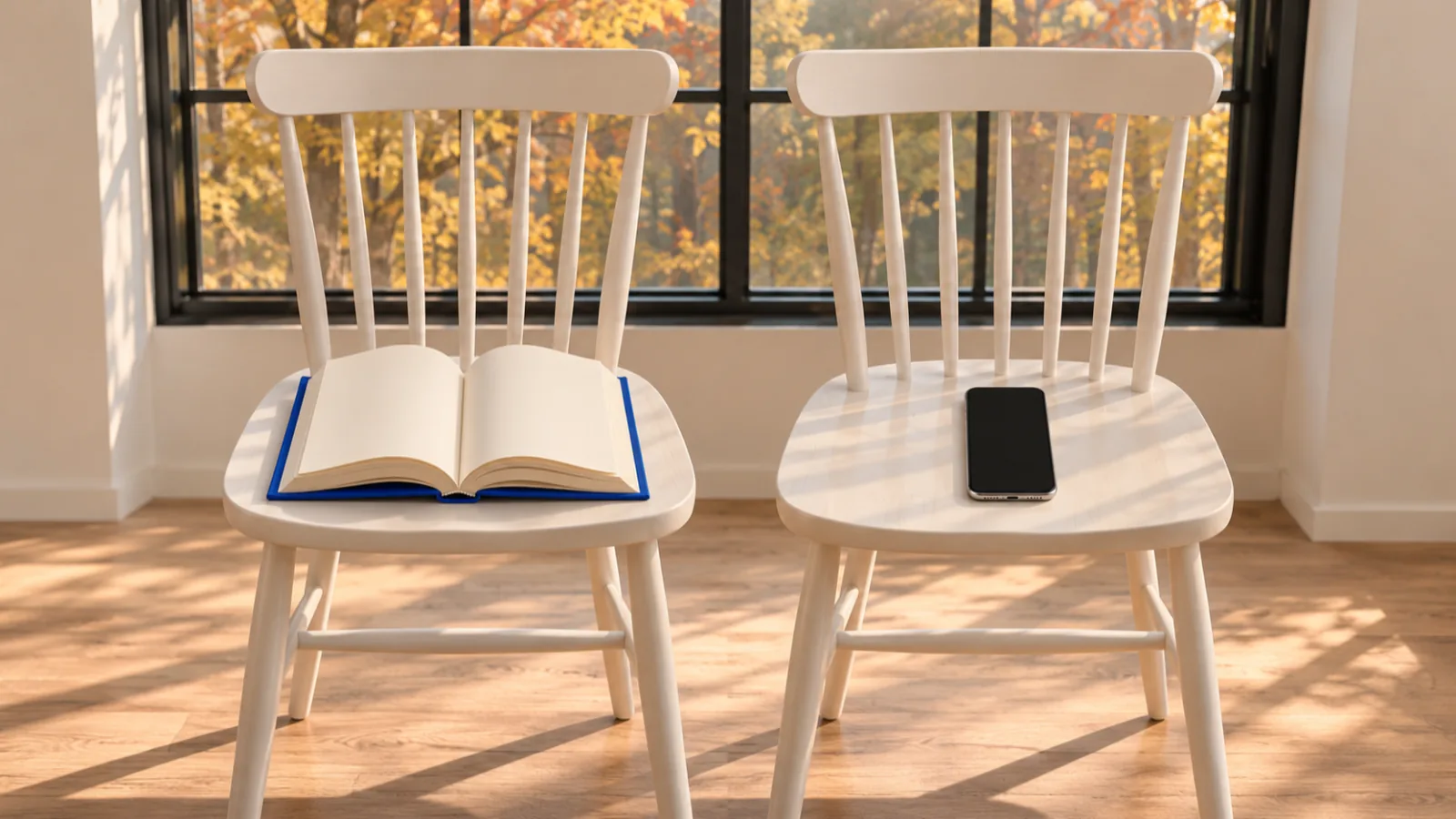
Listening vs Reading: Which Is Better for Comprehension?
Listening vs reading: 46 studies found no reliable comprehension gap. See when reading wins, when audio matches it, and how to remember more by ear.
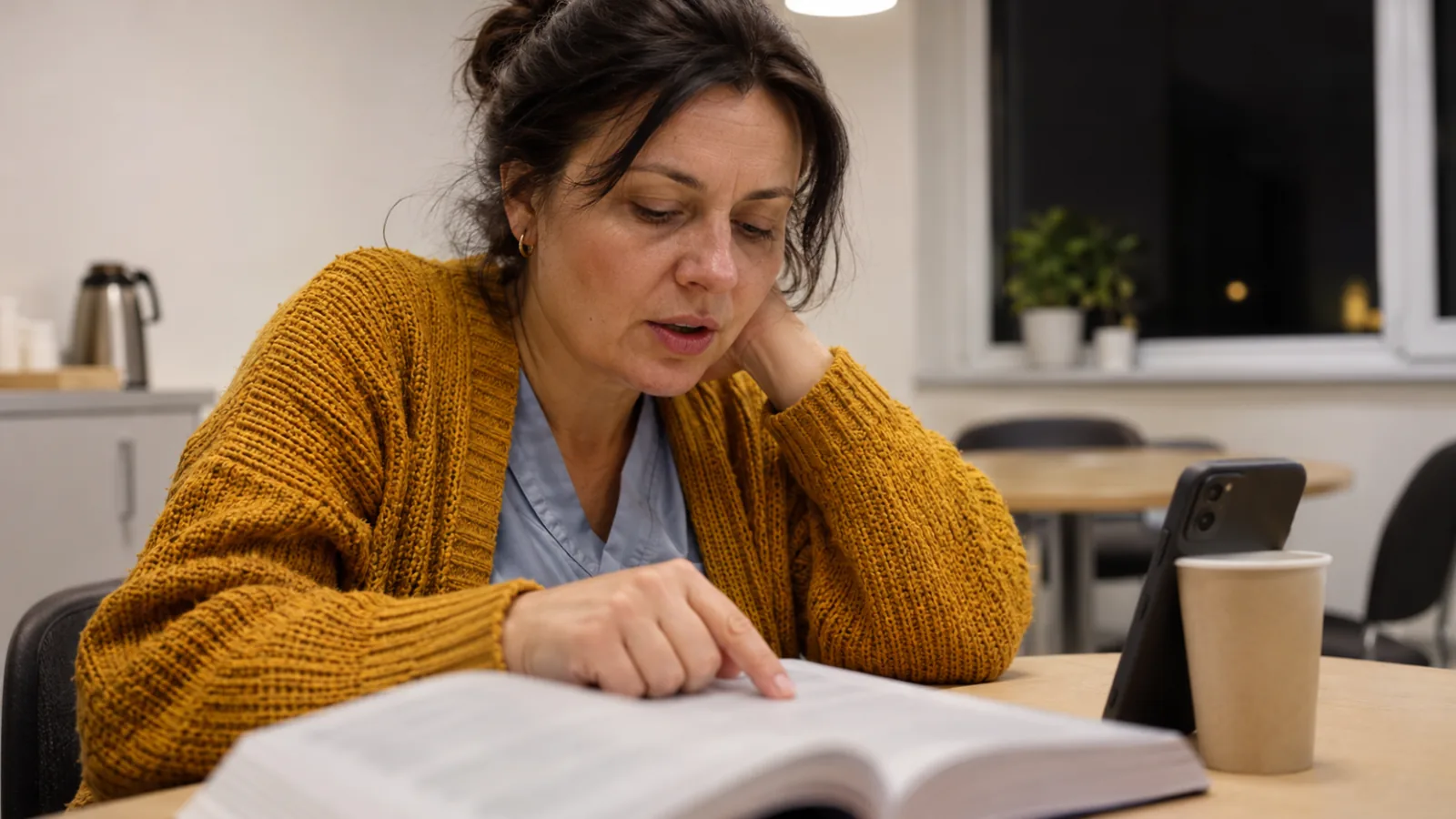
Reading While Listening: Why Doing Both Helps You Remember
Does reading while listening help you remember? What 30 studies found, the one condition that decides it, who gains most and how to use it well.
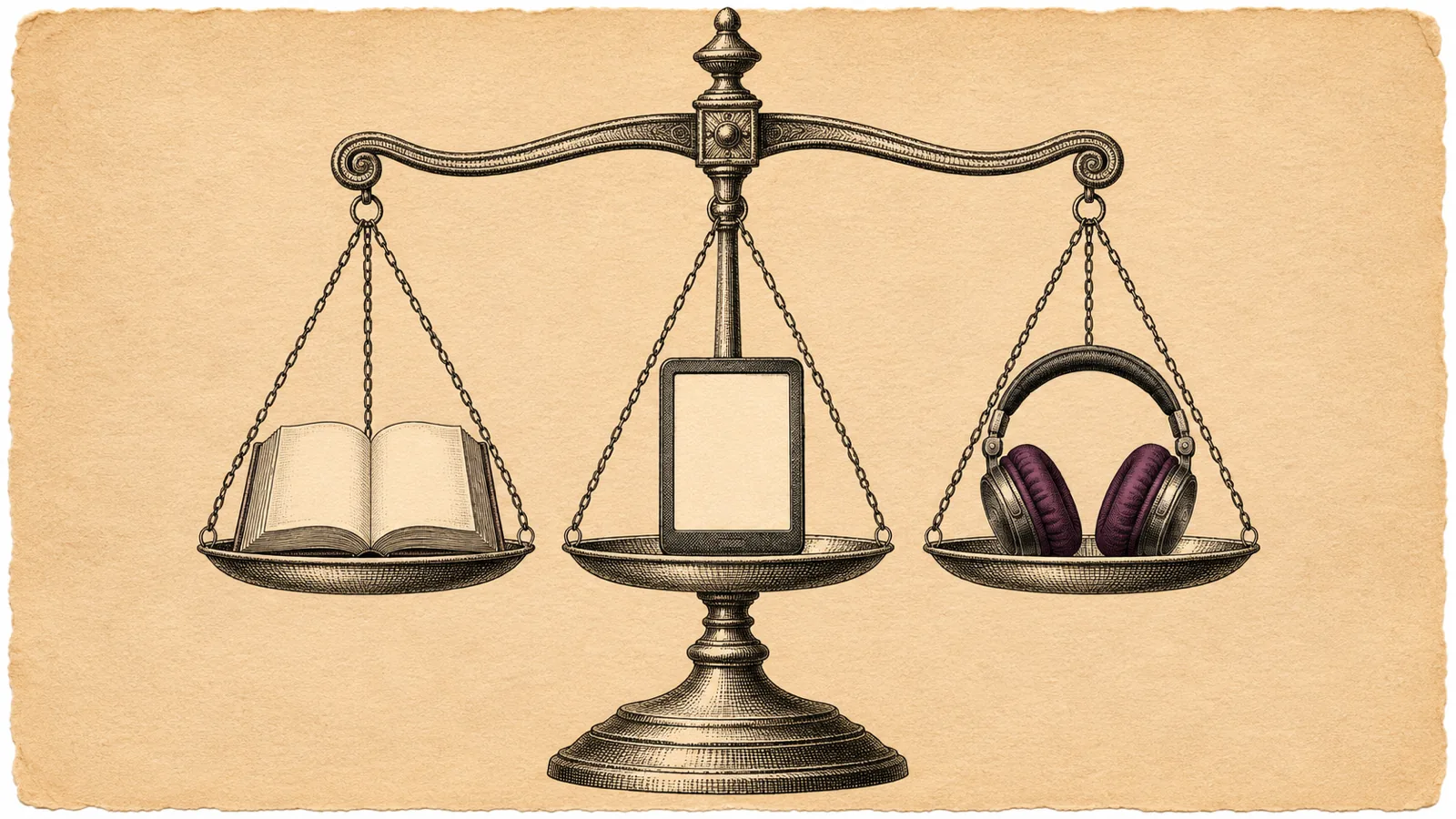
Audiobooks vs eBooks vs Print: Pros and Cons
Audiobooks vs ebooks vs print, compared on comprehension, cost, focus, ownership and convenience, with what the research says about remembering more.