


Audiobooks vs eBooks vs Print: Pros and Cons
Audiobooks vs ebooks vs print, compared on comprehension, cost, focus, ownership and convenience, with what the research says about remembering more.
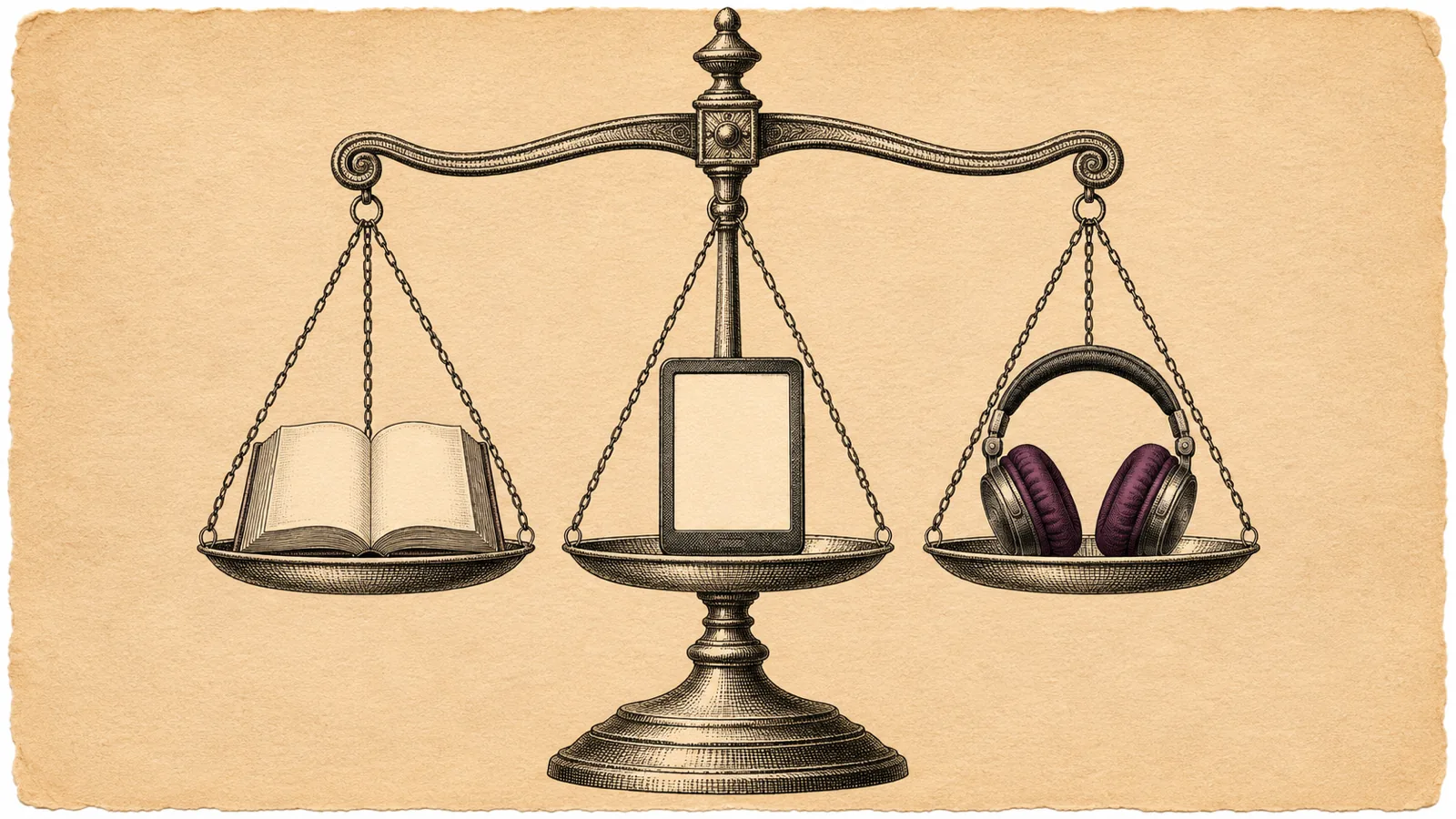
In the audiobooks vs ebooks vs print choice, no format wins everywhere. Print has a small, proven edge for understanding dense nonfiction. Ebooks are cheapest to carry and easiest to adjust. Audiobooks turn commutes and chores into reading time, with comprehension close to reading for stories. Pick by the book and the moment.
For stories, comprehension is about the same in all three formats; for informational text, two meta-analyses found a small advantage for paper over screens.
Listening is slower than reading: an average silent reader gets through a typical novel in about six hours; the audiobook runs closer to ten.
Most ebooks and audiobooks are licensed, not owned. Print is the only format you can lend, resell or keep forever without an account.
Libraries lend all three formats free, which makes the cost difference smaller than it looks.
Combining formats, such as listening while following the text, can help struggling readers most.
In the audiobooks vs ebooks vs print debate, each format wins at something different. Print is best for studying dense material, ebooks are best for cost and carrying a library in your pocket, and audiobooks are best for reading when your eyes and hands are busy. For stories, research finds people understand about as much from all three.
Below: the pros and cons of each, what the studies actually show, what each really costs, and how to choose. If you also want to hear PDFs, articles and books that have no audiobook, Speechly reads them aloud; more on that at the end.
Audiobooks vs ebooks vs print at a glance
| eBooks | Audiobooks | ||
|---|---|---|---|
| Best for | Study, deep focus, kids | Travel, price, big libraries | Commutes, chores, exercise |
| Comprehension | Strongest for dense nonfiction | Same as print for stories | Close to reading for stories |
| Speed | Your reading pace | Your reading pace | Narrator's pace, adjustable |
| Hands and eyes | Both needed | Both needed | Neither needed |
| Cost per title | Medium; used copies cheap | Often lowest | Often highest |
| Ownership | You own it | Usually a license | Usually a license |
| Accessibility | Fixed print | Adjustable text, read-aloud | No print needed |
What does the research say about comprehension?
Short answer: for stories, the format barely matters; for informational text, paper has a small edge over screens; and listening matches reading except on hard material.
- Print vs screens. A 2018 meta-analysis by Pablo Delgado and colleagues pooled 54 studies with about 171,000 readers and found people understood informational texts better on paper, with no difference for narrative texts. A 2019 meta-analysis by Virginia Clinton of 33 studies found the same pattern, and that screen readers were more likely to overestimate how well they'd understood.
- Listening vs reading. A 2021 meta-analysis by Clinton-Lisell of 46 studies and 4,687 people found no reliable difference overall. Reading did better on harder material, likely because readers can slow down and look back.
- Audiobooks vs ebooks directly. A 2016 study by Beth Rogowsky and colleagues gave adults a nonfiction book as an audiobook, an ebook, or both at once, and found no significant difference in comprehension.
- Attention. In a 2013 University of Waterloo study, people's minds wandered more, and they remembered less, when they listened to a passage than when they read it themselves.
Our deeper look at listening vs reading for comprehension covers these studies in detail.
Print books: pros and cons
Pros
- Best for deep study. The paper advantage shows up most with informational text and under time pressure.
- Easy to navigate. You remember where a passage was on the page and can flip back in seconds.
- No distractions. No notifications, no battery, no other apps one tap away.
- You own it. You can lend it, resell it, write in it and keep it forever.
Cons
- Heavy and bulky. A long novel is a lot to carry; a shelf of them takes up a room.
- Fixed text size. Large-print editions exist, but not for every book.
- Needs light, eyes and hands. You can't read print while driving, cooking or walking.
eBooks: pros and cons
Pros
- A library in your pocket. Thousands of books on one phone or e-reader, with instant delivery.
- Often the cheapest new copy, and many classics are free from Project Gutenberg and other public-domain sources.
- Adjustable. Change the font, size, spacing and brightness; tap a word for its definition; search the whole book.
- Read-aloud options. Many devices and apps can read ebooks aloud with text to speech.
Cons
- You usually buy a license. Amazon's Kindle Store Terms of Use say Kindle content is licensed, not sold, and on February 26, 2025 Amazon removed the option to download purchased Kindle books to a computer over USB.
- Screen distractions. On a phone or tablet, every other app is competing for your attention.
- Weaker for dense material. The comprehension gap shows up on screens for informational texts.
- Harder to flip around. Finding "that passage near the middle" takes longer than with paper.
Audiobooks: pros and cons
Pros
- Reading time where there was none. Commutes, chores, walks and workouts all become reading time.
- A good narrator adds something. Tone, accents and timing bring dialogue, poetry and plays to life.
- No print needed. Listening helps people with dyslexia, low vision or tired eyes get through books.
- Adjustable speed. Most apps let you speed up or slow down the narration.
Cons
- Slower than reading at normal speed. ACX estimates about 9,300 words per finished hour, so a 90,000-word novel runs close to ten hours. An analysis of 190 studies put average silent reading at about 238 words a minute for nonfiction, or roughly six hours for the same book.
- Easy to drift. It's harder to notice your mind has wandered, and harder to find your way back.
- Hard to skim or quote. Finding a sentence for an essay means scrubbing through audio.
- Often the most expensive. Many audiobooks cost more than the ebook, and not every book has one.
Which format costs less?
A library card makes all three free. Libraries lend print books, and apps like Libby and Hoopla lend ebooks and audiobooks with no late fees. See where to find free audiobooks legally for every option.
When you're buying:
- Print: you pay most for new hardcovers, but used copies are cheap and you can resell them.
- eBooks: often the cheapest new edition, and free for public-domain classics.
- Audiobooks: usually the priciest per title. Audible Premium costs $14.95 a month in the US for one credit a month, as listed November 18, 2026.
Which format is best for kids?
Print is the safest choice for reading together with young children. In a 2019 Pediatrics study of 37 parent-toddler pairs, parents and toddlers talked and collaborated less when reading electronic books than print books. Audiobooks are a great extra for older kids, but children learning to read still need to read the words themselves; see whether audiobooks count as reading.
Which should you choose?
Pick by the book and the moment, not by loyalty to one format:
| Situation | Best format |
|---|---|
| A textbook or dense nonfiction you'll be tested on | Print, or an ebook or PDF you can annotate |
| A novel for fun | Any; whichever you'll actually finish |
| A commute, workout or chores | Audiobook or text to speech |
| Travel | eBook on an e-reader or phone |
| Reading with a young child | |
| Dyslexia, low vision or tired eyes | Audio, or an ebook with large text and read-aloud |
| A book you'll keep, lend or reread for years |
Can you combine formats?
Yes, and it often works best. Listen to a novel on your commute and switch to the page at home, or listen while following the text. Research on reading while listening suggests the combination helps struggling readers and language learners most.
Text to speech fills the gap when there's no audiobook. Speechly reads ebooks, PDFs, Word documents and web pages aloud, with word-by-word highlighting so you can see and hear the text at once:
- Download Speechly for iPhone and iPad or Android, or use it on Mac and Windows.
- Import an EPUB or PDF, paste a link, take a photo of a printed page, or open one of 75,000+ free public-domain books.
- Choose from 25+ natural voices and a speed from 0.5× to 2×. Speechly saves your place on every device.
Speechly can't read DRM-protected Kindle or Audible books. The free plan includes two text-to-speech files with premium voices; Premium is $14.99/month or $139/year. For the full trade-off between narrated and AI audio, see audiobooks vs text to speech.
Frequently asked questions
Is it better to read a physical book or an ebook?
For novels, it makes little difference to comprehension. For textbooks and dense nonfiction, research finds a small advantage for paper, especially when you're under time pressure. Ebooks win on cost, portability and adjustable text size.
Do you remember more from audiobooks or reading?
About the same for stories, according to a 2021 meta-analysis of 46 studies. Reading has an edge for hard material because you can slow down and reread, and minds tend to wander more while listening.
Are audiobooks cheaper than ebooks?
Usually not. Audiobooks tend to cost more per title because they include a narrator's performance, and subscriptions like Audible Premium cost $14.95 a month in the US. Libraries lend both free.
Do audiobooks count as reading?
For enjoying and understanding a book, most people and most research say yes. For learning to read, or for close study of the text, they don't replace reading the words.
Which format is best for students?
Print or a PDF you can annotate for texts you'll be tested on, and audio for long novels, reviewing and getting through a heavy reading list. Many students combine both: listen first, then reread key passages.
Are e-readers easier on the eyes than tablets?
Many people find them more comfortable for long reading. E-ink screens look more like paper than phone or tablet screens do. If you get frequent eye strain or headaches, see an eye doctor.
Listen with Speechly
Natural AI voices on iPhone, iPad, Android, Mac and Windows, with word highlighting and your place saved on every device. Free to download.
Prices and features of other products were checked on November 18, 2026 and can change. Speechly is not affiliated with the other companies named here.
Listening vs Reading: Which Is Better for Comprehension?
Listening vs reading: 46 studies found no reliable comprehension gap. See when reading wins, when audio matches it, and how to remember more by ear.
Audiobooks vs Text to Speech: Which Should You Use?
Audiobooks vs text to speech: how they differ in voice, cost, what they can read and how well you learn from them, with a simple guide to which to use.

Does Listening to Audiobooks Count as Reading?
Does listening to audiobooks count as reading? Usually yes. What 46 studies and brain scans show, the 4 exceptions, and how it counts for goals and school.