


The Best Classic Novels to Listen To
The best classic novels to listen to, from Gatsby to Dracula: 17 picks with why each works by ear, exact run times, star narrators and free versions.
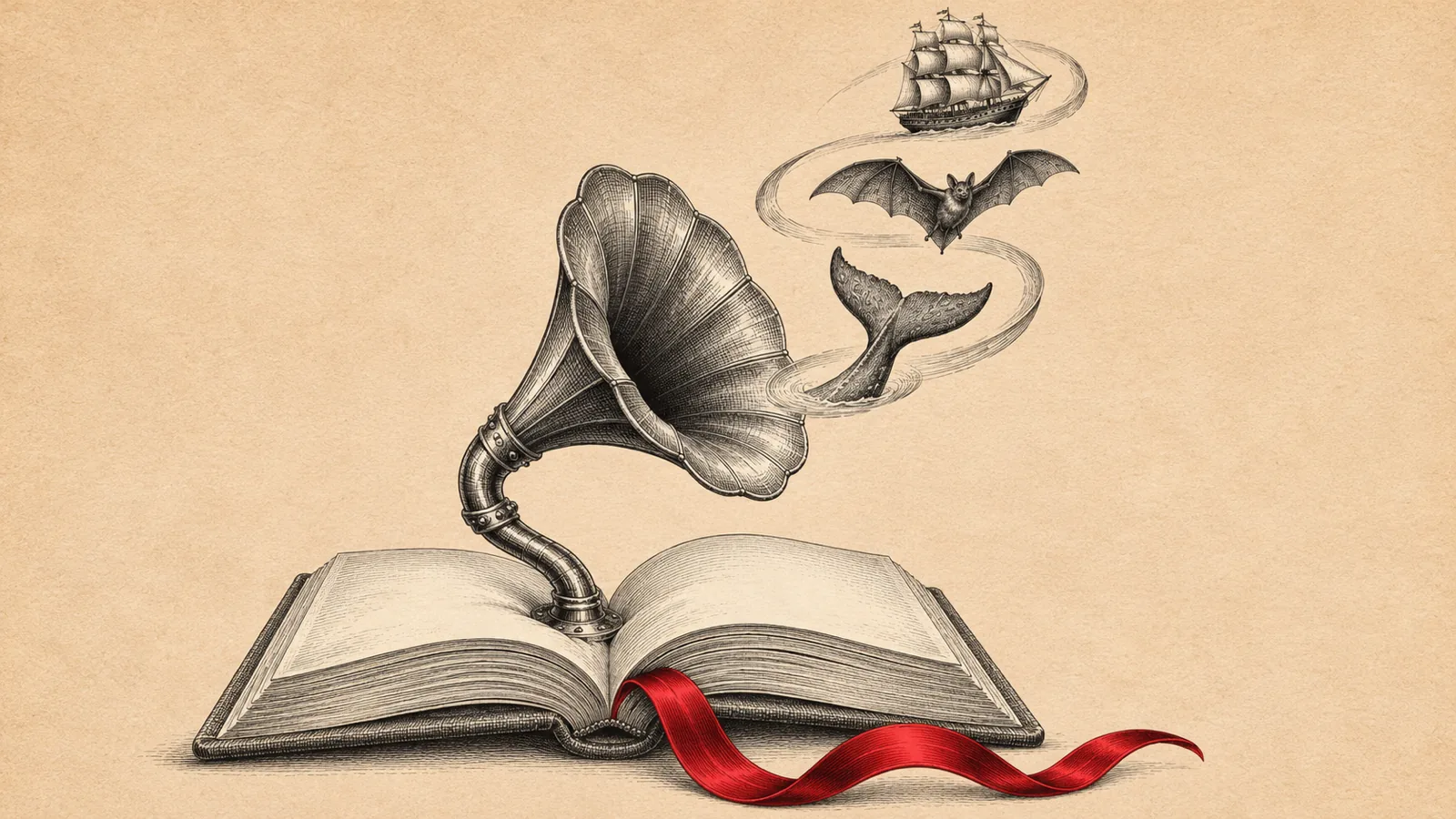
The best classic novels to listen to are Jane Eyre, Great Expectations, Pride and Prejudice, Dracula, Wuthering Heights and The Great Gatsby: books told in a strong voice. Start with Gatsby (about 5.5 hours) or A Christmas Carol (about 3 hours). All 17 picks below are free on LibriVox.
The best classic novels to listen to are built around a voice you can hear: a narrator talking straight to you, sharp dialogue, letters and diaries, or a cliffhanger at the end of every chapter. Many first came out in weekly or monthly installments, written to make you want the next chapter, and they still work beautifully in your ears.
Below are 17 picks, each with why it works on audio, how long it takes, the standout professional recording and the free version. Listening times are for LibriVox recordings, checked in November 2026. Every book on the main list is in the US public domain, so you can listen free.
The best classic novels to listen to, at a glance
| # | Novel | Why it works by ear | Free on LibriVox | Star narrator |
|---|---|---|---|---|
| 1 | The Great Gatsby (1925) | One confiding narrator | 5 h 38 min | Jake Gyllenhaal |
| 2 | A Christmas Carol (1843) | Five episodes, made for reading aloud | 3 h 14 min | Tim Curry |
| 3 | Pride and Prejudice (1813) | Comic dialogue and irony | 10 h 23 min | Rosamund Pike |
| 4 | The Hound of the Baskervilles (1902) | Watson's reports and diary | 5 h 53 min | — |
| 5 | Jane Eyre (1847) | Jane speaks to "Reader" | 18 h 36 min | Thandie Newton |
| 6 | Great Expectations (1861) | Weekly-serial cliffhangers | 17 h 54 min | — |
| 7 | Treasure Island (1883) | Boy narrator, pirate voices | 7 h 30 min | Full-cast drama |
| 8 | Wuthering Heights (1847) | A housekeeper tells it aloud | 14 h 49 min | Joanne Froggatt |
| 9 | Adventures of Huckleberry Finn (1884) | Written in spoken dialect | 10 h 42 min | Elijah Wood |
| 10 | Dracula (1897) | Diaries and letters, ideal for a cast | 15 h 59 min | Full cast |
| 11 | Frankenstein (1818) | Three nested narrators | 7 h 59 min | Dan Stevens |
| 12 | The Picture of Dorian Gray (1890) | Epigrams that land best spoken | 6 h 12 min | Russell Tovey |
| 13 | Crime and Punishment (1866) | Feverish inner voice | 19 h 53 min | — |
| 14 | Moby-Dick (1851) | Sermons and scenes written like a play | 23 h 35 min | Frank Muller |
| 15 | Anna Karenina (1878) | Short chapters, two clear stories | about 38 h 30 min | Maggie Gyllenhaal |
| 16 | Middlemarch (1871–72) | A warm, witty narrator | 33 h 03 min | Juliet Stevenson |
| 17 | The Count of Monte Cristo (1844–46) | Pure plot, built on cliffhangers | 49 h 43 min | John Lee |
Short classic audiobooks for beginners
The easiest way in: each runs under 11 hours. For even shorter picks, see short classics you can finish in a day.
1. The Great Gatsby by F. Scott Fitzgerald
Why listen: Nick Carraway tells the whole story in the first person, half confession and half gossip, so it sounds like someone confiding in you over a drink. It has been in the US public domain since January 1, 2021.
Free version: Kara Shallenberg's solo LibriVox recording runs 5 h 38 min.
Standout recording: Jake Gyllenhaal's 2013 reading for Audible.
2. A Christmas Carol by Charles Dickens
Why listen: Dickens divided it into five "staves," like verses of a carol, and each plays as a self-contained episode. In December 1853 he chose it for his first public reading, and he kept performing it for the rest of his career.
Free version: LibriVox's recording uses a different reader for each stave and runs 3 h 14 min.
Standout recording: Tim Curry narrates a version on Audible.
3. Pride and Prejudice by Jane Austen
Why listen: Austen's novels are mostly talk, and her irony comes through in a narrator's tone in a way it doesn't always on the page. Mrs. Bennet and Mr. Collins are funnier performed than read.
Free version: Karen Savage's solo LibriVox recording runs 10 h 23 min, the shortest of LibriVox's six full versions.
Standout recording: Rosamund Pike narrates a version on Audible. Next, see Jane Austen's novels in order.
4. The Hound of the Baskervilles by Arthur Conan Doyle
Why listen: the most famous Sherlock Holmes novel is a ghost story with a rational twist, and its middle chapters are Watson's reports and diary entries from Dartmoor, which play like letters read aloud.
Free version: Laurie Anne Walden's LibriVox recording runs 5 h 53 min. Hooked? Here's every Sherlock Holmes story in order.
Classics with a voice you'll remember
First-person and framed novels, where the whole book is someone telling you their story: the strongest case for listening.
5. Jane Eyre by Charlotte Brontë
Why listen: it was first published as Jane Eyre: An Autobiography, and Jane talks to you directly throughout, right up to "Reader, I married him" in the final chapter. On audio, it feels like a private conversation.
Free version: Elizabeth Klett's solo LibriVox recording runs 18 h 36 min.
Standout recording: Thandie Newton narrates a version on Audible.
6. Great Expectations by Charles Dickens
Why listen: it ran weekly in Dickens's magazine All the Year Round from December 1860 to August 1861, so nearly every chapter ends on a hook. Pip narrates his own life, and Miss Havisham, Magwitch, Joe Gargery and Mr. Jaggers give a good reader plenty to work with.
Free version: LibriVox has three solo recordings. Peter John Keeble's version is the shortest, at 17 h 54 min.
7. Treasure Island by Robert Louis Stevenson
Why listen: young Jim Hawkins narrates, so it's an adventure told at a boy's pace, and Long John Silver is one of the great characters to hear performed. It first ran as a serial in the children's magazine Young Folks in 1881–82.
Free version: the group LibriVox recording runs 7 h 30 min.
Good to know: Audible's full-cast Treasure Island (2017), with Catherine Tate and Philip Glenister, is a drama adapted by Marty Ross, not the complete text.
8. Wuthering Heights by Emily Brontë
Why listen: most of the story is told aloud by the housekeeper, Nelly Dean, to a visitor, so it already is an oral tale. And the servant Joseph's thick Yorkshire dialect, a struggle on the page, makes sense when you hear it.
Free version: Ruth Golding's solo LibriVox recording runs 14 h 49 min; a 14-reader version is shorter, at 11 h 33 min.
Standout recording: Joanne Froggatt narrates a version on Audible.
9. Adventures of Huckleberry Finn by Mark Twain
Why listen: the whole book is in Huck's spoken voice, and Twain opens with a note saying he reproduced several distinct dialects on purpose. Heard aloud, the dialogue is far easier to follow than it looks in print.
Free version: Annie Coleman Rothenberg's solo LibriVox recording runs 10 h 42 min.
Standout recording: Elijah Wood narrates a version on Audible.
Good to know: the novel uses racial slurs throughout. Preview it before playing it with children.
Gothic classics for dark evenings
Suspense is natural audio. For more, see the best public-domain horror and gothic fiction.
10. Dracula by Bram Stoker
Why listen: the novel is a stack of documents: journals, letters, telegrams, newspaper cuttings and Dr. Seward's diary, which he records on a phonograph. That makes it perfect for a multi-voice recording.
Free version: Kara Shallenberg's solo LibriVox recording runs 15 h 59 min. LibriVox also has an 18 h dramatic reading with a separate voice for each character.
Standout recording: Audible's full-cast edition, featuring Alan Cumming, Tim Curry, Simon Vance and Katherine Kellgren.
11. Frankenstein by Mary Shelley
Why listen: three narrators, each inside the last: explorer Robert Walton's letters to his sister, then Victor Frankenstein's account, then the creature's own story at the center.
Free version: Cori Samuel's LibriVox recording of the original 1818 text runs 7 h 59 min. LibriVox has the revised 1831 edition too.
Standout recording: Dan Stevens narrates a version on Audible.
12. The Picture of Dorian Gray by Oscar Wilde
Why listen: Wilde went on to write stage comedies, and Lord Henry's epigrams already sound like lines from them.
Free version: John Gonzalez's LibriVox recording runs 6 h 12 min.
Standout recording: Russell Tovey narrates a version on Audible.
Long classics that are easier to listen to than read
The big books people abandon in print. Listening while you walk or cook is often what gets you to the end.
13. Crime and Punishment by Fyodor Dostoyevsky
Why listen: it's a psychological thriller told from inside a feverish mind, and the cat-and-mouse conversations between Raskolnikov and the detective Porfiry play like stage scenes. It was first serialized in The Russian Messenger in 1866.
Free version: the LibriVox solo recording runs 19 h 53 min. Free editions use older public-domain translations; newer translations are under copyright.
14. Moby-Dick by Herman Melville
Why listen: it opens with "Call me Ishmael," includes a full sermon (chapter 9), and has a run of chapters (36–40) written like a play, with stage directions. On audio, even the whale-classification chapters go down easier, because the narrator keeps you moving.
Free version: Peter Dann's LibriVox recording runs 23 h 35 min.
Standout recording: Frank Muller narrates a version on Audible.
15. Anna Karenina by Leo Tolstoy
Why listen: Tolstoy built it in eight parts with short chapters and two parallel stories, Anna's and Levin's, so it's easy to listen to in 20-minute stretches without losing track.
Free version: LibriVox records the Constance Garnett translation as eight separate parts, about 38 h 30 min in total. It also has a single-reader recording of the Nathan Haskell Dole translation, about 37 hours.
Standout recording: Maggie Gyllenhaal's unabridged 2016 reading for Audible runs about 35.5 hours.
16. Middlemarch by George Eliot
Why listen: its narrator is warm, funny and wise, and constantly steps in to comment on the characters. That essay-like voice is exactly what a skilled reader brings alive. It first came out in eight installments in 1871–72.
Free version: the LibriVox group recording runs 33 h 03 min.
Standout recording: Juliet Stevenson's unabridged reading for Naxos AudioBooks runs about 35.5 hours.
17. The Count of Monte Cristo by Alexandre Dumas
Why listen: it's a revenge thriller first serialized in a Paris newspaper from 1844 to 1846, written to make you want the next chapter. At 117 chapters, it's the longest book here and one of the fastest-moving.
Free version: the LibriVox recording runs 49 h 43 min, shared among 63 volunteer readers.
Standout recording: John Lee's unabridged reading for Blackstone runs about 47 hours. Some shorter editions are abridged, so check that the listing says "unabridged."
Modern classics to borrow from the library
These 20th-century classics are still under US copyright, so they aren't on LibriVox. Their audiobooks are widely praised, and your library may lend them free through Libby or Hoopla:
- To Kill a Mockingbird by Harper Lee, read by Sissy Spacek.
- Their Eyes Were Watching God by Zora Neale Hurston, read by Ruby Dee. Hurston wrote the dialogue in dialect, and it comes alive on audio.
- Fahrenheit 451 by Ray Bradbury, read by Tim Robbins.
Our guide to finding free audiobooks legally explains how library apps work.
What makes a classic novel good to listen to?
We picked these books for how they sound, not just how famous they are. The best classics for listening have at least one of these:
- A narrator with a personality. First-person storytellers like Jane, Pip, Huck and Nick Carraway turn the book into a monologue.
- Lots of dialogue. Austen, Dickens and Wilde give a reader characters to perform.
- Dialect or old-fashioned speech. Hard to decode on the page, natural when heard.
- Letters, diaries and documents. Dracula, Frankenstein and The Hound of the Baskervilles switch between voices, which suits audio.
- Serial pacing. Books written for installments end chapters on hooks, which keeps you pressing play.
Dense description and long philosophical digressions are harder to follow by ear. If you lose the thread, slow down or read along.
How to listen to classic novels for free
Every novel in the main list is free in three ways:
- LibriVox. Volunteer recordings you can stream or download at librivox.org, no account needed. Quality varies by reader, so sample a minute before committing, and pick a solo recording if switching voices bothers you.
- Library apps. Libby and Hoopla lend professional recordings free with a library card. What's available depends on your library.
- Free eBooks plus text to speech. Project Gutenberg and Standard Ebooks offer free public-domain editions, and a text-to-speech app can read them to you in one consistent voice while you follow along. For more ideas, browse 100 classic books you can listen to for free.
How to listen to classics with Speechly
Speechly reads eBooks and documents aloud in natural AI voices on iPhone, iPad, Android, Mac and Windows:
- Download Speechly for iPhone and iPad or Android. You can start without an account.
- Open a novel from the built-in catalog of 75,000+ free public-domain books, import an EPUB from Project Gutenberg or Standard Ebooks, or take a photo of a page from your own paperback.
- Pick one of 25+ voices, including American and British English, and set the speed anywhere from 0.5× to 2×. Slower suits Dostoyevsky's long paragraphs; faster suits a reread of Gatsby.
- Follow the word-by-word highlighting, or lock your phone and keep listening on a walk.
Speechly saves your place automatically, so when you sign in with the same account you can start Jane Eyre on your phone and pick it up on another device. It also estimates how long each book will take to listen to. The free plan includes two text-to-speech files with premium voices; Premium is $14.99/month or $139/year for unlimited listening on every device.
Which classic should you listen to first?
Start with The Great Gatsby for a quick win, or Jane Eyre if you want to get lost in a book for a few weeks. Or pick by mood:
| If you want… | Listen to |
|---|---|
| Something finished in a weekend | The Great Gatsby, The Hound of the Baskervilles |
| A love story | Jane Eyre, Pride and Prejudice |
| Something scary | Dracula, Frankenstein |
| Adventure for the whole car | Treasure Island |
| A book to live in for a month | Middlemarch, The Count of Monte Cristo |
| A classic you gave up on in print | Moby-Dick, Crime and Punishment |
Pick one, press play on chapter one today, and download Speechly when you want any classic read in one clear voice.
Frequently asked questions
Are classic novels easier to listen to than to read?
Often, yes. A narrator handles old-fashioned sentences, dialect and irony for you, which is why books like Wuthering Heights and Huckleberry Finn open up on audio. Very descriptive or philosophical chapters can be harder to follow by ear, so slow down or read along for those.
Is LibriVox free and legal?
Yes. LibriVox volunteers record only books that are in the US public domain, and every recording is free to stream or download without an account. Copyright rules differ by country, so check your local law outside the US.
How long does it take to listen to a classic novel?
Anywhere from about 3 hours for A Christmas Carol to nearly 50 hours for the full Count of Monte Cristo. Most classics run 6 to 20 hours at normal speed, and listening at 1.5× cuts that by a third.
Should I choose an abridged or unabridged classic audiobook?
Unabridged, unless you only want the plot. An abridged audiobook cuts parts of the text, so check that the listing says unabridged, especially for very long books like The Count of Monte Cristo.
Which classic novels are good for a family road trip?
Treasure Island, The Hound of the Baskervilles and A Christmas Carol all work well: they're short, gripping and easy to follow. Preview Huckleberry Finn before playing it for children, because it uses racial slurs throughout.
Which classic audiobooks have famous narrators?
Jake Gyllenhaal reads The Great Gatsby, Rosamund Pike reads Pride and Prejudice, Thandie Newton reads Jane Eyre and Elijah Wood reads Huckleberry Finn, all on Audible. Juliet Stevenson reads the unabridged Middlemarch for Naxos AudioBooks.
Listen with Speechly
Natural AI voices on iPhone, iPad, Android, Mac and Windows, with word highlighting and your place saved on every device. Free to download.
Prices and features of other products were checked on November 18, 2026 and can change. Speechly is not affiliated with the other companies named here.
100 Classic Books You Can Listen to for Free
100 classic books you can listen to for free, from Pride and Prejudice to The Great Gatsby, each with a direct audiobook link and its exact run time.
Where to Find Free Audiobooks Legally
Where to find free audiobooks legally: Libby and Hoopla bestsellers with a library card, 21,000+ LibriVox classics, and how to spot pirated copies.
Short Classics You Can Finish in a Day
20 short classics you can finish in a day, from Kafka to Gatsby, with measured word counts, reading times and free audiobooks. Pick by the hours you have.