


The Best Public-Domain Horror and Gothic Fiction
The best public domain horror and gothic fiction: 20 free classics from Dracula to Lovecraft, with dates, listening times and free audiobook links.
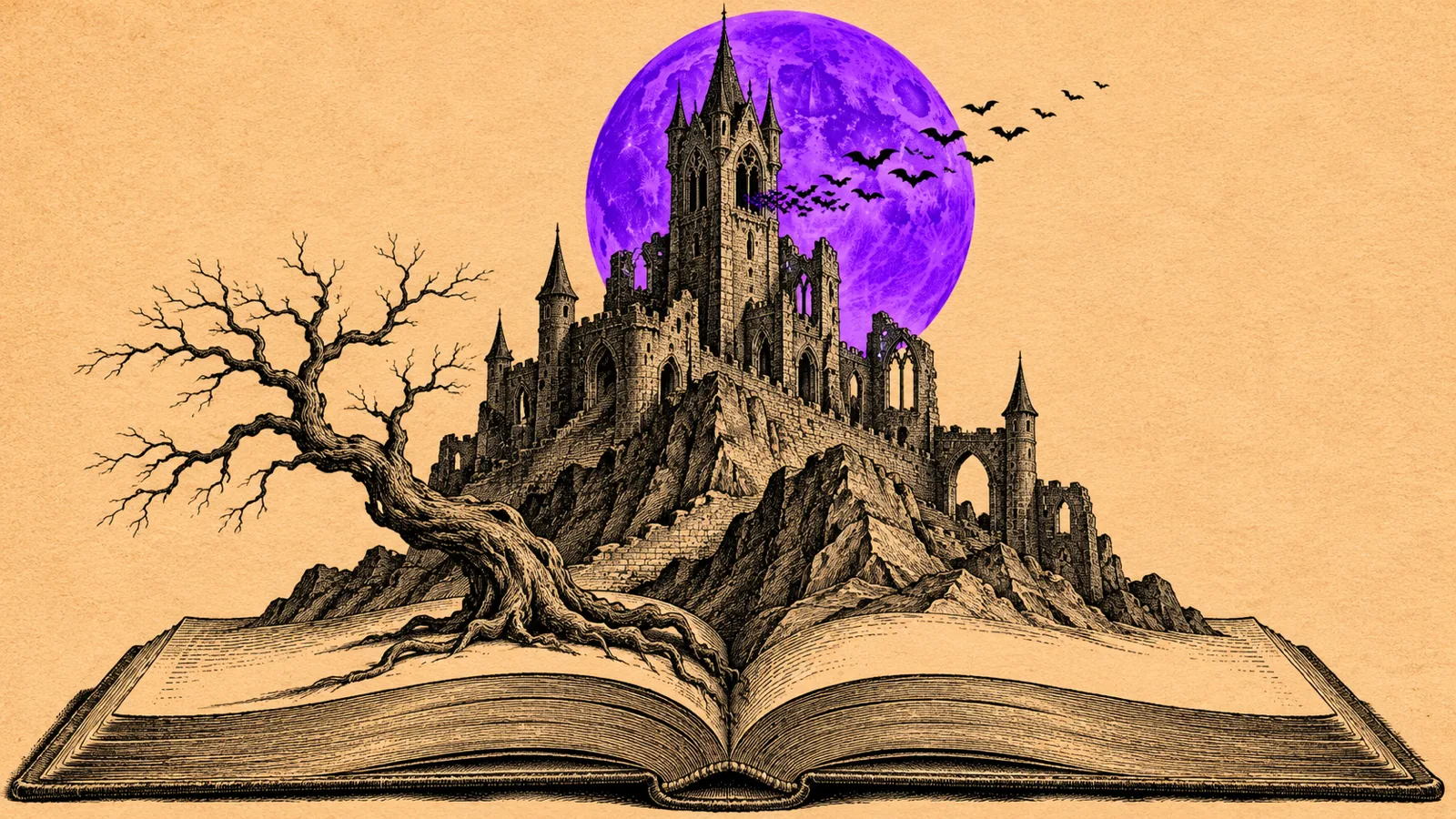
The best public domain horror and gothic fiction includes Dracula, Frankenstein, Carmilla, The Turn of the Screw, Poe's tales and M. R. James's ghost stories, all free to read and hear in the US. Start with Jekyll and Hyde (about 3 hours) or Carmilla, then go to Dracula.
The best public domain horror and gothic fiction covers 165 years of fear, from The Castle of Otranto (1764) to H. P. Lovecraft's The Dunwich Horror (1929). Every book below is free to read in the US, and each has a free audiobook on LibriVox, recorded by volunteers.
We've grouped the 20 picks by era and listed the running time of each recording, so you can pick a 25-minute story for tonight or a 30-hour gothic marathon for winter. Prefer a single natural voice with the text on screen? Speechly reads free public-domain books aloud; more on that at the end.
The best public domain horror and gothic fiction at a glance
| # | Book | Author | Year | Free audiobook |
|---|---|---|---|---|
| 1 | The Castle of Otranto | Horace Walpole | 1764 | 3 h 58 min |
| 2 | The Mysteries of Udolpho | Ann Radcliffe | 1794 | 32 h |
| 3 | The Monk | Matthew Lewis | 1796 | 16 h 18 min |
| 4 | Frankenstein | Mary Shelley | 1818 | 7 h 59 min |
| 5 | Melmoth the Wanderer | Charles Maturin | 1820 | 28 h 39 min |
| 6 | The Legend of Sleepy Hollow | Washington Irving | 1820 | 1 h 23 min |
| 7 | Tales of horror | Edgar Allan Poe | 1839–46 | 5 h 9 min |
| 8 | Carmilla | J. Sheridan Le Fanu | 1872 | 3 h 18 min |
| 9 | Strange Case of Dr Jekyll and Mr Hyde | Robert Louis Stevenson | 1886 | 3 h 8 min |
| 10 | The Picture of Dorian Gray | Oscar Wilde | 1890–91 | 6 h 12 min |
| 11 | The Great God Pan | Arthur Machen | 1894 | 2 h |
| 12 | The King in Yellow | Robert W. Chambers | 1895 | 4 h 38 min (part 1) |
| 13 | Dracula | Bram Stoker | 1897 | 16 h 31 min |
| 14 | The Beetle | Richard Marsh | 1897 | 11 h 56 min |
| 15 | The Turn of the Screw | Henry James | 1898 | 5 h 43 min |
| 16 | The Monkey's Paw | W. W. Jacobs | 1902 | 25 min |
| 17 | Ghost Stories of an Antiquary | M. R. James | 1904 | 10 h 7 min |
| 18 | The Willows | Algernon Blackwood | 1907 | 2 h 22 min |
| 19 | The Phantom of the Opera | Gaston Leroux | 1910 | 9 h 10 min |
| 20 | The Call of Cthulhu | H. P. Lovecraft | 1928 | 1 h 25 min |
Times are for the linked LibriVox versions, checked on November 18, 2026. Most titles have other versions, including full-cast dramatic readings of Dracula and Frankenstein.
The first gothic novels (1764–1820)
These books built the genre: crumbling castles, wicked monks, persecuted heroines and secrets buried in the family past.
1. The Castle of Otranto (1764), Horace Walpole
Why it's here: it's usually called the first gothic novel. Walpole first passed it off as a translation of an old Italian manuscript; the second edition admitted he wrote it and added the subtitle A Gothic Story. A giant helmet crashes into the courtyard and crushes the heir on his wedding day, and it only gets stranger.
Good to know: it's short, absurd in places and very influential. Listen in an evening.
2. The Mysteries of Udolpho (1794), Ann Radcliffe
Why it's here: one of the most popular novels of the 1790s. Orphaned Emily St. Aubert is shut up in a remote Italian castle by the sinister Montoni. Radcliffe's trick is the "explained supernatural": the terrors usually turn out to have rational causes.
Good to know: at 32 hours, it's for patient listeners. Jane Austen's Northanger Abbey is a loving parody of it; see Jane Austen's novels in order.
3. The Monk (1796), Matthew Lewis
Why it's here: Radcliffe's opposite. Lewis, who published it at 20, gives you real demons, a pious Madrid monk's fall into lust and murder, and a bleeding ghost nun. It caused a scandal.
Good to know: graphic for its time and still shocking in places.
4. Frankenstein (1818), Mary Shelley
Why it's here: the novel that started as a ghost-story challenge among Shelley, Lord Byron and John Polidori at Lake Geneva in 1816, and is often called the first science fiction novel. The creature is articulate, wounded and terrifying.
Good to know: the linked recording uses the original 1818 text. It also leads our list of the best public domain science fiction. Polidori's story from the same summer, "The Vampyre" (1819), created the aristocratic vampire.
5. Melmoth the Wanderer (1820), Charles Maturin
Why it's here: a man who sold his soul for 150 extra years searches for someone desperate enough to take the bargain off his hands. The stories nest inside one another like boxes. Maturin was Oscar Wilde's great-uncle, and Wilde used the name "Sebastian Melmoth" after prison.
Good to know: long and intricate; the last great novel of the first gothic wave.
6. The Legend of Sleepy Hollow (1820), Washington Irving
Why it's here: America's best-known ghost story. Schoolmaster Ichabod Crane rides home through the Hudson Valley and meets the Headless Horseman. It's more comic than frightening, which makes it a good October pick for all ages.
Victorian horror (1839–1898)
The gothic moved from foreign castles into English homes, laboratories and London streets, and the modern monster took shape.
7. Edgar Allan Poe's tales (1839–1846)
Why it's here: Poe perfected the short horror story. The linked collection of 12 includes "The Tell-Tale Heart," "The Fall of the House of Usher," "The Masque of the Red Death," "The Cask of Amontillado" and "The Pit and the Pendulum," plus "The Raven."
Good to know: each story takes 15 to 45 minutes. Start with "The Tell-Tale Heart," under 14 minutes in this recording.
8. Carmilla (1872), J. Sheridan Le Fanu
Why it's here: a female vampire novella written 25 years before Dracula. A lonely young woman in a remote Austrian castle forms an intense friendship with a mysterious guest, while local girls start dying. It first appeared in a magazine and was collected in In a Glass Darkly.
Good to know: about 3 hours, and one of the best first listens on this list.
9. Strange Case of Dr Jekyll and Mr Hyde (1886), Robert Louis Stevenson
Why it's here: you know the twist, yet it still works. The story is told mostly through the lawyer Utterson, trying to understand why his respectable friend protects a brutal man named Hyde.
Good to know: a little over 3 hours. The best quick classic for horror beginners.
10. The Picture of Dorian Gray (1890–91), Oscar Wilde
Why it's here: a beautiful young man stays young while his portrait ages and rots with every sin. Wilde first published it in Lippincott's Monthly Magazine in 1890, then expanded it from 13 chapters to 20 for the 1891 book.
Good to know: the linked recording is the 13-chapter magazine text; LibriVox also has the 20-chapter 1891 version at 9 h 30 min.
11. The Great God Pan (1894), Arthur Machen
Why it's here: a doctor's experiment on a young woman's brain lets her glimpse something ancient, and years later a string of London society men die in horror. It's a key ancestor of modern cosmic horror.
Good to know: 2 hours, told in fragments; let the pieces come together.
12. The King in Yellow (1895), Robert W. Chambers
Why it's here: the first four stories circle a forbidden play that drives its readers mad. Lovecraft admired it, and its lost city of Carcosa turned up in the first season of True Detective.
Good to know: the horror is in the first half; the linked part 1 covers it.
13. Dracula (1897), Bram Stoker
Why it's here: the vampire novel. Told through diaries, letters, telegrams and newspaper clippings, it begins with Jonathan Harker's trip to the Count's castle in Transylvania and ends in a chase across Europe.
Good to know: the many narrators make it especially good as a full-cast recording; try the LibriVox dramatic reading at 18 hours.
14. The Beetle (1897), Richard Marsh
Why it's here: published the same year as Dracula, and a popular success at the time. A shape-shifting creature from Egypt stalks a rising London politician, and four narrators each tell part of the story.
Good to know: pulpier than Stoker and full of the prejudices of its time.
15. The Turn of the Screw (1898), Henry James
Why it's here: a governess at a country house becomes convinced that two ghosts are after the children in her care. Or is she imagining them? Readers have argued for over a century.
Good to know: the sentences are dense. Many listeners find it clearer at a slightly slower speed.
Edwardian ghosts and weird fiction (1902–1929)
16. The Monkey's Paw (1902), W. W. Jacobs
Why it's here: a mummified paw grants three wishes, each with a terrible price. It's one of the most anthologized horror stories in English, and at 25 minutes it's the quickest pick here.
17. Ghost Stories of an Antiquary (1904), M. R. James
Why it's here: the gold standard of the English ghost story. James, a Cambridge scholar, wrote them to read aloud to friends at Christmas, which is why they sound so good spoken. Try "Oh, Whistle, and I'll Come to You, My Lad" and "Casting the Runes."
Good to know: the linked solo recording covers this book and its 1911 sequel, More Ghost Stories: 15 stories in 10 hours.
18. The Willows (1907), Algernon Blackwood
Why it's here: two friends canoeing down the Danube camp on a tiny island of willows and slowly realize something vast is noticing them. It's quiet, eerie and often named among the best weird tales ever written.
Good to know: a little over 2 hours, perfect for one long walk.
19. The Phantom of the Opera (1910), Gaston Leroux
Why it's here: a masked genius haunts the Paris Opera and the young soprano Christine Daaé. The original is darker, stranger and funnier than the musical.
Good to know: this is an English translation of the French novel, and reads like a gothic thriller.
20. The Call of Cthulhu (1928), H. P. Lovecraft
Why it's here: the story that launched the Cthulhu mythos, assembled from a dead professor's notes about a cult and something sleeping under the Pacific. It entered the US public domain on January 1, 2024.
Good to know: follow it with "The Colour Out of Space" (1927, 1 h 22 min) and "The Dunwich Horror" (1929, 1 h 56 min). Lovecraft's fiction includes racist views that are part of the work, not a side note.
More worth your time
- Wieland (1798), Charles Brockden Brown: an early American gothic about a family, a voice and religious mania.
- Uncle Silas (1864), J. Sheridan Le Fanu: an heiress, a sinister uncle and a locked-room mood.
- "The Yellow Wallpaper" (1892), Charlotte Perkins Gilman: a short, devastating story of a woman confined to a room.
- The Jewel of Seven Stars (1903), Bram Stoker: Stoker's mummy novel.
- The Woman in White (1860), Wilkie Collins: a gothic thriller that also opens our list of the best public domain mystery novels.
Which public domain horror should you start with?
Start with Jekyll and Hyde or Carmilla, both around 3 hours, then go to Dracula.
| If you want… | Start with |
|---|---|
| A story tonight (under 1 hour) | The Monkey's Paw, "The Tell-Tale Heart" |
| Quiet dread | The Turn of the Screw, Ghost Stories of an Antiquary |
| A classic monster | Dracula, Frankenstein, Carmilla |
| Cosmic, nameless horror | The Willows, The Great God Pan, The Call of Cthulhu |
| Gothic romance and castles | The Castle of Otranto, The Mysteries of Udolpho |
| Something for the whole family | The Legend of Sleepy Hollow |
What horror isn't public domain yet?
In the US, books published in 1930 or earlier are public domain as of 2026, according to Duke's Center for the Study of the Public Domain. Each January 1, another year joins: works from 1931 follow on January 1, 2027, under the 95-year rule, which should include Universal's 1931 films of Dracula and Frankenstein. The novels themselves have been free for a century.
Still under copyright in the US:
- Rebecca (1938), Daphne du Maurier: free in 2034.
- The Haunting of Hill House (1959), Shirley Jackson: decades away.
- Lovecraft's later stories (1931 onward): their status depends on publication and renewal details, so check each one.
Our guide to books entering the public domain tracks each new year.
Is it public domain outside the US?
For this list, almost certainly yes. Many countries protect books for 70 years after the author's death, and every author above died by 1951, so their work became free by January 1, 2022 under that rule. LibriVox follows US law and asks listeners elsewhere to check their own country's rules. Modern translations and introductions can still be under copyright even when the original is free.
Where to read and listen to these books for free
- Audiobooks: every pick above is on LibriVox, free to stream or download. See where to find free audiobooks legally for library apps and other sources.
- eBooks: Standard Ebooks and Project Gutenberg have free editions of most titles here.
How to listen with Speechly
Volunteer readers vary, and a 30-hour gothic novel with a different reader every chapter can be hard to settle into. Speechly reads public-domain eBooks in one natural AI voice:
- Download Speechly for iPhone and iPad or Android. You can start without an account.
- Open a book from the built-in catalog of 75,000+ free public-domain books, or import an EPUB from Standard Ebooks or Project Gutenberg.
- Choose from 25+ voices, then set the speed anywhere from 0.5× to 2×.
- Follow the word-by-word highlighting, or lock your phone and listen in the dark.
On a computer, select any passage and press ⌘E on Mac or Alt+R on Windows to hear it read aloud. Speechly saves your place across devices and can play calming focus sounds under your reading, though for these books you may prefer silence. The free plan includes two text-to-speech files with premium voices; Premium is $14.99/month or $139/year for unlimited listening on every device.
Start with Carmilla tonight
Pick a short one first: Carmilla or Jekyll and Hyde in an evening, then Dracula across a couple of weeks. Download Speechly to hear any of these classics in a natural voice, with the text in front of you.
Frequently asked questions
Is Dracula in the public domain?
Yes. Bram Stoker's novel was published in 1897 and Stoker died in 1912, so it is public domain in the US and in countries that protect books for 70 years after the author's death. Later adaptations, such as specific films, can still be under copyright.
Is H. P. Lovecraft in the public domain?
Much of it is. In the US, his stories published through 1930 are public domain, including The Call of Cthulhu (1928) and The Dunwich Horror (1929). Lovecraft died in 1937, so his work has been free since 2008 in countries that use the life-plus-70-years rule.
What was the first gothic novel?
Horace Walpole's The Castle of Otranto, published in December 1764, is usually called the first gothic novel. Its second edition was the first to call itself A Gothic Story.
What is the difference between gothic fiction and horror?
Gothic fiction is a style built on gloomy settings, family secrets and the past haunting the present, and it can be romantic or even comic. Horror is defined by the fear it aims to create. Most early horror grew out of the gothic, which is why the two are usually shelved together.
What is the scariest public domain book?
It depends on what scares you. The Turn of the Screw and M. R. James's ghost stories are the best for slow dread, The Willows and The Colour Out of Space for cosmic unease, and Dracula for sustained suspense.
Can I record or adapt a public domain horror story?
Yes, in the US you can record, adapt or publish any work that is public domain there, which is how LibriVox makes its free recordings. Check your own country's rules if you live elsewhere, and avoid copying newer material such as modern translations, introductions or film designs.
Listen with Speechly
Natural AI voices on iPhone, iPad, Android, Mac and Windows, with word highlighting and your place saved on every device. Free to download.
Prices and features of other products were checked on November 18, 2026 and can change. Speechly is not affiliated with the other companies named here.
The Best Public-Domain Mystery Novels
The best public domain mystery novels, ranked: 17 free classics by Christie, Hammett, Sayers and Collins, with reading times and free audiobooks.
The Best Public Domain Science Fiction
The best public domain science fiction: 20 free classics from Frankenstein to Philip K. Dick, with reading times, free audiobooks and where to start.
Where to Find Free Audiobooks Legally
Where to find free audiobooks legally: Libby and Hoopla bestsellers with a library card, 21,000+ LibriVox classics, and how to spot pirated copies.