


The Best Public Domain Science Fiction
The best public domain science fiction: 20 free classics from Frankenstein to Philip K. Dick, with reading times, free audiobooks and where to start.
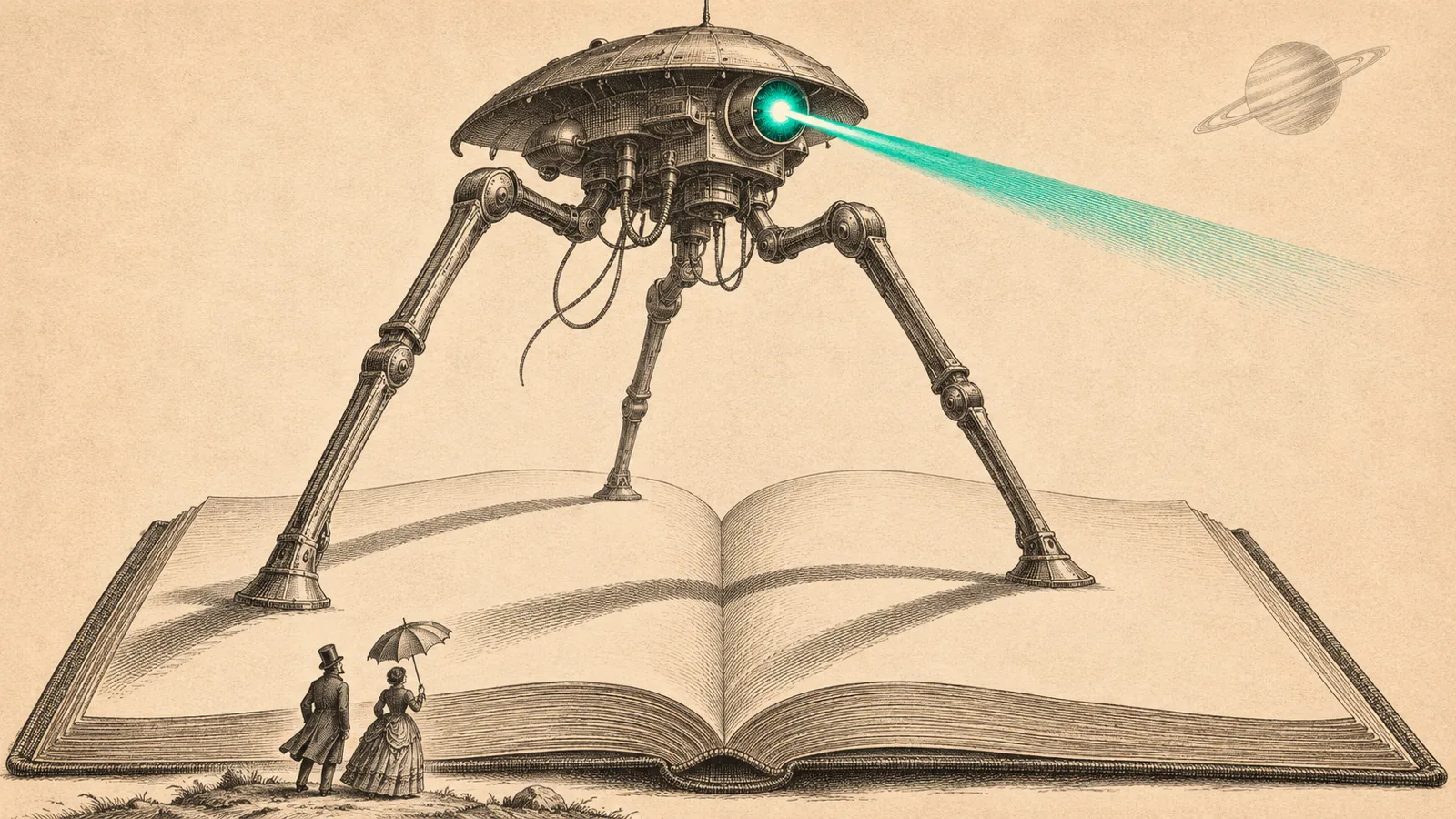
The best public domain science fiction starts with Mary Shelley's Frankenstein, H. G. Wells's The Time Machine and The War of the Worlds, Yevgeny Zamyatin's We and Jules Verne's Twenty Thousand Leagues Under the Sea. All are free in the US as eBooks and LibriVox audiobooks. Start with The Time Machine: about 2 hours to read.
The best public domain science fiction covers more than a century of big ideas, from Mary Shelley's Frankenstein (1818) to Olaf Stapledon's Last and First Men, which became free in the US on January 1, 2026. Time travel, alien invasion, robots, dystopias and space opera all started in books you can now read and hear for nothing.
Here are 20 picks, ranked, with why each matters, how long it takes and where to get it free. Reading times are Standard Ebooks estimates (ours, at the same pace, for single stories in a collection). Listening times are for the first LibriVox recording, checked in November 2026.
The best public domain science fiction at a glance
| # | Book | Author | Big idea | Read | Listen free |
|---|---|---|---|---|---|
| 1 | Frankenstein (1818) | Mary Shelley | Creating life | 4 h 44 min | 8 h 17 min |
| 2 | The Time Machine (1895) | H. G. Wells | Time travel | 1 h 58 min | 4 h 09 min |
| 3 | The War of the Worlds (1898) | H. G. Wells | Alien invasion | 3 h 39 min | 6 h 43 min |
| 4 | We (1924) | Yevgeny Zamyatin | Surveillance state | 3 h 53 min | 6 h 35 min |
| 5 | Twenty Thousand Leagues Under the Sea (1870) | Jules Verne | Submarine voyage | — | 16 h 30 min |
| 6 | The Machine Stops (1909) | E. M. Forster | Life through screens | 44 min | 1 h 12 min |
| 7 | Last and First Men (1930) | Olaf Stapledon | Future history | 7 h | 15 h 21 min |
| 8 | R.U.R. (1920) | Karel Čapek | Robots | — | 1 h 47 min |
| 9 | Early short stories (1952–1954) | Philip K. Dick | War machines, paranoia | 6 h 13 min | 1 h 44 min ("Second Variety") |
| 10 | Herland (1915) | Charlotte Perkins Gilman | Feminist utopia | 3 h 13 min | 5 h 34 min |
| 11 | Metropolis (1926) | Thea von Harbou | The robot city | 4 h 22 min | — |
| 12 | The Last Man (1826) | Mary Shelley | Global pandemic | 10 h 38 min | 18 h |
| 13 | A Princess of Mars (1912) | Edgar Rice Burroughs | Planetary romance | 4 h 04 min | 7 h 10 min |
| 14 | The Island of Doctor Moreau (1896) | H. G. Wells | Remaking animals | 2 h 39 min | 4 h 40 min |
| 15 | Flatland (1884) | Edwin A. Abbott | Extra dimensions | 2 h 02 min | 4 h 14 min |
| 16 | The Lost World (1912) | Arthur Conan Doyle | Living dinosaurs | 4 h 37 min | 8 h |
| 17 | A Martian Odyssey (1934) | Stanley G. Weinbaum | A truly alien alien | 37 min | 2 h 17 min (with a sequel) |
| 18 | The Invisible Man (1897) | H. G. Wells | Invisibility | 2 h 58 min | 4 h 54 min |
| 19 | The Skylark of Space (1928) | E. E. Smith | Space opera | 5 h 07 min | 9 h 23 min |
| 20 | Armageddon 2419 A.D. (1928) | Philip Francis Nowlan | Buck Rogers | 1 h 39 min | 2 h 56 min |
A dash means no Standard Ebooks edition or LibriVox recording; each entry says where else to look.
The essential six
These six set out the genre's core ideas: artificial life, time travel, alien invasion and the surveillance state.
1. Frankenstein (1818), Mary Shelley
Why it's here: the book most often called the first science fiction novel. Victor Frankenstein builds a living creature, then abandons it, and its loneliness turns to revenge. The horror comes from science, not the supernatural.
Good to know: Shelley wrote it for a ghost-story contest with Lord Byron in 1816. The creature is articulate and well-read, nothing like the film monster.
Length and where: about 78,000 words. Free from Standard Ebooks (the revised 1831 text); the LibriVox recording runs about 8¼ hours.
2. The Time Machine (1895), H. G. Wells
Why it's here: the novel that made "time machine" an everyday phrase. A Victorian inventor travels to the year 802,701 and finds humanity split into the gentle Eloi and the underground Morlocks.
Good to know: the final chapters jump millions of years ahead to a dying Earth.
Length and where: about 32,000 words, the shortest full novel here. Free from Standard Ebooks; the LibriVox recording runs about 4 hours.
3. The War of the Worlds (1898), H. G. Wells
Why it's here: the founding alien-invasion story. Martian cylinders land near Woking, southwest of London, and tripod fighting machines armed with a heat-ray tear through the English countryside.
Length and where: about 60,000 words. Free from Standard Ebooks; the first LibriVox recording runs about 6¾ hours.
4. We (1924), Yevgeny Zamyatin
Why it's here: the first great modern dystopia, written before Brave New World and 1984. In the glass-walled One State, citizens have numbers instead of names, and engineer D-503 is building a spaceship until a woman called I-330 makes him doubt everything.
Good to know: Zamyatin wrote it in Russia in 1920–21, but it first appeared in English in 1924, in Gregory Zilboorg's translation. George Orwell reviewed it in 1946, before writing 1984.
Length and where: about 64,000 words. Free from Standard Ebooks; the LibriVox recording runs about 6½ hours.
5. Twenty Thousand Leagues Under the Sea (1870), Jules Verne
Why it's here: the great undersea adventure. Professor Aronnax, his servant Conseil and harpooner Ned Land are captured by the mysterious Captain Nemo and carried around the world aboard the submarine Nautilus.
Good to know: early English translations cut large parts of the book. F. P. Walter's complete 1999 translation is free on Project Gutenberg and is the one LibriVox recorded.
Length and where: the LibriVox recording runs about 16½ hours. Standard Ebooks' edition uses a 1966 translation that is still under US copyright.
6. The Machine Stops (1909), E. M. Forster
Why it's here: a 1909 warning about the internet. People live alone in underground cells, talk through screens and rarely touch the outside world, until the Machine that runs everything starts to fail.
Length and where: about 12,000 words, in Forster's Short Fiction on Standard Ebooks; the LibriVox recording runs 1 h 12 min. For more one-sitting reads, see short classics you can finish in a day.
Robots, dystopias and the future of humanity
7. Last and First Men (1930), Olaf Stapledon
Why it's here: the biggest canvas in science fiction. It's a "future history" told by one of the last humans, covering two billion years and eighteen species of humanity as they rise, fall and move from planet to planet. Arthur C. Clarke and C. S. Lewis were among the writers it influenced.
Good to know: it entered the US public domain on January 1, 2026, and made Duke's Public Domain Day list.
Length and where: about 115,000 words. Free from Standard Ebooks; the LibriVox recording runs about 15 hours.
8. R.U.R. (1920), Karel Čapek
Why it's here: the play that gave the world the word "robot." A factory on a remote island mass-produces artificial workers, and Helena Glory arrives hoping to free them. The uprising that follows set the template for a century of robot stories.
Good to know: Čapek's robots are made of synthetic flesh, not metal. It's a play, so it works especially well as audio.
Length and where: short. Paul Selver's English translation is free on Project Gutenberg, and its LibriVox recording runs 1 h 47 min.
9. Early short stories (1952–1954), Philip K. Dick
Why it's here: free stories by the writer behind Blade Runner. Some of his early magazine stories are public domain in the US because their copyrights were never renewed. Start with "Second Variety," about self-building killer robots on a ruined Earth.
Good to know: Standard Ebooks gathers 13 of them, including "Beyond Lies the Wub," his first published science fiction story, and "The Variable Man." His best-known novels are still under copyright.
Length and where: the Standard Ebooks collection runs about 102,000 words; "Second Variety" alone takes about 55 minutes to read, and its LibriVox recording runs 1 h 44 min.
10. Herland (1915), Charlotte Perkins Gilman
Why it's here: three male explorers find a hidden country where only women have lived for 2,000 years, with no war, poverty or crime. Their assumptions about women collapse one by one, to sharply comic effect.
Length and where: about 53,000 words. Free from Standard Ebooks; the LibriVox recording runs about 5½ hours.
11. Metropolis (1926), Thea von Harbou
Why it's here: the novel behind Fritz Lang's 1927 film, with the same towering city, underground workers and a robot made in the likeness of a woman named Maria. Von Harbou, Lang's wife, also wrote the screenplay.
Length and where: about 72,000 words in the 1927 English translation. Free from Standard Ebooks. LibriVox has no finished recording yet.
12. The Last Man (1826), Mary Shelley
Why it's here: Shelley's other science fiction novel, and one of the first about a global pandemic. A plague spreads across the world in the late 21st century, and narrator Lionel Verney watches humanity dwindle.
Length and where: about 175,000 words, the longest here. Free from Standard Ebooks; the LibriVox recording runs about 18 hours.
Mars, monsters and mind-benders
13. A Princess of Mars (1912), Edgar Rice Burroughs
Why it's here: the book that turned Mars into an adventure playground. Civil War veteran John Carter wakes on Barsoom, where low gravity makes him superhumanly strong, and fights across the planet for Dejah Thoris.
Length and where: about 67,000 words. Free from Standard Ebooks; the LibriVox recording runs about 7 hours.
14. The Island of Doctor Moreau (1896), H. G. Wells
Why it's here: the darkest of Wells's early novels. A shipwrecked man lands on an island where a disgraced scientist surgically reshapes animals into half-human "Beast Folk," and the line between human and animal starts to blur.
Length and where: about 44,000 words. Free from Standard Ebooks; the LibriVox recording runs about 4½ hours. For more scientific horror, see the best public domain horror and gothic fiction.
15. Flatland (1884), Edwin A. Abbott
Why it's here: a geometry lesson disguised as satire. A Square in a two-dimensional world meets a Sphere and must imagine a dimension he can't see.
Length and where: about 34,000 words. Free from Standard Ebooks; the LibriVox recording runs about 4¼ hours.
16. The Lost World (1912), Arthur Conan Doyle
Why it's here: the most purely fun book here. Dinosaurs survive on a South American plateau, and the volcanic Professor Challenger leads an expedition to prove it.
Length and where: about 76,000 words. Free from Standard Ebooks; the LibriVox recording runs about 8 hours.
17. A Martian Odyssey (1934), Stanley G. Weinbaum
Why it's here: the story that showed aliens didn't have to be monsters. A stranded explorer crosses Mars with Tweel, a bird-like Martian whose mind works nothing like ours. Isaac Asimov said it hit the field like an exploding grenade.
Good to know: in 1970, Science Fiction Writers of America members ranked it second only to Asimov's "Nightfall" among stories published before 1965.
Length and where: about 10,000 words, in Weinbaum's Short Fiction on Standard Ebooks. The LibriVox recording pairs it with its sequel, "Valley of Dreams."
18. The Invisible Man (1897), H. G. Wells
Why it's here: a bandaged stranger takes a room at a village inn, and the scientist under the wrappings, Griffin, proves more dangerous than his secret.
Length and where: about 49,000 words. Free from Standard Ebooks; the LibriVox recording runs about 5 hours.
19. The Skylark of Space (1928), E. E. Smith
Why it's here: often called the first space opera. A chemist discovers a metal that can power a ship to other stars, and a ruthless rival steals it.
Length and where: about 84,000 words. Free from Standard Ebooks; the LibriVox recording runs about 9½ hours.
20. Armageddon 2419 A.D. (1928), Philip Francis Nowlan
Why it's here: the debut of Anthony "Buck" Rogers. Trapped in a mine by gas, Rogers sleeps for nearly five centuries and wakes in an occupied America, where he joins the resistance.
Length and where: about 27,000 words, a novella. Free from Standard Ebooks; the LibriVox recording runs about 3 hours.
More worth your time
- The First Men in the Moon (1901), H. G. Wells: an inventor and a bankrupt businessman fly to the Moon and find a civilization underground.
- Little Fuzzy (1962), H. Beam Piper: a prospector on a colony world meets small furry creatures that may be people. A rare 1960s novel that's public domain in the US.
The best public domain science fiction short stories
Most take under an hour to read:
- "The Machine Stops" (#6) and "A Martian Odyssey" (#17): the most influential stories here.
- "Second Variety" and "The Variable Man" (#9): Philip K. Dick at his early best.
- "The Star" (1897) and "The Land Ironclads" (1903), H. G. Wells: a rogue star on a collision course with the solar system, and armored war machines years before the first tanks. Both are in Wells's Short Fiction on Standard Ebooks.
For a deeper dig, Project Gutenberg hosts full issues of the pulp magazine Astounding Stories from 1930 and 1931. The Online Books Page shows that no issue was renewed before October 1933.
Which public domain science fiction should you read first?
Start with The Time Machine: about 2 hours, Wells at his best, and its ideas are still everywhere. Then pick by mood:
- You want ideas that feel current: "The Machine Stops," then We.
- You want adventure: A Princess of Mars, The Lost World or Twenty Thousand Leagues Under the Sea.
- You want robots and AI: R.U.R., then Philip K. Dick's "Second Variety."
- You want one huge, mind-stretching listen: Last and First Men, at about 15 hours on audio.
What science fiction entered the public domain in 2026?
Last and First Men is the standout. In the US, books published before 1978 get at most 95 years of copyright, so each January 1 frees another year: 1930's books on January 1, 2026.
Next up, on January 1, 2027, are works from 1931, including Universal's film Frankenstein with Boris Karloff. Aldous Huxley's Brave New World (1932) follows on January 1, 2028, a date Standard Ebooks already lists. Our guide to books entering the public domain tracks each year.
Dick's and Weinbaum's stories are free for another reason: US works published before 1964 needed a copyright renewal, and many pulp stories never got one.
Is it public domain where you live?
Everything on this list is public domain in the US. In the UK and the EU, copyright on a book lasts 70 years from the end of the year the author died, so dates differ.
| Author | Died | Free in the UK and EU from |
|---|---|---|
| H. G. Wells | 1946 | Already free (2017) |
| Edgar Rice Burroughs | 1950 | Already free (2021) |
| Olaf Stapledon | 1950 | Already free (2021) |
| E. E. Smith | 1965 | January 1, 2036 |
| E. M. Forster | 1970 | January 1, 2041 |
| Philip K. Dick | 1982 | January 1, 2053 |
Shelley, Verne, Abbott and Gilman are free almost everywhere. Translations, like those of We and R.U.R., have their own copyright based on the translator. Standard Ebooks, Project Gutenberg and LibriVox follow US law, so check your local rules first. Our explainer on what public domain books are covers the details.
Where to read and listen to these books for free
- eBooks: Standard Ebooks has carefully proofread EPUBs of 18 of the 20 titles on the main list. Project Gutenberg has most of them too, in EPUB and plain text.
- Audiobooks: LibriVox volunteers have recorded 19 of the 20. Group recordings switch readers between chapters. See where to find free audiobooks legally for more sources.
How to listen with Speechly
When there's no recording, or you want one steady voice with the text in front of you, Speechly reads the eBook aloud:
- Download Speechly for iPhone and iPad or Android. You can start without an account.
- Import an EPUB from Standard Ebooks or Project Gutenberg, or browse the built-in catalog of 75,000+ free public-domain books.
- Pick one of 25+ voices, such as a British English accent for Wells's Surrey, and set the speed anywhere from 0.5× to 2×.
- Follow the word-by-word highlighting through Stapledon's long sentences, or lock your phone and keep listening.
On a Mac, open the EPUB in Speechly and listen from the reading view. On Windows, select text in any app and press Alt+R. Speechly saves your place so you can pick up on any device. The free plan includes two text-to-speech files with premium voices; Premium is $14.99/month or $139/year for unlimited listening.
Start with The Time Machine
The Time Machine takes about 2 hours and costs nothing. Download Speechly and hear the Time Traveller's first journey tonight.
Frequently asked questions
What is the first science fiction novel?
Mary Shelley's Frankenstein (1818) is the book most often called the first science fiction novel, because its monster comes from a scientific experiment rather than magic. Older imaginary voyages, such as Johannes Kepler's Somnium (published 1634), are usually counted as forerunners.
Is Brave New World in the public domain?
Not yet. Aldous Huxley's 1932 novel enters the US public domain on January 1, 2028. In the UK and the EU it stays protected until January 1, 2034, 70 years after the end of the year Huxley died.
Is 1984 by George Orwell in the public domain?
It depends on where you live. In the UK and the EU, Orwell's work has been free since January 1, 2021, because he died in 1950. In the US, Nineteen Eighty-Four (1949) stays under copyright until January 1, 2045.
Are Philip K. Dick's stories in the public domain?
Some of his early short stories are, in the US only, because their magazine copyrights were never renewed. They include "Beyond Lies the Wub," "Second Variety" and "The Variable Man." His best-known novels, including Do Androids Dream of Electric Sheep?, are still under copyright.
What science fiction enters the public domain in 2027?
On January 1, 2027, works published in 1931 join the US public domain. The best-known science fiction title is Universal's film Frankenstein, starring Boris Karloff. Later Frankenstein films and Universal's trademarks are still protected.
Are free science fiction audiobooks legal?
Yes, when the book is in the public domain where you live. LibriVox volunteers record only books that are public domain in the US, and anyone can stream or download them for free. Outside the US, check your country's copyright term first.
Listen with Speechly
Natural AI voices on iPhone, iPad, Android, Mac and Windows, with word highlighting and your place saved on every device. Free to download.
Prices and features of other products were checked on November 18, 2026 and can change. Speechly is not affiliated with the other companies named here.
Books Entering the Public Domain (2027)
The Good Earth, The Waves, Sanctuary, The Glass Key: the books entering the public domain in 2027, the 2026 list, and where to read them all free.
Where to Find Free Audiobooks Legally
Where to find free audiobooks legally: Libby and Hoopla bestsellers with a library card, 21,000+ LibriVox classics, and how to spot pirated copies.
The Best Public-Domain Mystery Novels
The best public domain mystery novels, ranked: 17 free classics by Christie, Hammett, Sayers and Collins, with reading times and free audiobooks.