

What Are Public-Domain Books?
What are public domain books? Books with no copyright. See how the US rules work, famous examples, how to check any title and where to read them free.
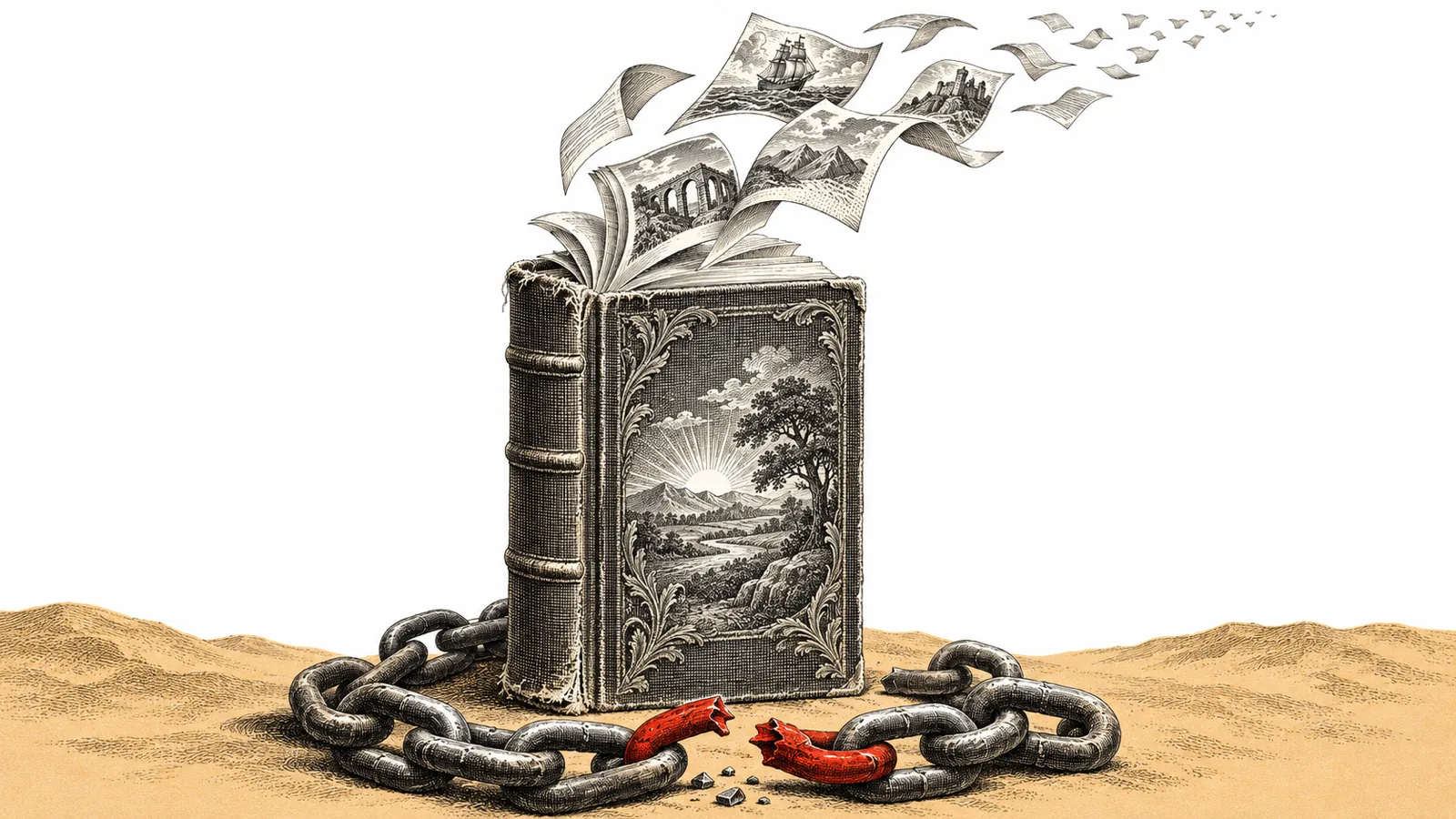
Public domain books are books no longer protected by copyright, so anyone can read, copy, share, adapt or sell them without permission or payment. In the US, that covers every book published before 1931 (before 1932 from January 1, 2027), plus many later books whose copyright was never renewed.
A public-domain book has no copyright owner, so you can read, copy, translate, record, adapt or sell it without asking anyone.
In the US, books published before 1931 are public domain. Books from 1931 to 1977 get up to 95 years from publication, and newer books last for the author's life plus 70 years.
The rules change by country: the UK and most of the EU count 70 years from the author's death, so a book can be free in the US and protected in the UK, or the reverse.
Only the original text is free. A new translation, introduction, illustrations or audiobook recording of the same book can still be under copyright.
Books from 1931, including The Good Earth, Sanctuary and The Waves, enter the US public domain on January 1, 2027.
What are public domain books? They are books whose copyright has ended, or never existed, so they belong to everyone. You can read, copy, share, translate, record, adapt and even sell them without asking permission or paying anyone. In the US, that includes every book published before 1931.
That's why Pride and Prejudice and The Great Gatsby are free to download. Below: the exact rules, famous examples, how other countries differ, the catches, and where to find these books legally. Dates were checked on November 18, 2026; this is an explainer, not legal advice.
What are public domain books, and how do books get there?
A book is in the public domain when no one owns the exclusive rights to copy and publish it. The US Constitution only lets Congress grant copyright "for limited Times" (Article I, Section 8), so every copyright is designed to run out.
A book can end up in the public domain in four ways:
- Its copyright expired. This is how most classics got there.
- It was never copyrighted. In the US, works created by federal government employees as part of their job have no copyright under 17 U.S.C. § 105, so a NASA report or a Supreme Court opinion is free to reuse.
- The owner missed a legal step. Until March 1, 1989, US books generally needed a copyright notice, and books published before 1964 had to be renewed in their 28th year. Many weren't, so their copyright lapsed early.
- The author gave it away. Some creators dedicate their work to the public domain on purpose, often with the Creative Commons CC0 tool. Standard Ebooks does this with its own editing and formatting work.
Examples of famous public domain books
Many of the classics taught in school are public domain in the US. The older ones have been free for generations, including Pride and Prejudice (1813), Frankenstein (1818), Moby-Dick (1851), Alice's Adventures in Wonderland (1865), Little Women (1868), Dracula (1897), The Wonderful Wizard of Oz (1900) and The Secret Garden (1911).
Books from the 1920s arrive one year at a time:
| Became free in the US | Published | Famous books |
|---|---|---|
| 2021 | 1925 | The Great Gatsby, Mrs Dalloway |
| 2022 | 1926 | The Sun Also Rises, Winnie-the-Pooh |
| 2023 | 1927 | To the Lighthouse, The Case-Book of Sherlock Holmes |
| 2024 | 1928 | The House at Pooh Corner |
| 2025 | 1929 | A Farewell to Arms, The Sound and the Fury |
| 2026 | 1930 | As I Lay Dying, The Maltese Falcon |
How long does copyright on a book last?
In the US, it depends mainly on when the book was published. Here are the rules as of 2026, based on Cornell University Library's public domain chart, a widely used library reference:
| When the book was published (US) | Copyright status in 2026 |
|---|---|
| Before 1931 | Public domain |
| 1931–1963, copyright not renewed | Public domain |
| 1931–1963, copyright renewed | 95 years from publication |
| 1964–1977 | 95 years from publication |
| 1978 or later | Author's life + 70 years |
| 1978 or later, anonymous, pen name or work for hire | 95 years from publication or 120 from creation, whichever ends first |
| Never published | Author's life + 70 years (authors who died before 1956 are public domain) |
Copyright runs to the end of the calendar year, so books enter the public domain together every January 1, known as Public Domain Day.
Which books became public domain in 2026?
On January 1, 2026, US copyrights on books published in 1930 expired. Highlights from Duke University's Center for the Study of the Public Domain include:
- As I Lay Dying by William Faulkner
- The Maltese Falcon by Dashiell Hammett
- The Murder at the Vicarage by Agatha Christie, the first Miss Marple novel
- The first four Nancy Drew mysteries, starting with The Secret of the Old Clock
- Swallows and Amazons by Arthur Ransome
- Vile Bodies by Evelyn Waugh and Strong Poison by Dorothy L. Sayers
Next up are books from 1931, including Pearl S. Buck's The Good Earth, Faulkner's Sanctuary, Virginia Woolf's The Waves and Hammett's The Glass Key, on January 1, 2027. For the full list, see books entering the public domain in 2026.
Why did no books enter the public domain from 1999 to 2018?
The 1998 Copyright Term Extension Act stretched copyright on 1923–1977 works to 95 years. As a result, no published works entered the US public domain between 1999 and 2018. The yearly flow restarted in 2019, according to Duke's 2021 report.
Is a public-domain book free everywhere?
No. Copyright is national, and the law that applies is the law where you use the book. Most countries count from the author's death, not the publication date:
- Life plus 70 years: the UK, most of the EU, Russia and most of South America, per The Public Domain Review. Authors who died in 1955, such as Thomas Mann, became public domain there in 2026.
- Life plus 50 years: most countries in Africa and Asia.
- Canada: moved from life plus 50 to life plus 70 on December 30, 2022, without reviving copyrights that had already expired.
- Mexico: life plus 100 years, the longest term in the world according to CISAC.
The same book can switch places depending on where you are:
| Book | Published | Author died | Free in the US | Free in the UK |
|---|---|---|---|---|
| The Great Gatsby | 1925 | 1940 | 2021 | 2011 |
| Winnie-the-Pooh | 1926 | 1956 | 2022 | 2027 |
| Cakes and Ale | 1930 | 1965 | 2026 | 2036 |
| Nineteen Eighty-Four | 1949 | 1950 | 2045 | 2021 |
That's why Project Gutenberg says its books are public domain in the US and asks readers elsewhere to check their own country's law before using them.
What's free in a public-domain book, and what isn't?
Only the original text is free. Anything someone added later can have its own copyright:
- Translations. A translation is a new work. Franz Kafka's The Castle was published in German in 1926, but Willa and Edwin Muir's 1930 English translation only became public domain in the US in 2026.
- Introductions, notes and illustrations. In a modern annotated edition, the novel's text is public domain, but the new essays, footnotes and artwork are not.
- Audiobook recordings. A recording has its own copyright and its own clock. US sound recordings published from 1923 to 1946 get a 100-year term, so only 1925 recordings entered the public domain in 2026. A professional narration of Jane Eyre recorded last year is fully protected. LibriVox is the exception: its volunteers record public-domain books and release the audio into the public domain.
- Later versions of characters. Only what appears in the public-domain book is free. The 1926 Winnie-the-Pooh is public domain in the US, but Tigger first appeared in 1928, so he stayed protected until 2024. Disney's versions are still Disney's.
- Trademarks. A character's name or logo can also be a trademark, which lasts as long as it's in use. It doesn't stop you republishing the book, but it can limit using the name to brand products.
- Special exceptions. A 1988 UK law gives Great Ormond Street Hospital's charity a royalty from Peter Pan in perpetuity, whenever the play or an adaptation of it is performed, published commercially or broadcast in the UK.
Courts have backed this line. When Arthur Conan Doyle's estate demanded a license fee for a new Sherlock Holmes anthology, the Seventh Circuit ruled in Klinger v. Conan Doyle Estate (2014) that elements from the out-of-copyright stories were free for public use. Since 2023, every Holmes story is public domain in the US, as our Sherlock Holmes reading order explains.
How do you know if a book is in the public domain?
Work through these steps in order. Most classics are settled at step 2.
- Find the first publication date and country. Check the copyright page of an early edition or a library catalog record, not a modern reprint.
- Published before 1931? It's public domain in the US (before 1932 from January 1, 2027).
- Published in the US from 1931 to 1963? Check whether the copyright was renewed in its 28th year. Search the renewal records for the publication year plus 27 and plus 28; the Online Books Page's guide to copyright renewals explains where to look. No renewal usually means public domain, but some foreign books had their US copyright restored in 1996.
- Published from 1964 onward? Renewal became automatic, so assume it's protected for 95 years (or life plus 70 for books from 1978).
- Outside the US? Add 70 years (or your country's term) to the author's year of death. The book is free on January 1 of the following year.
- Check the edition. Make sure the translation, introduction and illustrations in your copy are also public domain.
If you plan to publish or sell something based on a book, the Online Books Page suggests contacting the author's estate or last publisher, or paying the Copyright Office or a search firm to check the records. For a commercial project, ask a copyright lawyer.
What can you do with a public-domain book?
Anything you like, because there's no copyright to infringe. You can:
- Read it, print it and share copies with anyone
- Turn it into an audiobook, podcast, play or film
- Translate, abridge or modernize it
- Write a sequel or fan fiction using its characters as they appear in it
- Publish and sell your own edition
The catch with selling is that anyone else can sell the same text. Amazon KDP may refuse public-domain content that's already available on Amazon or other sites, and may ask for proof that a text is public domain. If a free version is already in its store, it only accepts a differentiated edition (translated, annotated, or with 10 or more original illustrations) labeled "(Translated)", "(Annotated)" or "(Illustrated)" in the title field.
Where can you find public domain books for free?
These sources are legal, free and need no account to read or download:
| Source | What you get |
|---|---|
| Project Gutenberg | 75,000+ free eBooks in EPUB, Kindle, HTML and plain text |
| Standard Ebooks | Carefully edited and formatted eBooks, released under CC0 |
| Internet Archive | Scans of old printed books, plus audio |
| HathiTrust | Full-view scans from university libraries |
| Wikisource | Transcribed texts in many languages |
| LibriVox | 21,000+ volunteer-read audiobooks |
For how the biggest library works, read Project Gutenberg explained. If you'd rather hear classics than read them, here are legal places to find free audiobooks and 100 classic books you can listen to for free.
Listen to public-domain books with Speechly
Not every public-domain book has an audiobook, and volunteer recordings vary from reader to reader. Speechly is a text-to-speech reader with a built-in catalog of 75,000+ free public-domain books, so you can pick a classic and listen to it in a natural voice.
- 25+ natural AI voices in eight languages, with word-by-word highlighting as you listen
- Speed from 0.5× to 2×, and your place is saved automatically
- Reads your own downloads, including EPUBs from Project Gutenberg or Standard Ebooks, plus PDFs and photos of printed pages
- Every device: iPhone and iPad, Android, Mac and Windows, with one account
Speechly is free to download, and the free plan includes two text-to-speech files with premium voices, no card required. Premium costs $14.99/month or $139/year for unlimited listening on every device.
Frequently asked questions
Are all books published before 1931 in the public domain?
In the US, yes: anything published before 1931 is public domain as of 2026, and the cutoff moves to 1932 on January 1, 2027. In countries that count from the author's death, an old book can still be protected if its author lived long after publishing it.
Is it legal to download public-domain books?
Yes. Downloading, reading and sharing a public-domain book is legal, and sites like Project Gutenberg, Standard Ebooks and the Internet Archive offer them free. Outside the US, check that the book is public domain in your country too.
Can I sell a public-domain book?
Yes. You can print, publish and sell a public-domain text, but so can everyone else. Some stores add rules: if a free version is already in Amazon's store, KDP only accepts editions that are translated, annotated or have 10+ original illustrations.
Is an out-of-print book in the public domain?
Not necessarily. Out of print only means no one is selling new copies; the copyright can still run for decades. Check the publication date and renewal status instead.
Is Sherlock Holmes in the public domain?
Yes, in the US. The last Sherlock Holmes stories, from The Case-Book of Sherlock Holmes, entered the US public domain on January 1, 2023, so all of Arthur Conan Doyle's Holmes stories are now free to use there.
When will Harry Potter be in the public domain?
Not for many decades. Books written since 1978 are protected for the author's life plus 70 years in the US, the UK and the EU, and J.K. Rowling is alive.
What is the difference between public domain and Creative Commons?
A Creative Commons license keeps the copyright in place and lets you use the work on stated terms, such as crediting the author. Public domain means no copyright at all. The CC0 tool is the exception: it waives rights so the work is effectively public domain.
Listen with Speechly
Natural AI voices on iPhone, iPad, Android, Mac and Windows, with word highlighting and your place saved on every device. Free to download.
Prices and features of other products were checked on November 18, 2026 and can change. Speechly is not affiliated with the other companies named here.
Project Gutenberg Explained
Project Gutenberg explained: where its 78,000+ free eBooks come from, whether it's legal and safe where you live, and how to read or listen to them.
Books Entering the Public Domain (2027)
The Good Earth, The Waves, Sanctuary, The Glass Key: the books entering the public domain in 2027, the 2026 list, and where to read them all free.
Where to Find Free Audiobooks Legally
Where to find free audiobooks legally: Libby and Hoopla bestsellers with a library card, 21,000+ LibriVox classics, and how to spot pirated copies.