


Charles Dickens's Books in Order
Charles Dickens's books in order: all 15 novels with serial dates, word counts and free audiobooks, plus his Christmas books and which one to read first.
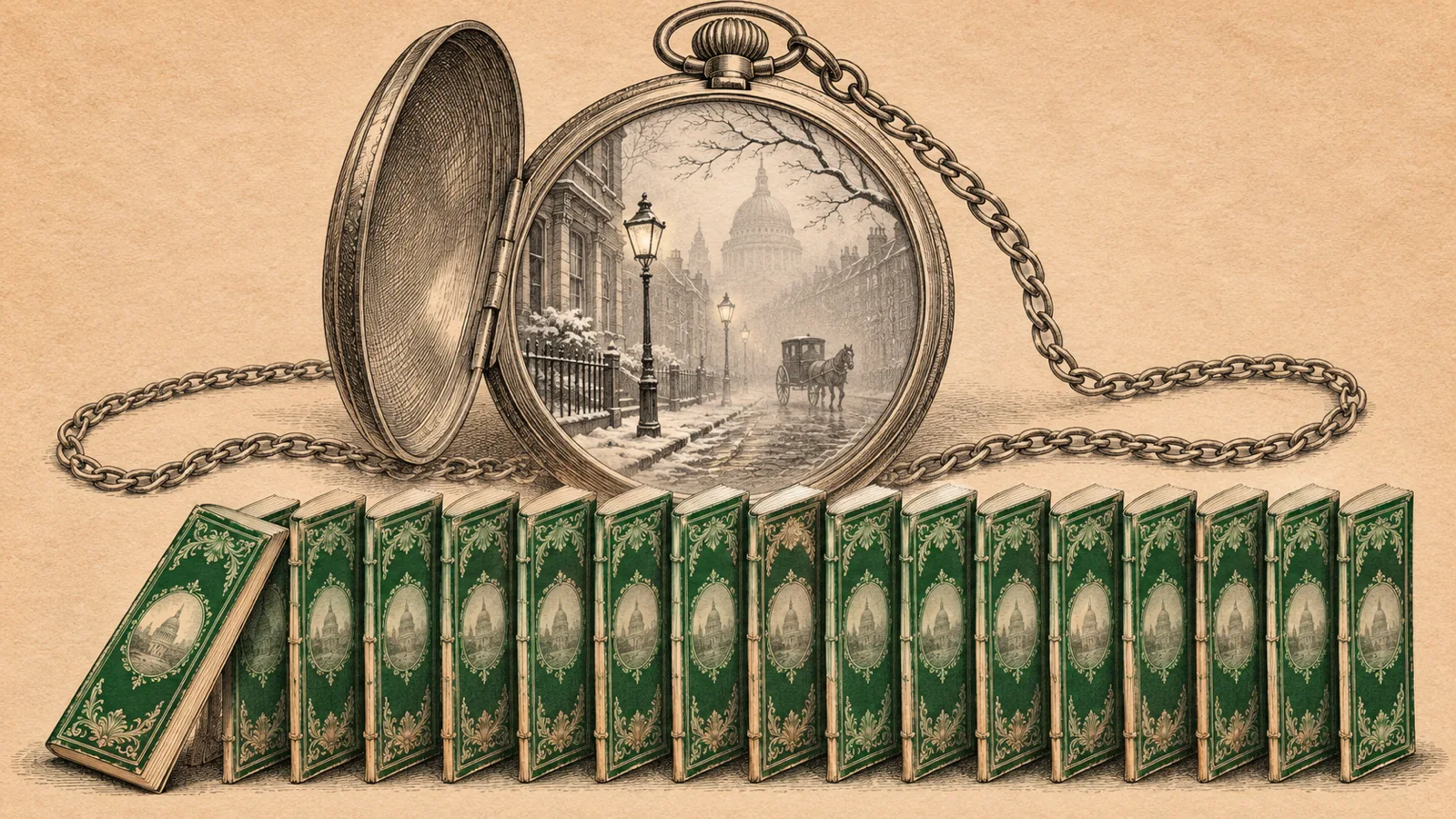
Charles Dickens's books in order: Pickwick Papers (1836), Oliver Twist (1837), Nicholas Nickleby (1838), Old Curiosity Shop (1840), Barnaby Rudge (1841), Martin Chuzzlewit (1843), Dombey and Son (1846), David Copperfield (1849), Bleak House (1852), Hard Times (1854), Little Dorrit (1855), A Tale of Two Cities (1859), Great Expectations (1860), Our Mutual Friend (1864) and the unfinished Edwin Drood (1870).
Dickens wrote 15 novels, the last left half-finished when he died in June 1870.
Every novel first came out in installments, monthly or weekly, so the dates below are when each serial began.
The novels stand alone; start with A Christmas Carol or Great Expectations rather than at the beginning.
All of his work is public domain, with free eBooks from Standard Ebooks and free audiobooks from LibriVox.
Charles Dickens's books in order of publication run from The Pickwick Papers (1836) to The Mystery of Edwin Drood (1870), which he left unfinished when he died. That's 15 novels in 34 years, every one of them first sold in installments, plus five Christmas books and a shelf of travel writing and sketches.
Below you'll find the full list with serial dates, word counts and free audiobook links, what each book is about, the Christmas books, and the best order for a first-time reader. Serial dates come from the Victorian Web's Dickens chronology. If you'd rather hear Dickens in one steady voice with the words highlighted, Speechly reads free public-domain eBooks aloud; details near the end.
Charles Dickens's books in order: quick list
| # | Novel | First serialized | Words | Free audiobook |
|---|---|---|---|---|
| 1 | The Pickwick Papers | Apr 1836 – Nov 1837 | 302,000 | 32 h |
| 2 | Oliver Twist | Feb 1837 – Apr 1839 | 158,000 | 17 h 1 min |
| 3 | Nicholas Nickleby | Apr 1838 – Oct 1839 | 325,000 | 34 h |
| 4 | The Old Curiosity Shop | Apr 1840 – Feb 1841 | 219,000 | 23 h 24 min |
| 5 | Barnaby Rudge | Feb – Nov 1841 | 255,000 | 24 h 17 min |
| 6 | Martin Chuzzlewit | Jan 1843 – Jul 1844 | 338,000 | 33 h 44 min |
| 7 | Dombey and Son | Oct 1846 – Apr 1848 | 351,000 | 40 h 22 min |
| 8 | David Copperfield | May 1849 – Nov 1850 | 357,000 | 35 h 41 min |
| 9 | Bleak House | Mar 1852 – Sep 1853 | 355,000 | 43 h 30 min |
| 10 | Hard Times | Apr – Aug 1854 | 103,000 | 10 h 55 min |
| 11 | Little Dorrit | Dec 1855 – Jun 1857 | 339,000 | 36 h 10 min |
| 12 | A Tale of Two Cities | Apr – Nov 1859 | 136,000 | 15 h |
| 13 | Great Expectations | Dec 1860 – Aug 1861 | 185,000 | 20 h 26 min |
| 14 | Our Mutual Friend | May 1864 – Nov 1865 | 326,000 | 33 h 26 min |
| 15 | The Mystery of Edwin Drood | Apr – Sep 1870 (unfinished) | 96,000 | 12 h 21 min |
Word counts are rounded from the Standard Ebooks editions. Listening times are for the LibriVox recordings linked; most novels have two to five other versions, so pick another if a reader doesn't suit you. All 15 add up to about 412 hours.
Charles Dickens's books in order of publication
1. The Pickwick Papers (1836–37)
The story: the kindly, naive Mr. Pickwick and three friends travel around England reporting on the people they meet. It's loose, episodic and very funny, and it became a craze once Sam Weller, Pickwick's sharp-tongued servant, turned up in the fourth monthly number.
Read it if: you like comic road trips. Dip in and out; the plot barely matters.
2. Oliver Twist (1837–39)
The story: a workhouse orphan who dares to ask for more runs away to London and falls in with Fagin's gang of pickpockets, the Artful Dodger, Nancy and the brutal Bill Sikes.
Read it if: you want a fast, dark crime story. Be aware that the portrayal of Fagin draws on antisemitic stereotypes; Dickens cut many of the references to "the Jew" in later editions.
3. Nicholas Nickleby (1838–39)
The story: left penniless, Nicholas takes a job at Dotheboys Hall, a cruel Yorkshire boarding school run by Wackford Squeers, then joins a traveling theater company while his scheming uncle Ralph plots against his family. Dickens researched the Yorkshire schools himself in early 1838.
Read it if: you want a big-hearted adventure with a clear hero and villain.
4. The Old Curiosity Shop (1840–41)
The story: young Nell Trent and her gambling-addicted grandfather flee London and the grotesque moneylender Daniel Quilp, wandering across England. It ran weekly in Dickens's own magazine, Master Humphrey's Clock.
Read it if: you enjoy Victorian melodrama at full volume. Quilp is one of his great villains.
5. Barnaby Rudge (1841)
The story: Dickens's first historical novel, set around the anti-Catholic Gordon Riots that tore through London in 1780. Its simple-hearted hero has a talking pet raven, Grip, based on Dickens's own raven and often cited as a spark for Poe's "The Raven."
Read it if: you like crowd scenes and history. It's the least read of the 15, so save it for later.
6. Martin Chuzzlewit (1843–44)
The story: a novel about selfishness, following young Martin to America and back. It gave English two famous comic creations, the hypocrite Seth Pecksniff and the gin-loving nurse Sarah Gamp, and its American chapters satirize the country Dickens toured in 1842.
Read it if: you want Dickens at his most satirical.
7. Dombey and Son (1846–48)
The story: proud merchant Paul Dombey cares only that his business pass to his son, and neglects his loving daughter, Florence. The new railways cutting through London run through the book.
Read it if: you want to see Dickens move from episodes to a tightly planned novel. Many readers consider it the start of his mature period.
8. David Copperfield (1849–50)
The story: David tells his own life, from a happy early childhood and a cruel stepfather to work in a London warehouse, school, love, and success as a writer. The cast includes the always-hopeful Mr. Micawber and the creeping Uriah Heep.
Read it if: you want the warmest, most personal Dickens. He called it his "favourite child," and much of David's childhood is his own.
9. Bleak House (1852–53)
The story: an endless inheritance case, Jarndyce and Jarndyce, swallows lives in the fog of the Court of Chancery. Half the book is narrated by the orphan Esther Summerson; the other half follows a murder investigated by Inspector Bucket, one of the first detectives in English fiction.
Read it if: you want his masterpiece and have time. It's long, but it plays like a prestige TV series.
10. Hard Times (1854)
The story: in the industrial town of Coketown, schoolmaster Thomas Gradgrind raises his children on facts alone, with miserable results. It ran weekly in Household Words.
Read it if: you want a short, sharp Dickens. At about 103,000 words, it's his shortest finished novel.
11. Little Dorrit (1855–57)
The story: Amy Dorrit was born in the Marshalsea, the London debtors' prison where her father has lived for years. Dickens's own father was imprisoned there in 1824. The book also mocks government red tape through the Circumlocution Office.
Read it if: you liked Bleak House and want more of its scope.
12. A Tale of Two Cities (1859)
The story: London and Paris before and during the French Revolution, with a doctor freed from the Bastille, his daughter, two men who love her and the knitting Madame Defarge. It opened Dickens's new weekly magazine, All the Year Round.
Read it if: you want plot above all. It has a famous opening, a famous last line and almost no comedy.
13. Great Expectations (1860–61)
The story: orphan Pip helps an escaped convict on the marshes, is taken up by the jilted Miss Havisham and her cold ward Estella, then learns he has a secret benefactor. Dickens rewrote the ending after his friend Edward Bulwer-Lytton found the first one too bleak.
Read it if: you want one Dickens novel to stand for all of them. It's tight, funny and moving at about 185,000 words.
14. Our Mutual Friend (1864–65)
The story: a body pulled from the Thames, a fortune made from London's rubbish heaps and a set of characters who all want money. Dickens was carrying part of the manuscript when he survived the Staplehurst rail crash in June 1865, and mentions it in the book's postscript.
Read it if: you want his darkest, most modern novel.
15. The Mystery of Edwin Drood (1870)
The story: in the cathedral town of Cloisterham, choirmaster and secret opium user John Jasper is obsessed with his nephew Edwin's fiancée. Then Edwin vanishes. Dickens died on June 9, 1870, with six of 12 parts published, so the solution died with him.
Read it if: you love an unsolved puzzle. Readers and writers have been inventing endings ever since.
Dickens's Christmas books
A Christmas Carol started a tradition: between 1843 and 1848, Dickens published five short Christmas books, each in time for the holidays. Each is a quick listen.
| Christmas book | Published | Free audiobook |
|---|---|---|
| A Christmas Carol | December 1843 | 3 h 14 min |
| The Chimes | December 1844 | 4 h 18 min |
| The Cricket on the Hearth | December 1845 | 3 h 22 min |
| The Battle of Life | December 1846 | 3 h 29 min |
| The Haunted Man and the Ghost's Bargain | December 1848 | 3 h 44 min |
A Christmas Carol is under 29,000 words, the shortest way into Dickens. LibriVox also has the condensed version Dickens cut for his own public readings, at 1 h 37 min. For the ghost story he wrote later, try "The Signal-Man" (1866), included in Three Ghost Stories.
Dickens's other books
- Sketches by Boz (1836): his first book, short scenes of London life. 22 hours.
- American Notes (1842): his often unflattering account of his first trip to the US. 11 h 12 min.
- Pictures from Italy (1846): a travel book from a year living in Genoa. 7 h 43 min.
- A Child's History of England (1851–53): English history written for his children. 16 h 20 min.
- The Uncommercial Traveller (1860 onward): essays from his night walks and journeys. 15 h 37 min.
Which Charles Dickens book should you read first?
Start with A Christmas Carol to see if you like his voice, then go to Great Expectations. Every novel stands alone, with no shared characters, so you don't need publication order. Here's the order we'd suggest:
- A Christmas Carol: an afternoon's listen, and all of Dickens in miniature.
- Great Expectations: his best-built novel, and the best first full-length one.
- A Tale of Two Cities: pure plot, and short by his standards.
- David Copperfield: the warm, sprawling life story he loved most.
- Bleak House: his masterpiece, once you're used to his length.
- Our Mutual Friend: dark and modern, for when you're hooked.
Or pick by mood:
| If you want… | Read |
|---|---|
| Something short | A Christmas Carol, Hard Times |
| Comedy | The Pickwick Papers, Martin Chuzzlewit |
| A crime story | Oliver Twist, Bleak House, Edwin Drood |
| History and revolution | A Tale of Two Cities, Barnaby Rudge |
| A coming-of-age story | David Copperfield, Great Expectations |
| His biggest social novels | Bleak House, Little Dorrit, Our Mutual Friend |
After Dickens, Jane Austen's novels in order are the natural next author, and our list of the best classic novels to listen to has more.
Is Dickens easier to listen to than to read?
For many people, yes. Dickens wrote for an audience that often heard his books read aloud at home, and from 1858 he toured giving paid public readings of his own work. His long sentences, comic voices and cliffhangers work well spoken.
Three tips:
- Listen in installments. Each novel was built from monthly or weekly parts that end on a hook. A chapter or two a day is close to how Victorians met them.
- Keep a cast list handy. The big novels have dozens of named characters. A quick look at a character list before you start saves confusion later.
- Slow down for the openings. The first chapters introduce most of the cast. Once the plot takes hold, you can speed up.
Where to read or listen to Dickens for free
Dickens died in 1870, so all of his work is public domain worldwide.
- eBooks: Standard Ebooks has carefully formatted editions of all 15 novels and A Christmas Carol; Project Gutenberg has those plus the shorter works. Our guide to listening to Project Gutenberg books explains the formats.
- Audiobooks: LibriVox volunteers have recorded every novel, most several times, in solo and multi-reader versions. See where to find free audiobooks legally for more sources.
How to listen to Dickens with Speechly
A 35-hour novel is a long time to spend with one volunteer reader, and multi-reader versions can change voices every chapter. Speechly reads the eBook in one natural AI voice you choose:
- Download Speechly for iPhone and iPad or Android. You can start without an account.
- Open a novel from the built-in catalog of 75,000+ free public-domain books, or import an EPUB from Standard Ebooks or Project Gutenberg.
- Pick from 25+ voices, including British English, and set the speed from 0.5× to 2×.
- Follow the word-by-word highlighting to keep the characters straight, or lock your phone and keep listening.
Speechly saves your place automatically, so you can start Bleak House on your phone and continue on your Mac or Windows PC, and it estimates how long each book will take. The free plan includes two text-to-speech files with premium voices; Premium is $14.99/month or $139/year for unlimited listening on every device.
Start with A Christmas Carol
Give A Christmas Carol one evening. If you like Scrooge, you'll like Pip, so go straight to Great Expectations next. Download Speechly and listen to the first stave tonight.
Frequently asked questions
How many books did Charles Dickens write?
Charles Dickens wrote 15 novels, 14 finished plus The Mystery of Edwin Drood, which he left half-written. He also wrote five Christmas novellas, starting with A Christmas Carol, two travel books, A Child's History of England, and hundreds of sketches, stories and articles.
Do you need to read Dickens's books in order?
No. Every Dickens novel is a standalone story with its own characters, so you can start anywhere. Reading in publication order is rewarding later, because you can hear his style grow darker and more tightly plotted from Pickwick to Our Mutual Friend.
What is Charles Dickens's shortest novel?
Hard Times is his shortest finished novel, at about 103,000 words, or around 11 hours as an audiobook. If you want something shorter still, A Christmas Carol is a novella of under 29,000 words that takes about 3 hours to listen to.
What is Charles Dickens's longest novel?
David Copperfield is the longest by word count, at about 357,000 words, with Bleak House and Dombey and Son only slightly shorter. Each takes 35 to 45 hours in a full audiobook.
What was Charles Dickens's last book?
The Mystery of Edwin Drood was his last. Six of a planned twelve monthly parts appeared between April and September 1870; Dickens died on June 9, 1870, so nobody knows how the mystery was meant to end.
Which Dickens novel is the most autobiographical?
David Copperfield. Dickens called it his favorite child in the preface to a later edition, and David's months washing bottles in a London warehouse echo Dickens's own childhood job in a boot-blacking factory.
Listen with Speechly
Natural AI voices on iPhone, iPad, Android, Mac and Windows, with word highlighting and your place saved on every device. Free to download.
Prices and features of other products were checked on November 18, 2026 and can change. Speechly is not affiliated with the other companies named here.
Jane Austen's Novels in Order
Jane Austen's novels in order of publication and writing, with dates, word counts, free audiobooks, her unfinished books and which one to read first.
The Best Classic Novels to Listen To
The best classic novels to listen to, from Gatsby to Dracula: 17 picks with why each works by ear, exact run times, star narrators and free versions.
Where to Find Free Audiobooks Legally
Where to find free audiobooks legally: Libby and Hoopla bestsellers with a library card, 21,000+ LibriVox classics, and how to spot pirated copies.