


Dyslexia at Work: Tools and Accommodations
Dyslexia at work, made easier: the accommodations to ask for, free tools for reading and email, your US and UK rights, and what to say to your boss.

Dyslexia at work is best handled with low-cost accommodations: text-to-speech and dictation software, written instructions, agendas before meetings, extra time for reading-heavy tasks and proofreading support. In the US (ADA) and the UK (Equality Act 2010), employers generally have to make reasonable accommodations once you ask, and you only need to explain how dyslexia affects your work.
The accommodations that help most with dyslexia at work cover reading (text to speech), writing (dictation, spelling and grammar tools), meetings (agendas, captions, written follow-ups) and time (realistic deadlines for reading-heavy work).
In the US, the ADA lists reading, learning and concentrating as major life activities and covers employers with 15 or more employees. In the UK, Acas says a worker doesn't need a diagnosis to be considered disabled.
You only have to disclose dyslexia if you want accommodations, and you can describe how it affects your work without sharing assessments or your school history.
Most accommodations are cheap: in JAN's employer survey, 61% cost nothing. In Great Britain, Access to Work grants can pay for assistive software and don't have to be repaid.
Ask in plain words, name the task and the fix, and get what's agreed confirmed in writing. UK tribunal deadlines doubled to 6 months minus 1 day for problems on or after 1 October 2026.
Dyslexia at work usually comes down to a few pressure points: long documents, a full inbox, writing that has to be error-free, and meetings that move faster than your notes. The fixes are mostly simple and cheap: text to speech, dictation, agendas in advance, realistic deadlines and a quiet place to work. In the US and UK, the law can require your employer to provide them once you ask.
If reading load is the hardest part, see how Speechly helps readers with dyslexia.
How does dyslexia affect you at work?
It mostly affects how fast and how comfortably you take in and produce text. Acas says dyslexia "mostly affects reading and writing skills," and lists slow reading and writing, spelling difficulty, forgetting things and trouble concentrating while listening as common effects. It also lists strengths: problem-solving, creative thinking and strong verbal communication (Acas).
You're far from alone. The British Dyslexia Association estimates that 10–15% of the population have dyslexia and/or another specific learning difference.
| Work task | What makes it hard | What helps |
|---|---|---|
| Long reports, policies, contracts | Slow, tiring decoding; losing your place | Text to speech with word highlighting; summaries first |
| Volume; rereading to check meaning | Listening to emails; templates for common replies | |
| Writing reports | Spelling, word-finding, ordering ideas | Dictation, spelling and grammar tools, a proofreading step |
| Meetings | Taking notes while listening | Agenda in advance, captions, written action points |
| Verbal instructions | Long lists are easy to lose | Instructions in writing, checklists |
| Deadlines | Reading takes longer than people expect | Realistic deadlines, notice for big reading tasks |
| Reading aloud or writing live | Pressure in front of others | Material in advance, not being asked cold |
None of this is about ability. It's about how information reaches you.
Is dyslexia a disability at work?
Often, yes, in law, even if you don't think of yourself as disabled. That turns accommodations from a favor into a legal duty.
In the US: the ADA
- The ADA lists "learning, reading, concentrating, thinking, communicating, and working" among major life activities (42 U.S.C. § 12102).
- Whether dyslexia substantially limits you is judged without the benefit of mitigating measures, which the law says include assistive technology and "learned behavioral or adaptive neurological modifications." The workarounds you've built since school don't count against you.
- Title I covers employers with 15 or more employees, plus state and local governments, employment agencies and labor unions (ADA.gov).
In the UK: the Equality Act 2010
- A disability is an impairment with a "substantial" (more than minor or trivial) and "long-term" (12 months or more) negative effect on normal daily activities (GOV.UK).
- Acas says being neurodivergent "will often amount to a disability" under the Act, and that a worker "does not need a diagnosis to be considered disabled" (Acas).
- The duty to make reasonable adjustments applies to all workers, including trainees, apprentices and contract workers, and extends to the recruitment process (GOV.UK).
Outside the US and UK, check your national equality body.
What accommodations help with dyslexia at work?
Ask for the ones that match your hardest tasks. The Job Accommodation Network (JAN), funded by the US Department of Labor, keeps a fuller list for learning disabilities. These come up most for dyslexia:
Reading
- Text-to-speech or screen-reading software for documents, emails and web pages.
- OCR scanning to turn printed pages into text the software can read.
- Extra time to read information and complete tasks (Acas lists this directly).
- Colored overlays or backgrounds, if they help you personally.
- Summaries or key points first on long documents, or a quick talk-through.
Writing
- Speech recognition (dictation) software.
- Word prediction, spelling and grammar tools.
- Proofreading support for documents that go to clients or senior leaders.
- Templates for reports, emails and forms you write often.
- Spoken responses where writing isn't the point of the task.
Meetings, memory and time
- Agendas and papers sent ahead.
- Written instructions and action points after verbal briefings.
- Captions or transcripts in video calls.
- Planners, reminders and checklists, plus realistic deadlines on reading-heavy work.
- A quiet space or noise-canceling headphones; a fixed desk if hot-desking is disruptive.
Hiring, training and reviews
- Extra time, a reader or a spoken alternative on written tests.
- Training materials in advance and in more than one format.
- Adjusted performance and conduct processes (Acas).
For the software side in depth, see the assistive technology for dyslexia guide.
Free tools for dyslexia at work you can use today
You don't have to wait for HR. Most work computers and phones have the basics built in.
| Task | Tool | How to start it |
|---|---|---|
| Hear a Word document | Read Aloud in Word (Windows and Mac) | Review > Read Aloud, or Ctrl+Alt+Space on Windows and Control+Option+Space on Mac (Microsoft) |
| Dictate on Windows | Voice typing | Click in a text box and press Windows key+H; needs an internet connection (Microsoft) |
| Dictate on a Mac | Dictation | Turn it on in System Settings > Keyboard > Dictation, then press the Microphone key or choose Edit > Start Dictation (Apple) |
| Follow a Teams meeting | Live captions | In the meeting, select More actions > Captions (Microsoft) |
| Hear your screen on iPhone | Speak Screen | Turn on Settings > Accessibility > Read & Speak > Speak Screen, then swipe down with two fingers from the top of the screen (Apple) |
Read Aloud in Word needs Office 2019, Office 2021 or Microsoft 365. For your inbox, here's how to make Outlook read emails aloud.
Two habits make them work harder:
- Listen before you send. Hearing your email read back catches missing words and wrong-but-real words a spell checker misses. See how to proofread by listening.
- Read and listen together. Follow the words as the voice reads; slow it down for dense sections.
Listening to work documents with Speechly
Built-in tools each cover one piece: Read Aloud in Word, captions in Teams, Speak Screen on your iPhone. Speechly is a text-to-speech reader app for iPhone, iPad, Android, Mac and Windows that reads documents, PDFs, web pages and selected text with natural AI voices.
- Download Speechly free. The free plan includes two text-to-speech files with premium voices, and no card is required.
- On Windows, select text in any app (an email, a web page, a policy) and press Alt+R. A floating player reads it aloud, and recent readings are saved. Get Speechly for Windows.
- On a Mac, select text in any app and press ⌘E. A small always-on-top mini player reads it.
- For whole files, open a PDF, Word document or EPUB, or paste a link. You can also take a photo of a printed handout or letter and listen to it.
- Follow the word-by-word highlighting, jump to any sentence to hear it again, and set the speed anywhere from 0.5× to 2×.
Your place saves automatically, so you can start a report at your desk and finish it on your phone on the way home, screen locked. On iPhone and iPad it can skip repeating headers and footers in PDFs. Premium ($14.99/month or $139/year) covers every device. Speechly is a reading tool; it works alongside the accommodations your employer provides, not instead of them.
Should I tell my employer I have dyslexia?
You don't have to: Acas says nobody has to tell their employer they're neurodivergent. But to get accommodations, you need to tell someone enough for them to act.
| If you tell | If you don't |
|---|---|
| Your employer has to consider reasonable accommodations | No legal duty to change anything |
| You can explain mistakes before they become a performance issue | Spelling or speed may be misread as carelessness |
| Your manager can plan deadlines and formats around you | You manage everything with your own tools |
| You decide how much detail to share | No risk of stigma, but no support either |
- You control the detail. You don't need to share assessments or your school history; a few sentences like the sample request below are enough.
- Timing is yours. After a job offer, in your first weeks, or when a task comes up. In the US, employers generally can't ask whether you need an accommodation for the job before a conditional job offer (EEOC).
- Ask who will be told. In the US, the EEOC says employers must keep medical information from the accommodation process confidential. Supervisors may be told about necessary work restrictions; coworkers may not be told.
Not sure dyslexia explains what you're noticing? Start with the signs of dyslexia in adults; a qualified assessor can confirm it.
How to ask for accommodations for dyslexia at work
A clear, specific request gets a faster yes.
- List your hardest tasks. Be concrete: "the 40-page monthly compliance report," "minutes in client calls."
- Match each task to a fix. Try the free tools first so you know what works.
- Ask your manager or HR. In the US, the EEOC says you can use plain English, don't have to mention the ADA, and don't have to ask in writing. Email is still wise, for a dated record. In the UK, Acas has a free reasonable adjustment request template.
- Have the conversation. US law calls this the "interactive process." Your employer may ask questions and, if the need isn't obvious, ask for documentation, but only what's needed, not your full medical records.
- Be open to alternatives. The employer can choose among effective accommodations, so a different tool that does the same job is a fair outcome.
- Get it confirmed in writing. Acas offers employers a reasonable adjustment confirmation letter for this.
- Review it. Acas suggests reviewing adjustments every 6 months or when something changes.
A short request can look like this:
"I'm dyslexic, which makes long documents and note-taking slower for me. Three things would help: text-to-speech software on my work laptop, meeting papers a day in advance, and written action points after briefings. Can we talk about these this week?"
Who pays for dyslexia accommodations?
Usually your employer, and often the cost is zero. JAN surveyed employers who contacted it between 2019 and 2024: 61% of accommodations cost nothing, and one-time costs had a median of $300 (JAN).
In the UK, the employer pays for reasonable adjustments, and cost is one factor in what's reasonable (Acas). On top of that, Access to Work can give you a grant:
| Access to Work | Details |
|---|---|
| Who | Age 16+, in paid work or starting or returning within 12 weeks, living and working in England, Scotland or Wales |
| Diagnosis | Not needed to apply |
| Covers | Specialist equipment, assistive software, support workers such as a job coach, and more |
| Doesn't cover | Reasonable adjustments your employer must legally make |
| Repayment | None, and it doesn't affect other benefits |
| Good to know | You or your employer may pay some costs up front and claim them back |
Self-employed people need an annual turnover of at least £6,500. Northern Ireland has a separate Access to Work (NI) scheme (GOV.UK).
What if your employer says no?
Ask why, and what they can offer instead. An employer can refuse an accommodation that isn't reasonable or would cause undue hardship, but should still look for one that works. Keep notes of every request and answer.
- US: You can file a charge with the EEOC, generally within 180 calendar days of the discrimination, or 300 days where a state or local agency enforces a similar law. Federal employees have a different process (EEOC). JAN gives free, confidential advice on accommodations.
- UK: Make an informal or formal complaint to your employer first. If that fails, you can claim at an employment tribunal, but you must notify Acas for early conciliation first. The deadline for most claims is 3 months minus 1 day for problems before 1 October 2026, and 6 months minus 1 day for problems on or after that date (Acas).
How managers can support employees with dyslexia
Many of the best fixes help the whole team:
- Send agendas and papers at least a day ahead.
- Follow verbal briefings with written action points.
- Use clear headings, short paragraphs and plain language.
- Turn on captions in video meetings by default.
- Don't ask people to read aloud or write live on a shared screen without warning.
- Offer a quiet space, review hot-desking, and judge work on substance, with a proofreading step for client-facing documents.
The BDA also recommends dyslexia awareness training and workplace needs assessments (BDA). For rolling out listening tools across a team, see text to speech at work: a guide for managers.
The bottom line
Dyslexia at work is manageable with the right setup: text to speech for reading, dictation for writing, written follow-ups for meetings and realistic deadlines. Ask in plain words, get it in writing, and use the free tools while you wait. To listen to reports, emails and PDFs on every device, download Speechly free and try it on the longest document in your inbox.
Frequently asked questions
Is dyslexia considered a disability at work?
Often, yes. In the US, dyslexia is covered when it substantially limits a major life activity such as reading or learning, judged without counting the coping strategies you've built. In the UK, Acas says being neurodivergent will often amount to a disability under the Equality Act 2010.
Can I be fired for having dyslexia?
Firing someone because of a disability is discrimination under the ADA and the Equality Act. An employer can still hold you to the essential standards of the job, which is why asking for accommodations before performance problems build up matters.
Do I need a formal diagnosis to get accommodations for dyslexia at work?
In the UK, no: Acas says employers should offer support whether or not a worker has a diagnosis, and Access to Work doesn't require one either. In the US, an employer may ask for documentation when the need isn't obvious, but only what's needed to show the disability and the need for the accommodation.
What jobs are good for people with dyslexia?
There's no list of right or wrong jobs. Acas notes that dyslexic people may be good at problem-solving, creative thinking and verbal communication, and the right tools make reading-heavy roles workable too.
Can I ask for accommodations in a job interview or a written test?
Yes. US employers may tell applicants what the hiring process involves, such as a timed written test, and ask whether they need an accommodation for it. UK employers must make reasonable adjustments for job applicants too. Ask for extra time, a reader or a spoken alternative before the test date.
Who pays for dyslexia software at work?
Usually the employer, as part of a reasonable accommodation. In England, Scotland and Wales, Access to Work can fund specialist equipment and assistive software beyond what counts as a reasonable adjustment, and the grant doesn't have to be repaid.
Listen with Speechly
Natural AI voices on iPhone, iPad, Android, Mac and Windows, with word highlighting and your place saved on every device. Free to download.
Prices and features of other products were checked on November 18, 2026 and can change. Speechly is not affiliated with the other companies named here.
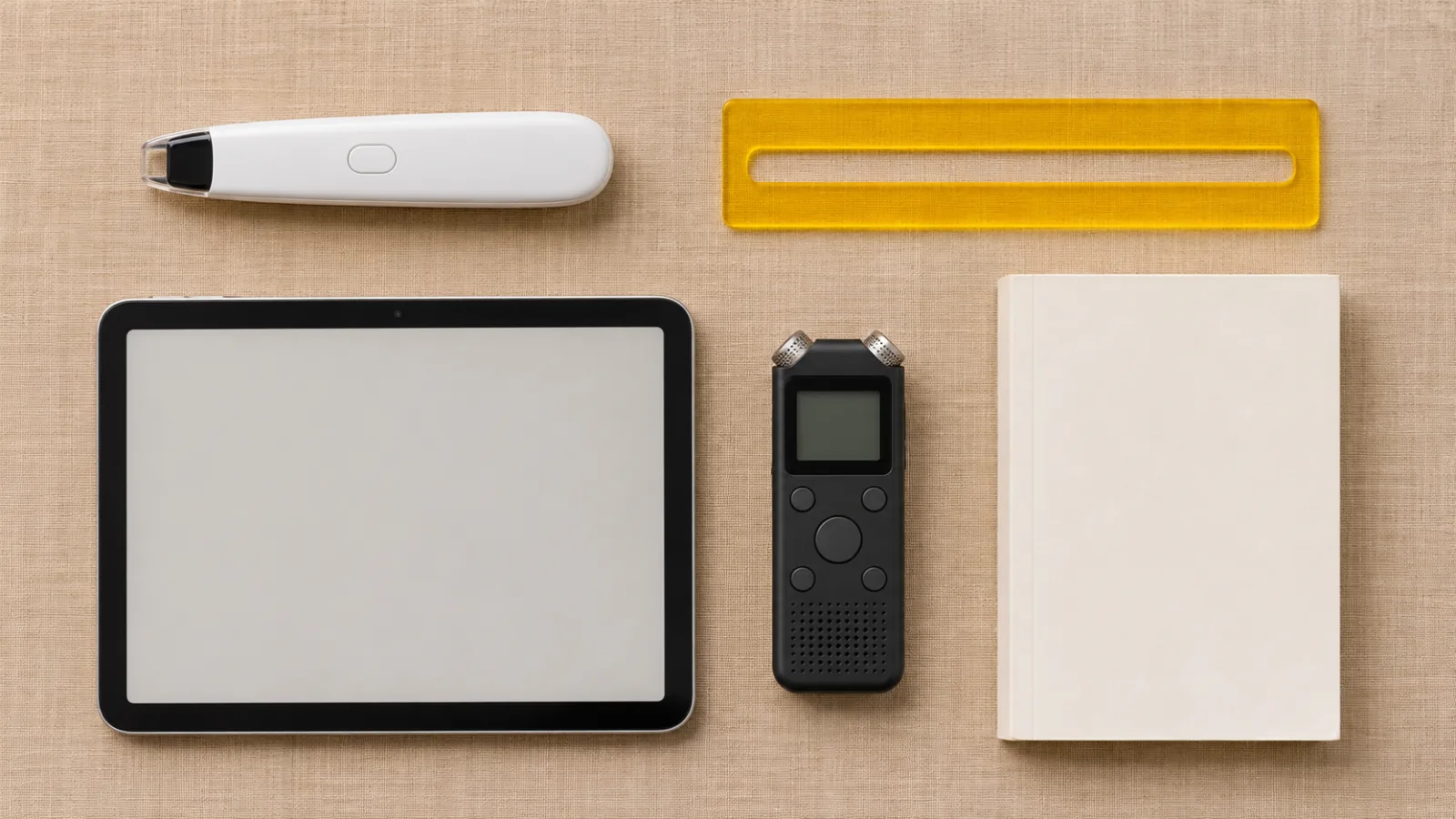
Assistive Technology for Dyslexia: A Complete Guide
Assistive technology for dyslexia by task: text to speech, dictation, reading pens and audiobooks, the free tools on your devices, and who pays for more.

Reading Tips for Adults with Dyslexia: 15 Strategies That Help
15 reading tips for adults with dyslexia: free read-aloud tools you already have, text layouts that help, work reading tricks and what research says.

Text to Speech at Work: A Guide for Managers
Text to speech at work, for managers: who it helps, the free tools your team already has, handling accommodation requests and docs that read well aloud.