


Walking and Listening: Why It Helps You Think
Walking and listening, backed by 7 studies: why walks spark more ideas, what to play on each route, a 5-step thinking walk, and how to stay safe.
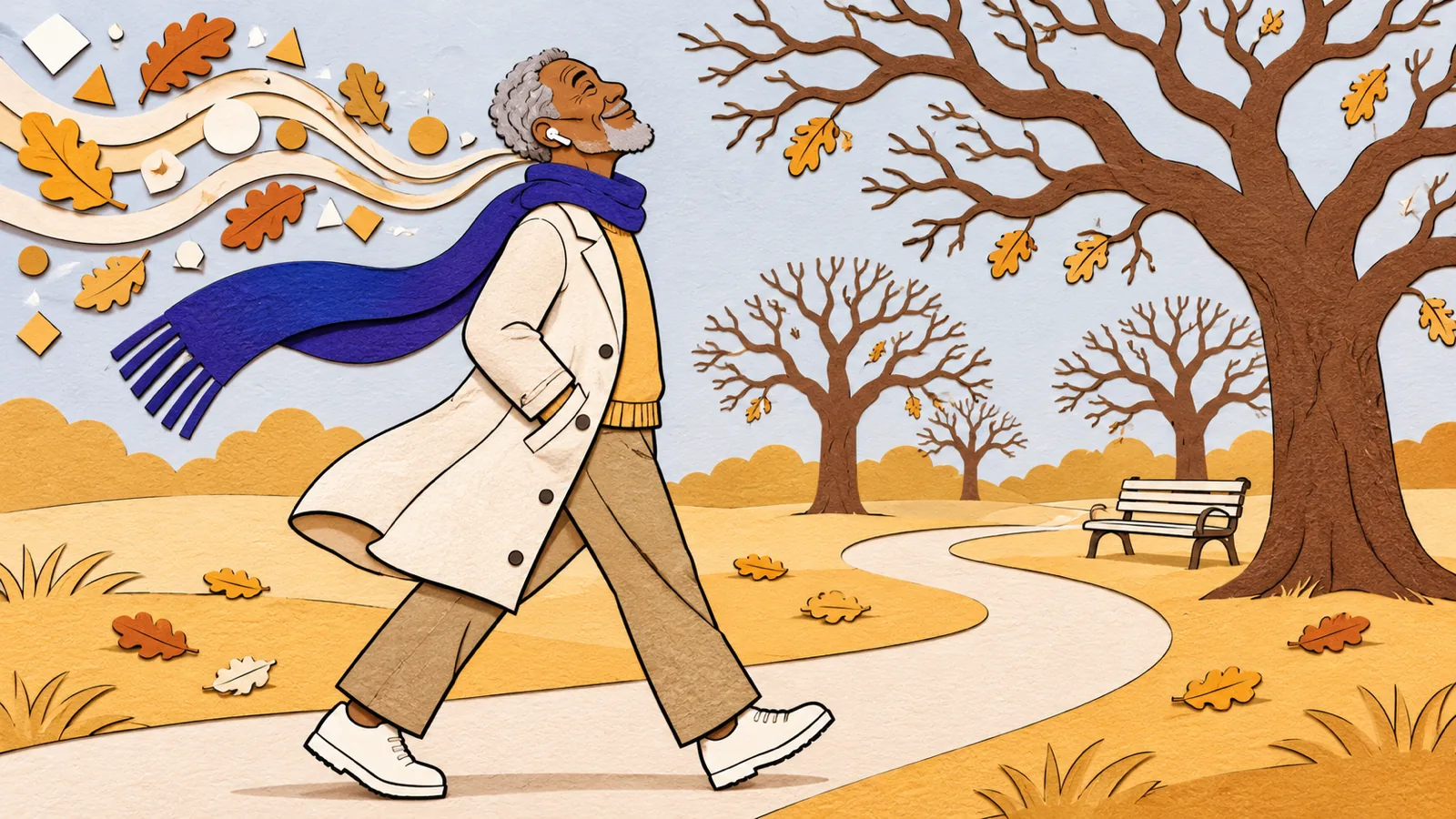
Walking and listening helps you think because walking boosts open-ended, creative thinking, while listening feeds it ideas and keeps your eyes free. In Stanford experiments, creative output rose 60% on average during walking. Walking doesn't help with single-answer problems, so listen for the first half of a walk, then pause the audio and think.
In four Stanford experiments with 176 people, walking raised creative idea generation, and the boost lasted for a short while after people sat back down.
Walking helps open-ended thinking (brainstorming, options, analogies), not focused, single-answer problems, where walkers did slightly worse.
Healthy young adults showed no differences in main gait measures while listening to an audiobook on a treadmill, but rated the combination as clearly more mentally demanding.
Walks in green spaces have been linked to better attention and less rumination than walks along busy streets.
The best routine alternates: listen for input, pause for thinking, then write ideas down soon after the walk.
Walking and listening helps you think because the two do different jobs: walking loosens up open-ended, creative thinking, and listening gives that thinking something to work on while your eyes stay on the path. In Stanford experiments, the overwhelming majority of people were more creative walking than sitting.
The catch is that walking helps some kinds of thinking and not others, and listening adds real mental load. Below is what the research shows, what to play on each kind of walk, a five-step "thinking walk" you can try today, and how to turn your own reading into audio with your phone's built-in tools or an app like Speechly.
Does walking help you think? What the research shows
Yes, for generating ideas. The best-known evidence is a 2014 Stanford study by Marily Oppezzo and Daniel Schwartz, published in the Journal of Experimental Psychology: Learning, Memory, and Cognition. Across four experiments with 176 college students and other adults, people were consistently more creative while walking than while sitting.
Here is what they found:
- More ideas. In the alternate-uses test (list as many uses as you can for an everyday object), creative output rose by an average of 60% while people walked.
- The setting mattered less than the walking. A treadmill facing a blank wall worked about as well as a walk around campus.
- The boost lingers. People who walked and then sat down stayed more creative for a short while afterward.
- It doesn't help everything. On a task with one right answer (find the word that links "cottage, Swiss, cake"), walkers did slightly worse than sitters.
- Short walks counted. Sessions ran 5 to 16 minutes depending on the task.
The researchers were careful about limits. Oppezzo said walking can help at the "beginning stages of creativity," not that it turns anyone into a genius.
What kind of thinking walking helps
| Thinking task | Walking helps? | Better approach |
|---|---|---|
| Brainstorming options or names | Yes | Walk while you generate ideas |
| Finding analogies and connections | Yes | Walk, then jot down the best ones |
| Planning a talk, essay or tricky email | Mostly | Sketch the outline on foot, write it seated |
| Puzzles with one right answer | No | Sit down and focus |
| Exact recall, calculations, proofreading | No | Do it at a desk |
Does walking and listening at the same time work?
Yes for most healthy adults, but it takes more effort than it feels like. No study has tested the full "listen, then think" routine in this guide, so it helps to look at the pieces separately.
The closest evidence is a 2023 treadmill study from RWTH Aachen University in BMC Sports Science, Medicine and Rehabilitation. Forty healthy adults aged 18 to 35 walked for five minutes with and without a classic-literature audiobook. The researchers found no differences in their main gait measures, but self-rated mental workload rose by about 80%, from roughly 16 to 28 on the NASA-TLX scale.
Three details are useful:
- Experience may help. The 16 participants who rarely listen while walking rated the workload higher than the 6 who often do. The groups were tiny, so treat this as a hint, not proof.
- It isn't the same for everyone. The authors flag audio while walking as a possible fall risk for older adults and people with conditions such as Parkinson's disease or multiple sclerosis, which still needs study. If balance is a concern, walk on a safe, even surface and ask your doctor or physical therapist.
- Listening beats looking. In a 2023 Wayne State University study, texting while walking disrupted gait the most, while passively listening to a story changed it less. Audio keeps your eyes up; a screen doesn't.
In practice, walking and listening is a great way to take in ideas, while the walking itself does its best work on your thinking once the audio stops. That's why the routine below alternates the two.
Does walking change how your brain hears?
It seems to. In a 2025 study in The Journal of Neuroscience, researchers at the University of Würzburg recorded brain activity with mobile EEG and found that walking strengthened the brain's response to ongoing sounds compared with standing still. The sounds were simple tones, not speech, so this doesn't prove you understand an audiobook better on foot. It does suggest your brain stays tuned to sound while you move.
Why walking in a park beats a busy street
Where you walk changes what's left in your head afterward. Two studies stand out:
- Attention. In a 2008 University of Michigan study in Psychological Science, people did a demanding memory-and-attention task, then walked in a park or through downtown Ann Arbor. Performance improved after the park walk, not after the city walk. The authors' explanation: traffic, signs and crowds demand constant effortful attention, while nature holds attention gently.
- Rumination. In a 2015 Stanford study in PNAS, 38 healthy people walked for 90 minutes either through grassland with oak trees or along a busy Palo Alto street. Only the nature walkers showed less self-reported rumination and lower activity in a brain area linked to it. The sample was small, so treat it as promising rather than settled.
A city street still beats sitting at your desk for creative ideas, as the Stanford treadmill result shows. But a busy route takes some of the attention you'd otherwise spend on what you're hearing.
What to listen to on each kind of walk
Match how demanding the audio is to how demanding the route is.
| Walk | What to play | Why |
|---|---|---|
| Quiet park or familiar loop | Dense nonfiction, essays, work reports | Few interruptions, so you can follow hard material |
| Treadmill or indoor track | Anything, including your hardest reading | No traffic, and creativity gets the same boost |
| Busy city streets | Light podcasts, news, fiction you know well | Your attention belongs on crossings and cars |
| Walk before a creative task | A short brief, notes or one article on the problem | Gives your brain raw material for the walk's idea boost |
| Unwinding walk at day's end | Music, an easy novel or silence | Rest, not input |
Speed matters too. Many people listen faster at a desk but slow down on a walk, especially on hills or busy routes. Our guide to audio learning covers how to build up your listening stamina.
How to take a "thinking walk" in 5 steps
This routine uses each part of the research: listening for input, walking for ideas, and the short creative afterglow when you sit back down.
- Pick one question. Write it down before you leave, such as "three angles for Thursday's pitch" or "what's the main argument of chapter 4?"
- Listen for the first half. Play the material that feeds the question: a report, an article, a book chapter or your own draft. On a 30-minute walk, that's about 15 minutes.
- Stop the audio and keep walking. Spend the rest of the walk turning the question over in silence. This is the open-ended thinking walking helps most.
- Capture ideas out loud. Record a voice memo when something good comes up, so you don't have to hold it in your head.
- Sit down and write soon after. Get the ideas onto the page within a few minutes of getting back, while the creative boost lasts. Then do the focused, single-answer work, like choosing the best idea, at your desk.
For more ways to keep what you hear, see how to remember what you listen to.
How to stay safe walking and listening
Keep enough of your hearing on the world around you. A 2012 study in Injury Prevention reviewed 116 US reports from 2004 to 2011 of pedestrians killed or injured by trains or cars while wearing headphones. Seventy percent of the pedestrians died, 55% of the vehicles were trains, and 29% of the cases mentioned a warning sound before the crash. The reports can't prove headphones caused the crashes, but the authors point to distraction and masked warning sounds as likely factors.
- Let outside sound in. Use your earbuds' transparency or ambient mode, open-ear headphones, or one earbud only.
- Pause at crossings. Stop the audio at busy roads and railroad crossings, and look up from your phone.
- Keep the volume down. The World Health Organization advises no more than 60% of your device's maximum volume.
- Save dense listening for safe routes. Hard material belongs on park loops, treadmills and quiet streets.
How to turn your reading into walking audio
The reading you want to think about is often text: articles, reports, PDFs and books. You can turn it into audio for free or with a text-to-speech app.
Free: your phone's browser
- iPhone: open the article in Safari, tap the Page Menu button, then tap Listen to Page. To pause, tap Page Menu again, then the Pause button. See Apple's guide to listening to a webpage.
- Android: open the article in Chrome, tap More (top right), then Listen to this page. Tap the player, then 1.0x to change the speed. Google says playback keeps going with the screen locked, though the option doesn't appear on every site.
Both read one web page at a time. More options are in our guide to listening to articles instead of reading them.
With Speechly: PDFs, documents, books and articles
Speechly reads PDFs, Word documents, EPUB books, web pages and photos of printed pages aloud on iPhone and Android with 25+ natural AI voices.
- Add your reading before you leave. Paste a link, open a PDF or EPUB, snap a photo of a book page, or pick from 75,000+ free public-domain books.
- Fit it to your walk. Speechly estimates how long each document takes to listen to, so you can match a chapter to a 20-minute loop.
- Set a walking speed. Preview voices and choose any speed from 0.5× to 2×.
- Lock your phone and go. Speechly keeps reading with the screen off.
- Missed a point at a crossing? Jump to any sentence and start again from there.
- Finish at your desk. Your place is saved automatically, so you can pick up on your Mac or Windows PC with the same account.
Speechly doesn't offer offline listening, so keep mobile data on for walks away from Wi-Fi. The free plan includes two text-to-speech files with premium voices, with no card required. Speechly Premium is $14.99/month or $139/year for unlimited listening.
Start with one walk this week
Pick one question you're stuck on, load 15 minutes of reading about it, and take a 30-minute walk: listen first, think second, write as soon as you're back. If you also want to listen while you train, our guide to listening while you work out covers earbuds, routes and what to play. When you want your PDFs, articles and books ready for every walk, Speechly is free to download on iPhone, iPad, Android, Mac and Windows.
Frequently asked questions
Is it good to listen to audiobooks while walking?
Yes, for most people it's an easy way to fit in more reading. Pick a quiet, familiar route for demanding books, keep the volume low enough to hear traffic, and pause or rewind when you lose the thread.
Is walking on a treadmill as good for thinking as walking outside?
For creative ideas, about the same. In the Stanford study, walking on a treadmill facing a blank wall raised creativity much like walking outdoors, so the walking itself mattered most.
How long should a thinking walk be?
Short walks count. The Stanford creativity sessions lasted 5 to 16 minutes, so a 15 to 30 minute walk is plenty for one problem. Longer walks in nature have been studied for mood and rumination.
Should I listen to music or podcasts on a walk?
It depends on what you want from the walk. Music suits a relaxed walk with nothing to process, while podcasts, audiobooks and articles give you material to think about. For a thinking walk, leave quiet time at the end either way.
Can you remember what you hear while walking?
Usually, if the route is easy and the material isn't too dense. Slow the speed for hard passages, replay key sentences, and say a one-line summary into a voice memo at the end of the walk.
Does walking help with studying?
It helps with the open-ended parts, such as reviewing a reading you've already done, thinking up essay angles or connecting ideas. For problem sets and exact recall practice, sit down after the walk.
Listen with Speechly
Natural AI voices on iPhone, iPad, Android, Mac and Windows, with word highlighting and your place saved on every device. Free to download.
Prices and features of other products were checked on November 18, 2026 and can change. Speechly is not affiliated with the other companies named here.
How to Remember What You Listen To
How to remember what you listen to, from podcasts to lectures: 7 research-backed habits, including the 10-minute break that boosted recall a week later.
Audio Learning: How to Learn by Listening
Audio learning, explained: what the research says, what you can learn by ear and what not, and 7 habits that make listening stick, with free sources.
How to Listen While You Work Out
How to listen while you work out: a 5-minute earbud setup, safer outdoor runs, phone-free Apple Watch audiobooks and what to play for each workout.