


How to Read 50 Books a Year: The Math and a Weekly Plan
How to read 50 books a year with a full-time job: the real math (45 minutes or 41 pages a day), a 7-step plan, a sample day and fixes for falling behind.
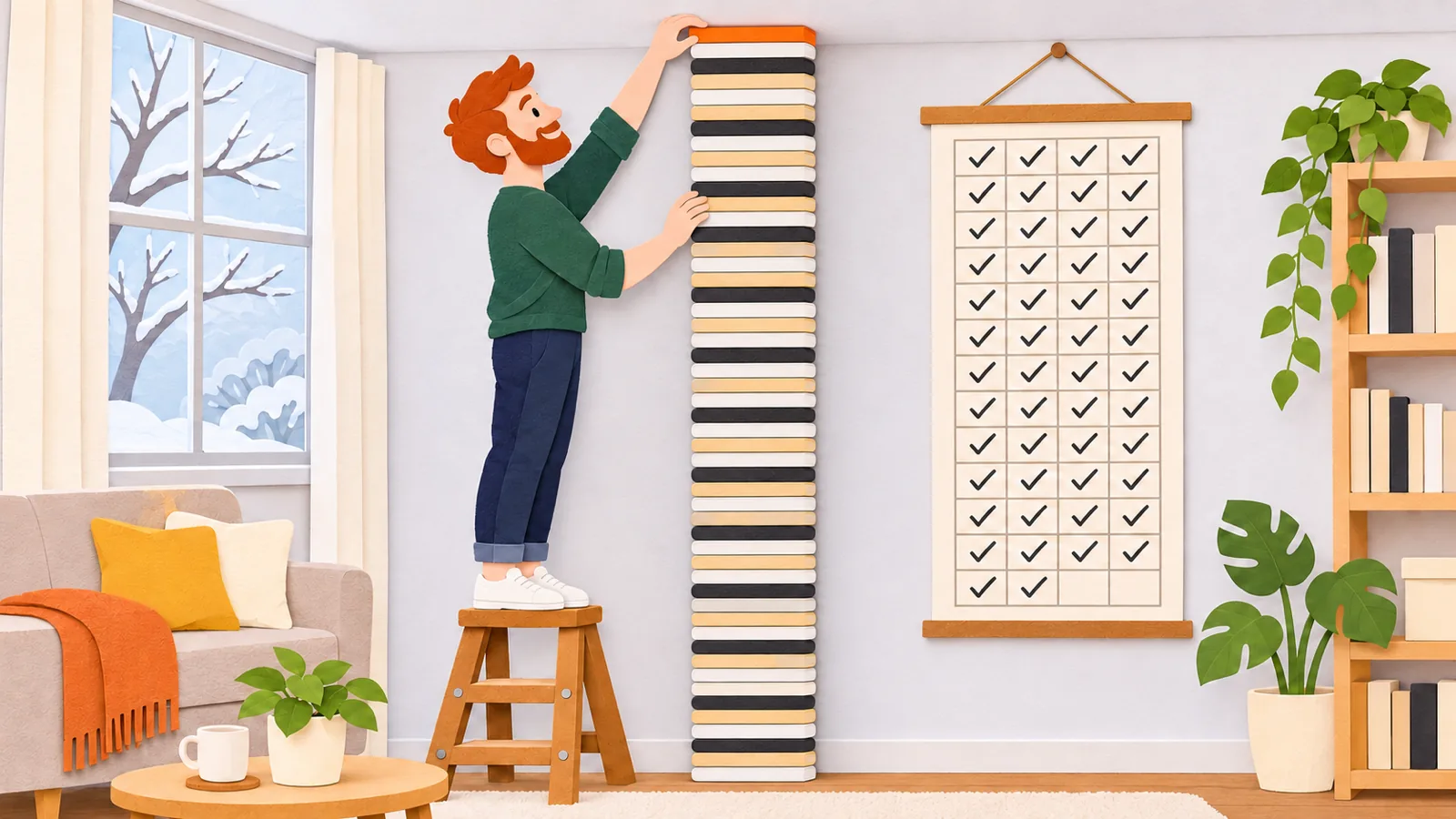
To read 50 books a year, finish about one book a week: roughly 45 minutes of reading a day, or about 41 pages a day if your books average 300 pages. Split the time into two or three short sessions, count audiobooks, and add shorter books when you fall behind.
Fifty books of about 80,000 words is 4 million words a year: roughly 42 to 46 minutes a day, or about 5 hours a week, at an average adult reading speed.
Think in weeks, not years. One book a week gives you 52, so you have two spare weeks for long books, holidays and slumps.
Collect your 45 minutes in pieces: before work, on the commute or at lunch, and in bed.
Keep two books going, one to read and one to listen to, so commutes, walks and chores count toward the goal.
Check your pace as you go: about 4 books a month, or 25 by the end of June. If you fall behind, add short books instead of longer sessions.
How to read 50 books a year comes down to one number: about one book a week. That works out to roughly 45 minutes of reading a day, or about 41 pages a day if your books average 300 pages. Few people have 45 free minutes in one block, so the trick is to collect the time in pieces and to count the time you spend listening, with an audiobook or a text-to-speech app like Speechly.
Below: the math for your own books and reading speed, a 7-step plan, a sample day that adds up, and what to do when you fall behind.
How many pages or minutes a day do you need to read 50 books a year?
About 45 minutes or 41 pages a day for typical books. Fifty books is about 4 million words, which takes 256 to 280 hours a year, or roughly 5 hours a week.
That assumes 80,000-word books, the low end of the 80,000–89,999 range Writer's Digest recommends for adult novels. It also assumes the average adult silent reading speed found in a review of 190 reading studies: 238 words per minute for nonfiction and 260 for fiction.
Your number depends mostly on how long your books are:
| Book length | Words (50 books) | Minutes a day | Hours a week |
|---|---|---|---|
| 60,000 words (shorter books) | 3 million | 32–35 | 3.7–4.0 |
| 80,000 words (typical adult novel) | 4 million | 42–46 | 4.9–5.4 |
| 100,000 words (fantasy and sci-fi) | 5 million | 53–58 | 6.2–6.7 |
If you think in pages, divide your yearly page total by 365:
| Book length | Pages a year | Pages a day |
|---|---|---|
| 250 pages | 12,500 | 34 |
| 300 pages | 15,000 | 41 |
| 400 pages | 20,000 | 55 |
Reading slowly doesn't rule you out. At 200 words per minute, 80,000-word books take about 55 minutes a day instead of 45. Don't try to fix that with speed reading: a 2016 review in Psychological Science in the Public Interest found a trade-off between speed and accuracy, so reading much faster means understanding less. Adding minutes works; rushing them doesn't.
How to read 50 books a year in 7 steps
1. Turn the yearly goal into a weekly pace
Fifty books feels huge in January. One book a week doesn't. A weekly pace also gives you 52 slots for 50 books, so two weeks are spare for a long book, a holiday or a bad month.
Check your count against these milestones, about 4 books a month:
| By the end of | Books finished |
|---|---|
| March | 12–13 |
| June | 25 |
| September | 37–38 |
| December | 50 |
2. Find your 45 minutes in two or three blocks
Look for time you already have. Most people find it in three places: before work, during the commute or lunch, and in bed. Fifteen minutes in each is enough.
Two habits make those blocks easier to keep:
- Read before you scroll. Open your book before social media or TV, not after.
- Keep a book on your phone. An e-book or audiobook on your phone turns waiting rooms, queues and short train rides into pages.
3. Keep two books going: one to read, one to hear
Read a print or e-book at home and listen to a different book on the commute, on walks and while you do chores. For most people this is the biggest lever, because it turns time you can't spend with a page into reading time. Pick two that feel different, like a novel and a nonfiction book, so you never mix them up.
4. Mix long and short books
A year of 500-page novels makes 50 books very hard. Balance each long book with one or two short ones: novellas, essay collections, memoirs, poetry or short classics you can finish in a day. Short books aren't cheating; they're how a weekly pace survives a doorstop.
5. Quit books you don't enjoy
Goodreads suggests a "Rule of 50": if you're not enjoying a book after about 50 pages, put it down and move on. The dropped book won't add to your count, but the weeks you save will.
6. Line up your next three books
Streaks tend to break between books. Keep a short "up next" list, and place library holds weeks before you need them, because popular titles often have waiting lists.
7. Track every finished book
Log each book the day you finish it, in the Goodreads Reading Challenge, The StoryGraph, a spreadsheet or a notebook. A visible count makes the milestones easy to check, and Goodreads lets you change your annual goal at any time. For choosing a number that keeps you motivated, see how to set and track reading goals.
A sample day that adds up to 50 books
This day has 55 minutes of reading, a small cushion over the 45 you need, and none of it needs a free evening.
| When | Format | Minutes |
|---|---|---|
| Before work, with coffee | Print or e-book | 15 |
| Commute (train, bus, car or walk) | Audiobook or text to speech | 20 |
| Lunch break | E-book on your phone | 10 |
| Bedtime | Print book | 10 |
| Total | 55 |
No time on weekdays? Two 90-minute weekend sessions plus 30 minutes of listening each weekday comes to 330 minutes a week, which is also enough. For more ideas, see these 15 habits that help you read more books.
How to read 50 books a year by listening
Listening can cover half the goal or more. In a 2016 study by Rogowsky, Calhoun and Tallal, 91 participants read a nonfiction text, listened to it as an audiobook, or did both, and comprehension showed no statistically significant difference between the groups. If you wonder whether it "counts", here's the case for audiobooks as reading.
Playback speed helps too: a book with a 9-hour runtime takes 6 hours at 1.5×. Build up to faster speeds gradually; this guide to listening at higher speeds explains how.
Free: borrow audiobooks with Libby
Libby is a free library app. All you need is a library card.
- Install Libby from the App Store, Google Play or the Amazon Appstore (Fire tablets), or open libbyapp.com in a browser on Windows, Mac or Chromebook.
- Follow the prompts to find your library and sign in with your library card.
- Search for an audiobook and borrow it, or place a hold if every copy is checked out.
- While it plays, tap the playspeed icon at the top of the screen. Choose a preset, or drag the Fine-tune slider to set any speed from 0.6× to 3× (Libby help).
What's available depends on your library, which is why step 6 above matters.
Listen to e-books, PDFs and classics with Speechly
Many books have no audiobook, or a long library wait. Speechly reads EPUB e-books, PDFs and Word files aloud with natural AI voices, so a book you have as a file becomes one you can listen to.
- Install Speechly on iPhone, iPad or Android. You can start without an account.
- Open a title from the built-in catalog of 75,000+ free public-domain books, or import your own EPUB, PDF or Word file. You can also take a photo of a printed page.
- Choose one of 25+ natural AI voices and set the speed anywhere from 0.5× to 2×. Speechly estimates how long each document will take to listen to, which makes it easy to plan your week.
- Press play. Each word is highlighted as it's read, and Speechly keeps reading with your phone locked.
- Stop whenever you like. Your place is saved, so you can pick up on another device signed in to the same account.
On a Mac, select text in any app and press ⌘E, or open an EPUB or PDF and listen from the reading view. On Windows, select text and press Alt+R. Speechly doesn't read DRM-protected Kindle or Audible books; use those apps for books you bought there.
Troubleshooting: what to do when you fall behind
- You're three or more books behind by spring. Don't double your sessions; you'll burn out. Read two or three short books in a row and the count catches up.
- One long book is eating your month. Move it to audio and read something lighter on paper, or set it aside and come back later.
- You're in a reading slump. Reread a book you loved, switch genre, or pick the shortest book on your list. The goal is to finish something this week.
- You missed a whole week. Restart the next day without trying to make it up. In a UCL study of habit formation, missing one opportunity to perform a new habit didn't materially affect how the habit formed.
- You finish books but forget them. After each book, write three sentences: what it was about, one idea or scene to keep, and who you'd recommend it to.
- It's October and 50 is out of reach. Lower the goal. Forty books you enjoyed beats 50 you rushed through.
Is 50 books a year a lot, and is it realistic?
It's a lot, but it's realistic with about 45 minutes a day. In a December 2021 Gallup poll, U.S. adults said they read an average of 12.6 books in the past year, and only 27% read more than 10. Fifty books puts you well above average.
It's worth it if a number gets you reading every day. If counting starts to push you toward books you don't want to read, set a goal of 24 or 30 and keep the daily habit instead.
Read 50 books a year with Speechly
The hardest part of a 50-book year is finding 5 hours a week, and listening can supply most of them. Speechly reads EPUB e-books, PDFs, Word files, web pages and photos of printed pages aloud with word-by-word highlighting, on iPhone, iPad, Android, Mac and Windows with one account. It's free to download, and the free plan includes two files with premium voices; Speechly Premium is $14.99/month or $139/year for unlimited listening.
Frequently asked questions
Can you read 50 books a year with a full-time job?
Yes, if you count listening. Fifteen minutes of reading before work, 20 minutes of audio on the commute and 10 to 15 minutes in bed adds up to the roughly 45 minutes a day you need, without one long session.
How many books does the average person read in a year?
In a December 2021 Gallup poll, U.S. adults said they read an average of 12.6 books in the past year, and 27% read more than 10. Fifty books is about four times that average.
How long does it take to read one book?
An 80,000-word book takes about 5 to 5.5 hours at an average silent reading speed of 238 to 260 words per minute. A 60,000-word book takes about 4 hours, and a 100,000-word fantasy novel about 6.5 to 7 hours.
Should I learn speed reading to hit 50 books?
No. A 2016 research review in Psychological Science in the Public Interest found a trade-off between speed and accuracy: readers are unlikely to double their speed and still understand as much. Finding more minutes is the reliable route.
How do you read 100 books a year?
Double the 50-book plan: about two books a week, or roughly 1.5 hours a day with 80,000-word books. At that pace, listening during commutes, walks and chores matters even more than it does for 50.
Is it better to read fewer books more deeply?
It depends on what you want from reading. Fifty books is a good goal if it gets you reading daily and you enjoy it; if counting makes you rush or pick books you don't care about, a goal of 24 or 30 is just as worthwhile.
Do audiobooks count toward a 50-book goal?
Yes. A book you finished is a book you finished, in any format. Goodreads itself suggests listening to audiobooks on your commute, during workouts or while doing chores to reach your Reading Challenge goal.
Listen with Speechly
Natural AI voices on iPhone, iPad, Android, Mac and Windows, with word highlighting and your place saved on every device. Free to download.
Prices and features of other products were checked on November 18, 2026 and can change. Speechly is not affiliated with the other companies named here.
How to Read More Books: 15 Habits That Work
How to read more books: 15 habits that make reading automatic, why 20 minutes a day adds up to 22+ books a year, and how to read on your commute.
Reading Goals: How to Set and Track Them
Reading goals that stick: how to pick the right kind, do the minutes-per-day math, track progress in Goodreads, StoryGraph or Apple Books, and adjust.

How to Turn Your Commute into Reading Time
How to turn your commute into reading time on a train, bus, walk or drive: 5 steps, what to read by trip length, free audiobooks and no-signal fixes.