


Reading Goals: How to Set and Track Them
Reading goals that stick: how to pick the right kind, do the minutes-per-day math, track progress in Goodreads, StoryGraph or Apple Books, and adjust.
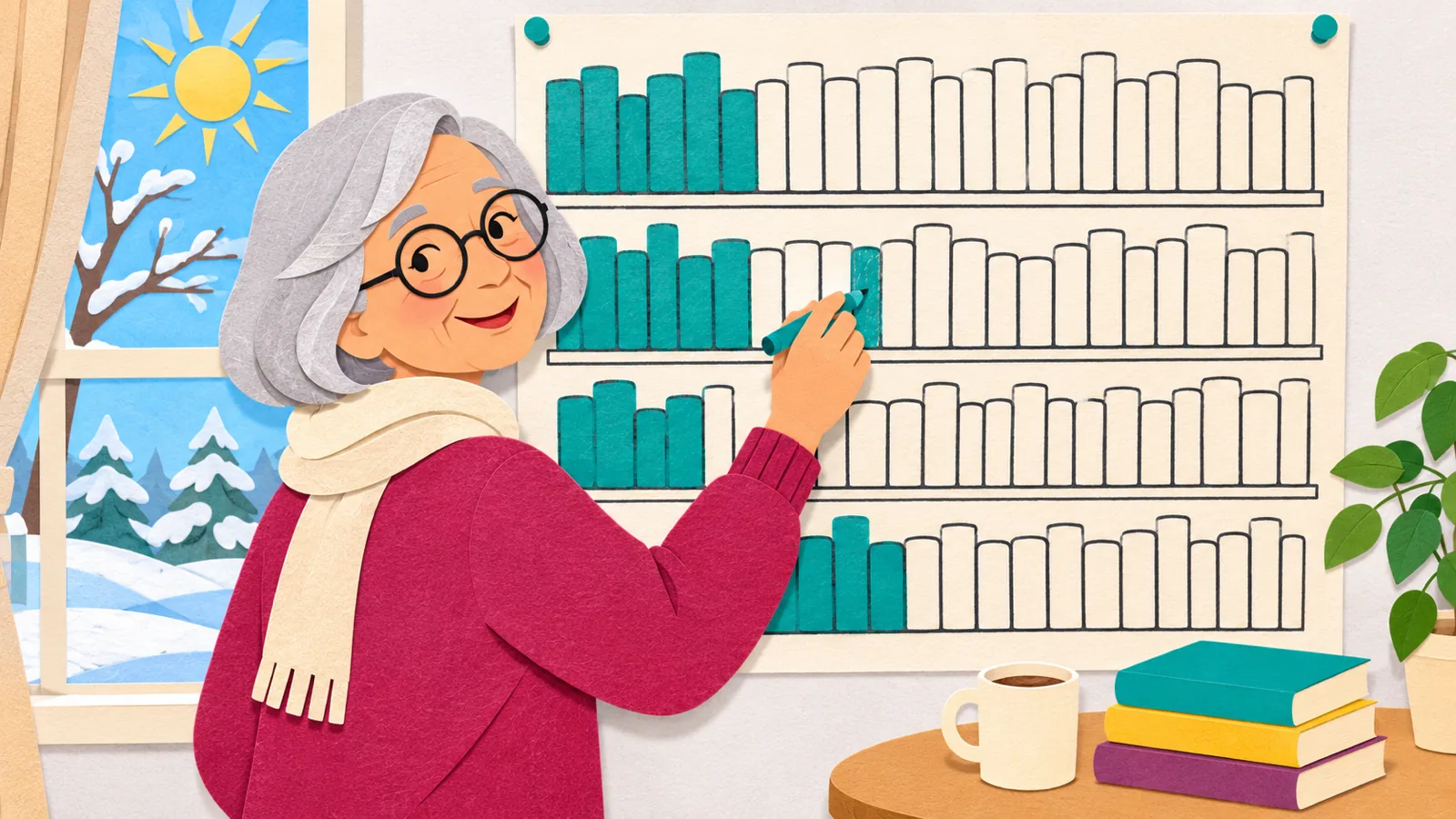
Good reading goals start from what you read last year, raise it a little, and turn the yearly number into minutes a day. Pick the unit that suits you (books, pages, minutes or hours), log progress somewhere you'll see it, such as Goodreads, StoryGraph or Apple Books, and review it every month.
Base your goal on last year's count, then add 20 to 50 percent. A goal you can see yourself hitting in March keeps you going in October.
Convert books into minutes: at an average 260 words per minute, a 24-book year of 80,000-word novels is about 20 minutes a day.
Book counts reward short books. Minutes, pages or hours goals reward time spent, which suits slow, long or difficult reading.
Tracking matters as much as the target. A meta-analysis of 138 studies found that monitoring progress helped people reach goals, especially when it was written down or shared.
Audiobooks and listening count. Apple Books counts finished audiobooks, and StoryGraph lets you set a goal in hours.
The best reading goals are specific, slightly above what you read last year, and broken down into minutes a day. Then you track them where you'll see your progress every week. This guide walks through choosing the type of goal, doing the math, picking a tracker and adjusting when life gets in the way.
If you mostly want a daily routine rather than a yearly number, start with how to build a daily reading habit. This page is about the number itself and how to keep score.
What kind of reading goal should you set?
Choose the unit that rewards the reading you want to do more of. A book count is motivating but favors short books. A time goal rewards showing up.
| Goal type | Example | Best for | Watch out for |
|---|---|---|---|
| Books per year | 24 books in 2027 | A clear finish line, a growing list | Avoiding long or hard books to keep the count up |
| Minutes per day | 15 minutes a day | Building a habit, busy schedules | Feels open-ended; pair it with a book list |
| Pages per year | 8,000 pages | Readers of long novels and nonfiction | Audiobooks and eBooks don't have fixed pages |
| Hours per year | 100 hours | Audiobook and text-to-speech listeners | Less satisfying than finishing books |
| List or theme | 12 classics, or one book per country | Reading wider, not more | Easy to stall on one title |
| Streak | Read every day for 30 days | Restarting after a slump | One missed day can feel like failure |
Most people do best with two layers: a yearly target for motivation and a small daily minimum, such as 10 minutes, for the days when nothing else happens.
How to set reading goals in 6 steps
1. Find your starting point
Count the books you finished in the last 12 months. Check your eBook app, library loans, Audible history or your shelves. If you have no idea, time yourself for a normal week of reading instead.
2. Raise it by 20 to 50 percent
A goal should stretch you without needing a different life. Six books last year becomes 8 or 9. Twenty becomes 24 to 30. Doubling or tripling your count usually means rushing or quitting by spring.
3. Turn the yearly number into minutes a day
This step is the one most people skip. Use your reading speed and a typical book length to see what a goal costs each day.
Adults read fiction silently at about 260 words per minute and nonfiction at about 238, according to a 2019 meta-analysis of 190 studies by Marc Brysbaert. At 260 words per minute, an 80,000-word novel takes about 5 hours. That gives:
| Yearly goal (80,000-word books) | Hours a year | Minutes a day |
|---|---|---|
| 12 books | About 62 | About 10 |
| 24 books | About 123 | About 20 |
| 36 books | About 185 | About 30 |
| 52 books | About 267 | About 44 |
If you read more slowly, or read dense nonfiction, add 10 to 30 percent. For the numbers behind this, see how fast people read and listen.
4. Decide when and where you'll read
Write one sentence: "After I [something you already do], I'll read for [minutes] at [place]." For example, "After I start the coffee maker, I'll read for 10 minutes at the kitchen table." Psychologists call these implementation intentions, and a meta-analysis of 94 studies found they made people more likely to reach their goals.
5. Make a short list, not a long one
Pick your next three books, not your next fifty. Mix in at least one short or easy one so you finish something in the first few weeks.
6. Choose your tracker today
Set it up before you read another page. The next section compares the options.
How to track reading goals: the best apps and methods
Use the tracker you already open. If you read on an iPhone, Apple Books is built in. If you want stats and a community, use Goodreads or The StoryGraph.
| Tracker | Goal units | What it counts | Cost |
|---|---|---|---|
| Goodreads Reading Challenge | Books per year | Books you mark Read with a finish date in that year | Free |
| The StoryGraph | Books, pages or hours, several goals at once | Books you log, including audiobooks | Free plan |
| Apple Books | Minutes per day, books per year | Time reading in the app; finished books and audiobooks; PDFs if you turn them on | Free on iPhone and iPad |
| Kindle Reading Challenges | Streaks, books read, achievements | Kindle books bought or borrowed from Amazon | Free |
| Open Library | Books per year | Books you check in with a finish date | Free |
| Paper or spreadsheet | Anything you like | Whatever you write down | Free |
A few details worth knowing:
- Goodreads says you can always change your annual goal. A book counts toward the year you finished it, so add the finish date when you mark it Read.
- The StoryGraph lets you set goals in books, pages or reading hours, and run more than one at a time, as PopSci describes. An hours goal is the easiest way to give audiobooks fair credit.
- Kindle counts only Kindle books bought or borrowed from Amazon, and Amazon says the app needs a data connection to track your reading. Linking Goodreads lets you earn some achievements from your Goodreads Read shelf too.
- Open Library counts a book once you mark it Already Read and add a check-in date.
How to set a reading goal in Apple Books
According to Apple's guide:
- Open Books and tap Home, then the reading goals button.
- Tap the reading goal timer, tap Adjust Goal, set your minutes per day, and tap Adjust Goal again. The default is 5 minutes.
- For a yearly goal, tap a book cover or placeholder, tap Adjust Goal, set the number of books, and confirm. The default is three.
- To count PDFs, go to Settings > Apps > Books and turn on Include PDFs under Reading Goals.
- Mark a book done from its More Info button with Mark as Finished.
Paper still works
A hand-drawn bookshelf where you color in a spine per book, a tick on the calendar for every reading day, or a simple spreadsheet with title, date finished and minutes all work. Paper has one advantage: you see it without opening an app.
Why tracking your reading helps you hit the goal
Writing progress down is not busywork. A 2016 meta-analysis in Psychological Bulletin pooled 138 experiments with almost 20,000 participants. Interventions that got people to monitor their progress helped them reach their goals. The effect was larger when progress was physically recorded or reported to others.
In practice:
- Log each book the day you finish it, not in a catch-up session at the end of the month.
- Check the pace once a week. Most apps tell you whether you're ahead or behind.
- Share it if that motivates you. A book club, a friend with the same goal, or a public Goodreads profile all count as reporting.
Do audiobooks and listening count toward reading goals?
Yes. You take in the same book, and in a 2016 study comprehension of a nonfiction text was similar whether people read it, listened to it or did both. Apple Books counts finished audiobooks toward its yearly goal, and Goodreads itself suggests listening on your commute, during workouts or while doing chores to reach your challenge. There's more on this in does listening to audiobooks count as reading?
Listening changes the math. Audiobook narrators speak at about 140 to 180 words per minute, according to the same Brysbaert review, so at normal speed an 80,000-word book runs roughly 7.5 to 9.5 hours. At 1.5×, you're close to silent reading time.
Listening also opens up time you can't read in: the commute, the gym, cooking, walking the dog. If your goal feels out of reach, a 20-minute listening slot on weekdays adds about 87 hours a year.
How to adjust your reading goal during the year
Review the goal at the end of each month, and rethink it at the end of each quarter.
- Ahead by March? Raise the target, or keep it and add a stretch list of longer books.
- Behind by a book or two? Recalculate the pace from today. Add one short book and one extra listening slot a week.
- Far behind by summer? Lower the goal. Thirty books you enjoyed beats fifty you resented.
- Reading has turned into a chore? Switch to a minutes goal for a month. Drop books you aren't enjoying; Goodreads suggests letting a book go if you're not enjoying it after about 50 pages.
For ambitious targets, how to read 50 books a year has a full weekly plan and fixes for falling behind.
Reading goal ideas to try
- The one-a-month year: 12 books, about 10 minutes a day.
- The 20-minute year: 20 minutes daily, no book count at all.
- The classics shelf: one public-domain classic a month.
- The format mix: half read, half listened.
- The backlog clear: finish 10 books you already own before buying more.
- The depth goal: 6 big books, such as a long biography or a history, with notes on each.
Hit your reading goals by listening with Speechly
Speechly is a text-to-speech reader for iPhone, iPad, Android, Mac and Windows that turns books, PDFs, articles and documents into audio with 25+ natural AI voices. For reading goals, three things help:
- Planning: it estimates how long each document will take to listen to, so you can match a chapter to your commute.
- Free books: a built-in catalog of 75,000+ free public-domain books, so a classics goal costs nothing extra.
- Momentum: it saves your place automatically, so you can read on your phone at lunch and continue on your Android tablet or Mac in the evening, with word-by-word highlighting if you want to follow along.
Set the speed anywhere from 0.5× to 2×. The free plan includes two text-to-speech files with premium voices, no card required. Premium is $14.99/month or $139/year for unlimited listening on every device. Speechly has no offline listening, so it needs an internet connection.
The bottom line
Pick a goal a little above last year's, convert it to minutes a day, and track it where you'll see it every week. Adjust without guilt. To turn commutes and chores into reading time, download Speechly free and add the next book on your list.
Frequently asked questions
What is a good reading goal for a year?
One that is slightly above what you read last year. If you finished 6 books, aim for 8 to 10; if you read 20, try 24 to 30. If you don't know your number, start with 12 books, one a month, or 10 minutes a day.
How many books does the average person read a year?
In Gallup's 2021 survey, U.S. adults said they read an average of 12.6 books in the past year, while 17% read none. Averages are pulled up by heavy readers, so compare yourself with your own last year instead.
Is it better to set a reading goal in books or minutes?
Minutes if you're building a habit or reading long, hard books; books if you like a clear finish line and a growing list. Many readers use both: a daily minutes floor and a yearly book target.
Can I change my Goodreads reading goal?
Yes. Goodreads says you can always change your annual goal, and Apple Books, StoryGraph and Open Library let you adjust theirs too. Lowering a goal you've outgrown or under-shot is normal, not cheating.
Do rereads count toward a reading goal?
It's your goal, so you decide. Most trackers let you log a reread as a new finished date. If you track minutes or hours, rereading counts automatically.
What should I do if I fall behind on my reading goal?
Recalculate the pace from today rather than trying to catch up in one weekend. Add a short book, a listening slot on your commute, or lower the target. A goal you still believe in beats one you've abandoned.
Listen with Speechly
Natural AI voices on iPhone, iPad, Android, Mac and Windows, with word highlighting and your place saved on every device. Free to download.
Prices and features of other products were checked on November 18, 2026 and can change. Speechly is not affiliated with the other companies named here.
How to Build a Daily Reading Habit That Sticks
How to build a daily reading habit that lasts: a 7-step plan starting at 10 minutes a day, how long it really takes, and how to restart after a slump.
How to Read 50 Books a Year: The Math and a Weekly Plan
How to read 50 books a year with a full-time job: the real math (45 minutes or 41 pages a day), a 7-step plan, a sample day and fixes for falling behind.
Does Listening to Audiobooks Count as Reading?
Does listening to audiobooks count as reading? Usually yes. What 46 studies and brain scans show, the 4 exceptions, and how it counts for goals and school.