


A Short History of Text to Speech
A short history of text to speech in one dated timeline: 1700s talking machines, the Voder, DECtalk and Hawking's voice, Siri and today's AI voices.
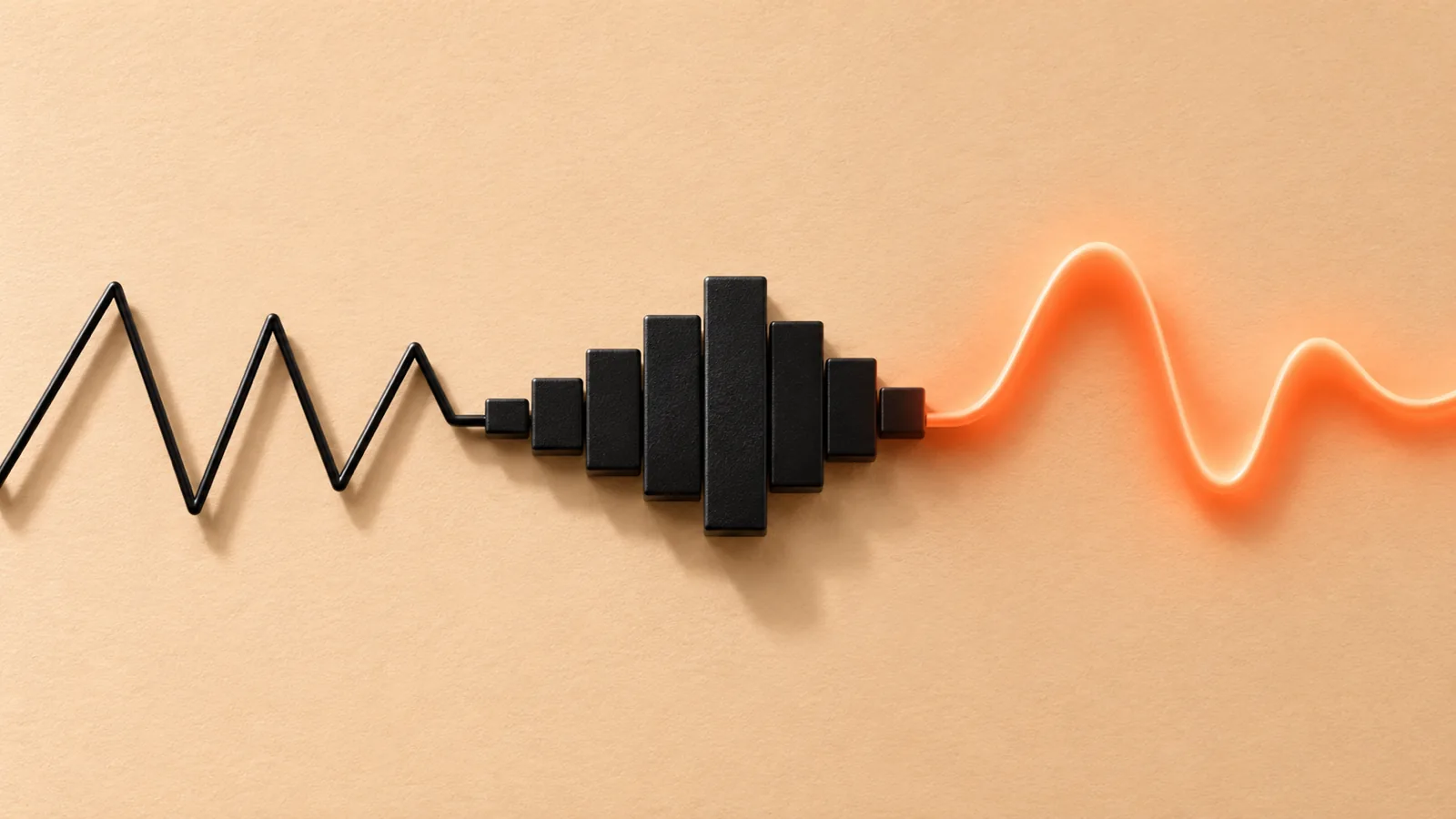
A short history of text to speech: mechanical talking machines in the late 1700s, Bell Labs' electronic Voder in 1939, the first general English text-to-speech system in 1968, robotic rule-based voices like DECtalk in the 1980s, voices stitched from real recordings in the 1990s, and neural AI voices since DeepMind's WaveNet in 2016.
Text to speech has no single inventor. It grew in stages: mechanical speaking machines (1779–1846), electronic voices (1939), computer text to speech (1968) and neural AI voices (2016 onward).
The first systems that read text automatically calculated speech from hand-written rules, which is why 1980s voices like DECtalk sounded clear but robotic.
From the 1990s, the most natural voices were stitched together from tiny pieces of real recordings. Even Siri's 2016–2017 voices still worked this way, with deep learning choosing the pieces.
WaveNet (2016) beat every earlier system in listening tests, and Tacotron 2 (2017) scored 4.53 out of 5 against 4.58 for real recordings. Neural voices reached Google Assistant the same year.
Built-in screen readers made text to speech an everyday tool: Narrator in Windows 2000, VoiceOver on the Mac in 2005 and the iPhone 3GS in 2009, and a text-to-speech engine in Android 1.6 the same year.
A short history of text to speech covers about 250 years: from 18th-century bellows and reeds that could say a few vowels, to 1960s computers reading typed English in a buzzing monotone, to today's AI voices that breathe and pause like a narrator. Each leap came from a new answer to one question: where does the sound come from?
Below is the full timeline, then each era in plain English, and what this history means for the voices you choose today.
A short history of text to speech: the timeline
| Year | Milestone | Why it mattered |
|---|---|---|
| 1779 | Kratzenstein's vowel resonators | A machine says five vowels |
| 1791 | Von Kempelen's speaking machine | Consonants and words, played by hand |
| 1846 | Faber's Euphonia | A talking head played from a keyboard |
| 1939 | Homer Dudley's Voder, New York World's Fair | First fully electronic voice, played by an operator |
| 1950 | Pattern Playback, Haskins Laboratories | Turns drawn spectrograms back into speech |
| 1961 | Bell Labs computer sings "Daisy Bell" | Early computer speech and song |
| 1968 | Umeda and colleagues, Electrotechnical Laboratory, Japan | Usually credited as the first general English text-to-speech system |
| 1976 | Kurzweil Reading Machine | Printed books read aloud for blind readers |
| 1978 | Texas Instruments Speak & Spell | Synthetic speech in a toy |
| 1984 | DECtalk ships; the Macintosh speaks at its launch | Text to speech becomes a product |
| 1996 | Unit selection (Hunt and Black) | Voices stitched from real recordings |
| 2000–2009 | Narrator, VoiceOver, Android's TTS engine | Text to speech built into every major platform |
| 2016 | DeepMind's WaveNet; Amazon Polly | Neural audio generation; cloud voices for any developer |
| 2017 | Tacotron 2; neural voices in Google Assistant | Near-human naturalness in everyday products |
| 2023 | VALL-E; Apple Personal Voice | Voices learned from short samples |
| 2024 | US FCC ruling on AI voices in robocalls | Lifelike synthetic voices become a legal issue |
1779–1846: Machines that talked with air
The first synthetic voices were mechanical, built from bellows, reeds and leather tubes shaped like a mouth.
- 1779: Christian Gottlieb Kratzenstein won a prize from the Russian Imperial Academy of Sciences in St. Petersburg for resonators that produced five long vowels.
- 1791: Wolfgang von Kempelen described his bellows-driven speaking machine. A model tongue and lips let it make consonants too, played by hand like an instrument.
- 1846: Joseph Faber exhibited the Euphonia, a talking head played from a keyboard.
None of these read anything; a person "performed" each word. But they proved that speech could be broken into parts and rebuilt, which is still the core idea.
1939–1960: The first electronic voices
Electronic speech came from the telephone industry. In the 1930s, Homer Dudley at Bell Labs built the vocoder, which split speech into a buzz or hiss plus a set of resonances, the shapes the mouth gives to sound.
Dudley then turned the idea around. His Voder, shown at the 1939 New York World's Fair, created speech from scratch with keys and a foot pedal. A trained operator had to play it, so it was not text to speech, but it was the first fully electronic talking machine.
In 1950, Franklin Cooper and colleagues at Haskins Laboratories completed the Pattern Playback, which turned painted spectrograms (pictures of sound) back into speech. Researchers used it to work out which acoustic cues make us hear each consonant and vowel. In 1960, Gunnar Fant's Acoustic Theory of Speech Production set out the source-filter model: a sound source shaped by the throat and mouth. Every rule-based voice that followed relied on this knowledge.
1961–1978: The first computers that read text aloud
The computer age made it possible to go straight from text to sound.
- 1961: Bell Labs researchers led by John L. Kelly Jr. programmed an IBM computer to sing "Daisy Bell," with accompaniment programmed by Max Mathews. Arthur C. Clarke later saw the demonstration, and HAL 9000 sings the same song as it shuts down in 2001: A Space Odyssey (1968).
- 1968: Noriko Umeda and colleagues at Japan's Electrotechnical Laboratory built what is usually credited as the first general English text-to-speech system: type any sentence, hear it spoken.
- 1976: Kurzweil Computer Products unveiled the Kurzweil Reading Machine, the first commercial reading machine for the blind. It combined a flatbed scanner, optical character recognition and a speech synthesizer. Walter Cronkite used it to read his sign-off: "And that's the way it is, January 13, 1976."
- 1978: Texas Instruments released the Speak & Spell, a spelling toy that brought synthetic speech into ordinary homes.
Most voices of this era used formant synthesis: speech calculated from rules about pitch and resonance rather than recorded from a person. Clear, small and fast, but unmistakably robotic. The Speak & Spell was an exception: it played heavily compressed recordings of real words. (Here's why some text-to-speech voices still sound robotic.)
1980s: DECtalk, Stephen Hawking's voice and the talking Mac
The 1980s turned research into products people could buy.
Dennis Klatt's work at MIT, known as MITalk and KlattTalk, became DECtalk. Digital Equipment Corporation announced it in December 1983 and began shipping it in early 1984 for US$4,000, with nine built-in voices including "Perfect Paul" and "Beautiful Betty" (DECtalk's history). DECtalk and Bell Labs' system dominated the 1980s and 1990s.
The era's most famous voice belonged to Stephen Hawking. He used a close relative of DECtalk, a CallText 5010 made by Speech Plus in 1988, and never switched. From January 2018 until his death that March, a Raspberry Pi emulation of the original hardware produced the same voice.
Speech also reached home computers:
- 1982: Software Automatic Mouth (SAM) became the first commercial all-software speech program.
- 1984: The Macintosh introduced itself out loud at its launch, using MacinTalk, which was based on SAM.
1990s–2009: Real recordings, stitched together
The next leap came from giving up on calculating speech and recording it instead. Concatenative synthesis cuts hours of a real speaker's recordings into tiny units and glues the right ones together for each new sentence.
In 1996, Andrew Hunt and Alan Black at ATR in Japan described unit selection, which searches a large database for the best-matching pieces of speech. Voices sounded far more human, with occasional audible seams where two pieces didn't quite match. A rival approach, statistical parametric synthesis based on hidden Markov models, grew in the 2000s. It was smoother and needed less data, but sounded muffled. The HTS toolkit is its best-known open-source version.
Two other changes made text to speech an everyday tool:
- A standard way to control voices. SSML, a markup language for pronunciations, pauses and emphasis, became a W3C Recommendation in 2004. Here's what SSML is and how it works.
- Screen readers built into the operating system. Windows 2000 included Narrator, and in Windows XP it spoke with a voice called Microsoft Sam. Apple added VoiceOver to Mac OS X 10.4 Tiger in 2005 and to the iPhone 3GS in 2009. Android 1.6 added a text-to-speech engine for apps in September 2009, in English, French, German, Italian and Spanish.
Not sure how a screen reader differs from a reading app? See screen readers vs text to speech.
2016–today: How AI voices took over
Instead of rules or stitched recordings, a neural network learns how people speak from recordings paired with transcripts, then generates new audio.
- September 2016: DeepMind's WaveNet paper generated the audio waveform one sample at a time. Listeners rated it significantly more natural than the best existing systems in English and Mandarin.
- November 2016: Amazon launched Amazon Polly with 47 voices in 24 languages, turning text to speech into a cloud service any developer could call. Its first voices were still concatenative.
- 2017: Google's Tacotron learned to speak directly from characters, without a hand-built pronunciation pipeline. Tacotron 2 scored 4.53 out of 5 for naturalness, against 4.58 for professional recordings.
- 2017, in products: Apple explained how Siri moved from traditional unit selection in iOS 9 to deep learning voices in iOS 10 and iOS 11, with a neural network choosing the recorded pieces. In October, Google put WaveNet voices into the Google Assistant, using a version more than 1,000 times faster than the original.
- 2023: Microsoft Research's VALL-E imitated a new speaker from a 3-second sample by predicting audio "tokens" the way a chatbot predicts words. Apple announced Personal Voice: people at risk of losing their speech read 15 minutes of prompts on an iPhone or iPad to create a voice that sounds like them.
- 2024: After fake robocalls imitating President Biden's voice before the New Hampshire primary, the US Federal Communications Commission ruled in February that AI-generated voices count as "artificial" voices under the Telephone Consumer Protection Act, so the same consent rules apply.
Built-in voices caught up too. Windows 11 added natural voices for Narrator, and phones, browsers and reading apps now offer neural voices as standard. For the mechanics, read how AI voices work.
Five ways machines have made speech
Every era answered "where does the sound come from?" differently:
| Approach | Era | Where the sound comes from | How it sounds |
|---|---|---|---|
| Mechanical | 1779–1846 | Air pushed through reeds and tubes | A few words, played by hand |
| Formant (rule-based) | 1960s–1990s | Formulas for pitch and resonance | Clear, small, robotic |
| Concatenative | 1990s–2010s | Pieces of real recordings, stitched | Human, with audible seams |
| Statistical (HMM) | 2000s–2010s | A model's averaged speech features | Smooth but muffled |
| Neural | 2016–today | A network trained on recorded speech | Natural rhythm, breath and tone |
What this history means when you listen today
Older generations haven't disappeared, and knowing them helps you pick better voices.
- Your device may offer several generations at once. Small default voices are often older, compact designs. If a voice sounds flat or buzzy, look for one labeled Enhanced, Premium, Natural or Neural, depending on the platform.
- The 1968 problem is still here. Every system has to turn text into pronunciations first, so names, abbreviations and numbers trip up even the best voice. See how accurate text-to-speech pronunciation is.
- Where the voice runs matters. Many of the most realistic neural voices are generated on remote servers, while smaller ones run on your device. That affects speed and where your text goes.
- Neural doesn't mean perfect. Generative voices can occasionally skip or repeat a word, an error rule-based voices didn't make.
For how a modern system gets from text to sound, start with what text to speech is and how it works.
Hear where the history ended up: Speechly
Speechly is a text-to-speech reader for iPhone, iPad, Android, Mac and Windows that reads PDFs, Word documents, EPUB books, web pages and photos of printed pages with natural AI voices.
- 25+ voices in eight languages, which you can preview on the Speechly voices page and switch anytime.
- Word-by-word highlighting while it reads, with speed from 0.5× to 2×.
- On a computer, select text in any app and press ⌘E on Mac or Alt+R on Windows to hear it in a small floating player.
Speechly is free to download, and the free plan includes two files with premium voices, no card required. Premium is $14.99/month or $139/year for unlimited listening on every device.
Frequently asked questions
Who invented text to speech?
No single person. Wolfgang von Kempelen built an early mechanical speaking machine (1791), Homer Dudley built the electronic Voder at Bell Labs (1939), and Noriko Umeda's team in Japan is usually credited with the first general English text-to-speech system (1968).
When was text to speech invented?
Machines that imitate speech date to 1779, but software that reads typed text aloud dates to the 1960s. A Bell Labs computer sang "Daisy Bell" in 1961, and the first general English text-to-speech system followed in 1968.
What text-to-speech voice did Stephen Hawking use?
A hardware synthesizer from the DECtalk era: a CallText 5010 made by Speech Plus in 1988. He kept that voice for the rest of his life, and from January 2018 until his death that March it ran on a Raspberry Pi emulation of the original device.
When did text to speech start sounding human?
Around 2016–2017. Listeners rated DeepMind's WaveNet significantly more natural than the best earlier systems, and Google's Tacotron 2 scored 4.53 out of 5 in listening tests, against 4.58 for professional recordings.
Why did old computer voices sound robotic?
Because they were calculated from rules rather than learned from people. Rule-based voices used fixed formulas for pitch and timing, so every sentence had the same flat rhythm and a slight buzz.
What was the first reading machine for blind people?
The first prototype was the optophone of 1913, which turned printed letters into tones rather than words. The first commercial reading machine that spoke was the Kurzweil Reading Machine, unveiled in January 1976; Walter Cronkite used it to read his famous sign-off.
Listen with Speechly
Natural AI voices on iPhone, iPad, Android, Mac and Windows, with word highlighting and your place saved on every device. Free to download.
Prices and features of other products were checked on November 18, 2026 and can change. Speechly is not affiliated with the other companies named here.
How Do AI Voices Work? Neural Text to Speech Explained
How do AI voices work? Neural text to speech explained in plain English: the 3 steps inside a voice, how it's trained, and why it still slips up.
What Is Text to Speech? How It Works
What is text to speech? How it works in 4 simple steps, why AI voices now sound human, and how to turn on the free TTS already on your phone or computer.
Why Do Some Text-to-Speech Voices Sound Robotic?
Why do some text-to-speech voices sound robotic? The 6 reasons, from old voice tech to messy PDFs, and how to get a natural voice on any phone or computer.